Showing posts with label origins. Show all posts

Saturday, May 11, 2024

Rednecks: the West Virginia Mine Wars and an origin of the term "rednecks"

Rednecks by Taylor Brown is an historical fiction based on the West Virginia Mine Wars between 1920 and 1921 culminating in the Battle of Blair Mountain. An army of 10,000 coal miners fought back against mine owners, state militia and the United States government in the largest labor uprising in American history and largest armed conflict since the Civil War. A powerful story of rebellion against oppression, in a land where coal companies used violence and intimidation to keep workers in line. Told from the perspectives of “Doc Moo” Muhanna, a Lebanese-American Doctor, who witnesses the blood toll and injustice occurring in the mining camps, and Frank Hugham, a black World War I veteran and coal miner, takes the dramatic steps to lead a miners’ revolt. Many historical figures make appearances as their roles in the conflict from the fiery Mother Jones, labeled as “The Most Dangerous Woman in America” to the sharp shooting police chief “Smilin’ Sid Hatfield. 

The Battle of Blair Mountain and the West Virginia Mine Wars were quickly forgotten by the world outside of Appalachia while the people who live in the region, the memory is alive and well. Taylor Brown is an award winning novelist who brings these events to life in vivid color and reminds the world of the lengths that were taken to achieve the labor protections we take for granted today. As someone who was raised outside of the Appalachian regions, I knew of the conflicts between miners and the mine owners, however; I was shocked to learn the details of the injustices suffered, the acts of heroism, and cheered at the power of a community when they band together. I was also surprised to learn the unexpected origin of the term redneck. Redneck details the grittiness of the region and the people’s determination to stand up and fight back against all odds with realism and authenticity. I highly recommend Rednecks


Rednecks will be available in hardcover, eBook and audiobook May 14, 2024


Wednesday, October 28, 2020

Critical Race Theory: what it is, its origins and its critics

 Critical Race Theory came to my attention when it was announced in September, President Donald Trump and the White House Office of Management and Budget would take the steps to cancel funding for training in Critical Race Theory among federal agencies. Their reasoning is it was a divisive un-American propaganda. After this announcement, the news and the internet exploded with outrage. People were proclaiming how dare he?!?! And it was a step backward. It was pushing the white supremacy agenda. I had no idea what Critical Race Theory is and why people were so upset. I had never heard it before. And like I have done with many other terms, I decided to investigate the theory. In 2002, over 20 American law schools offered Critical Race Theory courses. In addition to law, Critical Race Theory is taught in the fields including education, political science, women’s studies, and ethnic studies.

Critical Race Theory (CRT) is a theoretical framework in the social sciences that examines society and culture as they relate to race, law, and power. It developed out of critical theory of social philosophy where social problems are influenced and created more by societal structures and cultural assumptions than by individual and psychological factors. A few of the important scholars in CRT includes Derrick Bell, KimberlĂ© Williams Crenshaw, and Camara Phyllis Jones. Critical Race Theory began in the 1980s as people of color students art Harvard Law school organized protests the lack of racial diversity in the curriculum as well as in students and facility. The students supported Professor Derrick Bell’s racial law courses to be taught by a faculty of color. After the school ignored their required hired two white civil rights activists. A number of students boycotted and organized to develop an alternative course using Derrick Bell’s Race, Racism and American Law (1973, 1st edition). Harvard Law School continued to ignore the students requests led to the creation of Critical Race Theory in 1987 as an offshoot of critical legal studies. According to Crenshaw, "one might say that CRT was the offspring of a post-civil rights institutional activism that was generated and informed by an oppositionalist orientation toward racial power” (Gottesman, 2016).
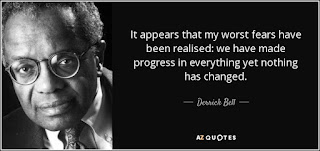
There are several themes in CRT. Rather than overwhelm my readers with the information, I will discuss a few. First, CRT criticizes liberalism. CRT favor a more aggressive approach as opposed to liberalism’s cautious approach and rejects affirmative action, color blindness, role modeling (emulating a successful person) and merit principle (goods and services are received through talent, effort, and achievement) (Delgado & Stefancic, 1993). Second, CRT uses storytelling, counter-storytelling or “naming one’s own reality.” It is the use of narratives to explain and explore experiences of racial oppression (Delgado & Stefancic, 1993). Third, CRT offers revisionist interpretations of American civil rights laws and progress. Derrick Bell argued that civil rights advances for blacks coincided with the self-interest of white elitists. Mary L Dudziak (1998) suggests that the civil rights legislations were passed to improve the US image to third world countries as the US needed allies during the Cold War. Lastly, institutional racism. According to Camara Phyllis Jones (2002) the structures, policies, practices, and norms result in the differential access to the goods, services, and opportunities by race. Historically, institutional racism was slavery, segregation, internment camps and reservations. Modern examples are bank lending practices, housing contracts, profiling by law enforcement and representation in news and media.

Many of the Critical Race Theory critics take issue with its foundations in postmodernisms and reliance on moral relativism and social constructionism. Richard Posner, a judge for the US Seventh Circuit Court of Appeals (1981-2017), argued that critical race theorists have “succumbed completely to postmodernist absurdity” and “radical legal egalitarianism” (1997). Alex Kozinski, a judge for the Ninth Circuit Court of Appeals (1985-2017), argued that CRT is a philosophy which “raises insuperable barriers to mutual understanding” and makes valid exchange of ideas impossible (1997). George Will (1996) argued that CRT’s use of storytelling and the insistence of racism “so institutionalized that all blacks are victims by definition” and not by an “identifiable act of discrimination.” Eleanor Krasne (2020) argued that CRT, rooted in Marxism, doesn’t allow for meaningful discourse that “questioning their ideas amount to tacit support of racism and makes you a racist.” She further states that “you either agree with the left’s worldview or you are an enemy of all that is good” (Krasne, 2020). Dan Subotnik also argues that leaving whites out of the race conversation doesn’t help anyone. “White males tempted to participate in the conversation were condemned in advance as interlopers, even imperialists” (Subotnik, 1998). Essentially whites were, and still, are told to step aside, sit down, and shut up, you have no say in the matter as you would not understand.

For far too long, minorities have been kept out of history, their roles pushed to the background and ignored and left out the conversations. There's no denying it. They have fought to be included in the history lessons and the conversation about today’s issues, to have their current contributions counted and celebrated as they should. However, there are a few are now enacting their revenge as they turn the tables on whites. “You left us out, now it’s your turn.” Critical Race Theory, at first look, seems like a good idea; however, in practice, it is an “agree with me or you’re my enemy” paradigm. It is still racism when the roles are reversed. An adage says, “An eye for an eye leaves the whole world blind.” Repaying evil with evil does not overcome evil. Evil is only overcome with kindness. Human nature has a long way to go.


References


Delgado, Richard and Stefancic, Jean (1993). Critical Race Theory: An Annotated Bibliography. Virginia Law Review. 79 (2): 461–516.


Dudziak, Mary L. (November 1998). Desegregation as a Cold War Imperative. Stanford Law Review. 41(1):61-120.


Gottesman, Isaac (2016). Critical Race Theory and Legal Studies. The Critical Turn in Education: From Marxist Critique to Poststructuralist Feminism to Critical Theories of Race. London, England: Taylor & Francis. ISBN 978-1317670957.


Jones, Camara Phyllis (2002). Confronting Institutionalized Racism. Phylon. 50(1/2): 7-22.


Krasne, Eleanor (June 29, 2020). How Leftists’ Critical Race Theory Poisons Our Discussion of Racism. The Heritage Foundation. www.heritage.org/civil-society/commentary/how-leftists-critical-race-theory-poisons-our-discussion-racism. Retrieved October 18, 2020.


Kozinski, Alex (November 2, 1997). Bending the Law. The New York Times Archives. www.archive.nytimes.com/www.nytimes.com/books/97/11/02/reviews/971102.02kosinst.html. Retrieved October 17, 2020.


Posner, Richard A. (October 13, 1997). The Skin Trade. The New Republic.

Sunday, October 18, 2020

Intersectionality: its origins, its practice and its criticisms

Feminism hasn’t been one long movement. It currently in its fourth wave as the systems of power continued to be challenged. The first wave occurred during the late 19th century and into early 20th century and focused on the stations of middle- and upper-class women who fought for a political voice and suffrage. The second wave occurred in the 1960s and started to focus on social and cultural inequalities. The third wave occurred during the 1980s and it is during this wave that created the theory of intersectionality. The term of intersectionality is one I first heard this year as it has gained popularity. It is a term I hadn’t really wanted to know more about until recently when I started hearing it more and more. I knew I had to research it. To discover its origins as well as the criticisms that have been stated about the theory itself and its practice.

Intersectionality is a theoretical framework for understanding how aspects of a person’s social and political identities. It is a qualitative analytic framework identifying how interlocking systems of power affect those who are marginalized to promote social and political equity. It attempts to broaden the lens of feminism to include women of color, immigrant women and other groups. The term was created by Professor KimberlĂ© Williams Crenshaw, a black feminist, in 1989, when studying three legal cases that dealt with issues of racial and sex discrimination, and argued that treating black women as purely women or purely black ignored the challenges that faced black women as a group (Coaston, 2019). Intersectionality was not widely accepted until the 2015 and is gaining popularity. Intersectionality is intended to illuminate how often racial inequality has been overlooked by feminist theory and movements. Linda Carty and Chandra Talpade Mohanty of the Feminist Freedom Warriors Project at Syracuse University summed up intersectionality. “All of us live complex lives that require a great deal of juggling for survival. What that means is that we are actually living at the intersections of overlapping systems of privilege and oppression” (Coleman, 2019).

Professor Crenshaw took a simple observation that black women were subjected to racism by a predominantly white feminist movement and sexism by the male dominated anti-racism movement and offered an explained why it is a dynamic that keeps repeated (Robertson, 2017). Unfortunately, her original theory has receded to the background as others have taken her idea and ran with it, adding and expanding. It reminds me of scientists who took Charles Darwin’s original theory of evolution and expanded on it so much that the original theory has been lost. The idea of intersectionality makes sense as the observation was made by Sojourner Truth in her 1851 speech “Ain’t I a Woman?” in which she identifies the difference between the oppression of white and black women. White women were often treated as emotional and delicate, needed help simply to get into a carriage while black women were subjected to racist abuse and not treated as delicately (National Park Service). Intersectionality attempts to explain the multiple dimensions to the human experience (Shelton, 2019). Intersectionality in simple terms is double or multiple discrimination as the group identities one can claim intersects and explains their experience.


Intersectionality is not without its critics. The main criticism discusses theological definitions. Kathy Davis (2008) argues that intersectionality is ambiguous and open-ended, and that its "lack of clear-cut definition or even specific parameters.” In a podcast, Dr. Mark Horowitz, a professor of sociology at Seton Hall University, stated that at its core, intersectionality is a way to explain the world and how people experience it; however, the definitions are so fluid that it is hard to pinpoint definitions across the different studies (Shelton, 2019). Rekia Jibrim and Sara Salem (2017) state that intersectionality “does not have a clear methodological preference to study the intersections of social categories or identities” (2017). One of the biggest critics has been conservative commentor Ben Shapiro. According to Shapiro, intersectionality creates a “us” versus “them” paradigm where racial and sexual identity count for everything (2018). In the Sensibly Speaking podcast, Dr. Horowitz echoes this sentiment as he states that the attempt to use biology as a part to explain the human experience, an intersectional sociologist will argue that “you are only trying to bring women down” and “you must have a patriarchal power agenda” (Shelton, 2019).

In conclusion, intersectionality makes sense that we are more than just one group. It makes us that we cannot and should not separate discrimination and as our experiences intersects. However, it is an idea that seems to work in theory but with no clear, well-defined definitions, intersectionality is a confusing idea. It is an empirical view which makes sense and has a usefulness to explain the world and how people experience it. While many of the criticisms focus on its lack of suitable definitions, there are criticisms focus on the activist side. It is the automatic dismissal which dismisses someone’s opinion or view simply because of their group identity or majority status. As Ben Shapiro snarky commented at the end of his PagerU video, “But what do I know? I’m just a straight white male” (2018). Unfortunately, for far too long, voices were kept out of the conversation and intersectionality, in practice, simply follows suit.


References

Coaston, Jane (May 28, 2019). The intersectionality wars. Vox. www.vox.com/the-highlight/2019/5/20/18542843/intersectionality-conservatism-law-race-gender-discrimination. Retrieved October 8, 2020.


Coleman, Arica L. (March 29, 2019). What's Intersectionality? Let These Scholars Explain the Theory and Its History. Time. www.time.com/5560575/intersectionality-theory/. Retrieved October 8, 2020.


Davis, Kathy (2008). Intersectionality as buzzword. Feminist Theory. www.kathydavis.info/articles/Intersectionality_as_buzzword.pdf. Retrieved October 9, 2020.


Jibrim, Rekia & Salem, Sara (May 27, 2017). Revisiting Intersectionality: Reflections on

Theory and Praxis. Trans-Scripts: An Interdisciplinary Online Journal in the Humanities and Social Sciences. Retrieved October 7, 2020.  


National Park Service (no date). Sojourner Truth: Ain't I A Woman? Women’s Rights National Historical Park. www.nps.gov/articles/sojourner-truth.htm. Retrieved October 10, 2020.


Robertson, Eleanor (September 30, 2017). Intersectional-what? Feminism's problem with jargon is that any idiot can pick it up and have a go. The Guardian. www.theguardian.com/world/2017/sep/30/intersectional-feminism-jargon. Retrieved October 9, 2020.


Shapiro, Ben (June 17, 2018). What is Intersectionality? PragerU. www.prageru.com/video/what-is-intersectionality/. Retrieved October 13, 2020.


Shelton, Chris (October 18, 2019). Intersectionality - Pros, Cons and Pitfalls ft. Dr. Mark Horowitz. Sensibly Speaking Podcast. www.youtube.com/watch?v=lshLPJJKbyU&feature=youtu.be. Retrieved October 15, 2020.

Tuesday, May 5, 2020

El Cinco de Mayo: a look into its surprising origins


El Cinco de Mayo: An American Tradition by David E. Hayes-Bautista is a historical, societal and political look into the origins of the popular holiday, Cinco de Mayo, as an American invention and not one transplanted from Mexico. Knowledge about the history and origins of the holiday had been lost in time as many celebrated with no real understanding why it was celebrated in the first place. Maybe people incorrectly assume Cinco de Mayo came to America with the immigrants after WWII. Mr. Hayes-Bautista witnessed spectacular celebration of Cinco de Mayo in the US in 1960s at the height of the Chicano movement and almost no celebrations in Mexico during the same decade. He set out to find out way and focused his book on the development of Cinco de Mayo in the US. What he discovered was a socially and deliberately constructed holiday in response to the events and changes around Latinos living in California during the Civil War.


Cinco de Mayo is a celebration commemorating the First Battle of Puebla on May 5, 1862. The United States had been at civil war since April 1861. Napoleon III, the Emperor of France, took advantage of the US’s inability to enforce the Monroe Doctrine (1823) and began an invasion of Mexico. The French lost the First Battle of Puebla but continued to occupy Mexico for another five years. So why is the First Battle of Puebla still commemorated by Latinos in California and the US as whole today? Because a network of Latino groups in California known as the juntas patriĂłticas mejicanas (Mexican Patriotic Assemblies) helped create and maintain a public memory of the day. The juntas used the Cinco de Mayo to encourage support defense of freedom and democracy for the US and Mexico. The juntas eventually ended after WWII but their influenced continued as the Latino communities grew and Cinco de Mayo became a day to help highlight trends and problems in their communities. By 1986, the true meaning and origins behind the holiday was truly lost in public memory. “One of the great traditions that has come to the United States from Mexico is the celebration of the Cinco de Mayo” (William Davila, then president of Vons grocery stories, 1994).


Growing up in California and having the Latino influence in my life, I was aware Cinco de Mayo referred to the Battle of Puebla; however, I was not aware of the depth of the holiday or its true origins. As Mr. Hayes-Bautista states, “It did not seem to occur to anyone that the commemoration of the first battle of Puebla might have originated in California.” Cinco de Mayo is a genuine American holiday. Created in California and echoed in Oregon, Nevada and eventually across the nation. It originated in devotion to basic American values of freedom and democracy. El Cinco de Mayo is a great and detailed book as it explores the origins and growth of the Cinco de Mayo. I now have a new understanding and greater appreciation for the holiday. Cinco de Mayo is as American as Thanksgiving and should be celebrated by all. I highly recommend El Cinco de Mayo for anyone who is curious and wishes to learn more about Cinco de Mayo.

El Cinco de Mayo: An American Tradition
is available in paperback and eBook

Sunday, February 23, 2020

Jim Crow Laws: the origins, the laws and the fight back


As it is Black History Month, I decided to research more into the Jim Crow Laws. As a student, I had heard the term and the very basics of what they were, but I realize that I didn’t know anything beyond that. Named for a black minstrel character, Jim Crow Laws were a collection of state and local statutes which legalized racial segregation. These laws existed for about 100 years from the post-Civil War until 1968. What was the origins of the Jim Crow Laws? How were they expanded across the South and the nation? What helped bring the end of Jim Crow? And what type of Jim Crow laws were enforced in my home state of California?


Jim Crow Laws started as Black Codes as early as 1865 (Editors, 2018), which were strict laws detailing where and how the newly freed slaves could work and for how much. It was a legal way to put blacks back into an indentured servitude as their voting rights were essentially taken away, they were told where to live and how to travel. And since former Confederate soldiers were now serving as police officers and judges, there was no real legal recourse for the blacks to fight back (Editors, 2018). Jim Crow Laws started with restricting blacks from voting. They included literacy tests, poll taxes and a grandfather clause (Urofsky, 2019). The grandfather clause stated that men who were entitled to vote before 1867 and their lineal descendants were exempted from the literacy and other qualifications. Segregation didn’t begin immediately. Until 1877, New Orleans had fully integrated schools and North Carolina had blacks and whites serving on juries together (Urofsky, 2019). It didn’t truly begin until the Plessy v Ferguson (1896) which created the “separate but equal” standard.  From very early on, people were fighting back against Jim Crow Laws. Notably, Ida B Wells, who refused to leave a first-class train car designated for whites only (Editors, 2018). As well as Isaiah Montgomery who founded a black only town, Mound Bayou, Mississippi, in 1887. The town still is predominately black residents (Editors, 2018).


Jim Crow Laws would expand across the nation. Public parks would be forbidden for blacks to visit. Theaters, restaurants, waiting rooms, water fountains, restrooms, building entrances, even cemeteries would all become segregated (Editors, 2018). Some states would even require different textbooks for white and blacks students and different Bibles would be used to swear on in court (Editors, 2018). After WWI, lynchings and violence was on the rise. For several months in 1919, there were widespread race riots in the country. As black WWI vets were returning home and fighting back. “Between April and November of 1919, there would be approximately 25 riots and instances of mob violence, 97 recorded lynchings, and a three day long massacre in Elaine, Arkansas during which over 200 black men, women, and children were killed after black sharecroppers tried to organize for better working conditions” (Higgins, 2019). The Great Migration of the 1920s, as blacks were leaving the South, found Jim Crow Laws spreading to the North and Western states. In the North, suburban developments would not allow blacks to obtain mortgages for certain “red-lined” neighborhoods (Editors, 2018). As the country would fall into the Great Depression, racial tensions would only deepen.


The end of the Jim Crow Laws began with post-WWII and the Civil Rights Movement (late 1940s- late 1960s). In 1948, President Harry Truman would integrate the military. In 1954, the Supreme Court would rule in Brown v the Board of Education that the “separate but equal” standard was unconstitutional and would begin the national integration of schools. In 1964, President Johnson would sign the Civil Rights Act which ended segregation in public places and banned employment discrimination based on race, color, religion, sex or national origin. In 1965, the Voting Rights Act would be passed, banning the use of literacy tests. In 1967, Loving v Virginia would end bans on interracial marriages. In 1968, the Fair Housing Acts ended discrimination in renting and housing sales (Editors, 2018). In 1971, the Supreme Court would uphold busing to insure integration of schools in Swann v. Charlotte-Mecklenburg Board of Education.


California had many laws which restricted people based on race. California produced more legislation against Chinese and other Asian descents due to the massive Asian immigration. In 1850, California passed a statute which stated that “no black, mulatto person, or Indian, shall be allowed to give evidence in favor or, or against, a white man.” In 1854, the California Supreme Court would rule that this statute also included individuals of Chinese descent. Between 1866-1947, California would pass 17 Jim Crow laws including anti-miscegenation (interracial marriages), education and employment. In 1891, all Chinese people would be required to carry a “certificate of residency.” If they were caught without it, they could be arrested and jailed. It would be illegal for whites to marry blacks, mulattos or Asian descents. It is interesting to note Hispanics were not included in the anti-miscegenation laws because they were considered white due to their Spanish heritage. Anti-miscegenation laws would be overturned in California with Perez v Sharp (1948) in which Andrea Perez (a Mexican American woman) and Sylvester Davis (a black man) were denied a marriage license in Los Angeles County. This case was the first in the 20th century to overturn anti-miscegenation laws. Chief Justice Warren would use this case as the basis for the Loving v Virginia decision.


In conclusion, Jim Crow Laws were a massive systemic discrimination against blacks and, by extension, other minorities. They were implicated slowly and gained prominence by the turn of the 20th century as the denials of basic rights like voting, housing and education were ways to keep prominent powerful white majority in positions of authority. The fight against them had been early on but didn’t gain momentum until after WWII as black vets returned home and said enough is enough. The history of Jim Crow Laws and other laws should not be ignored or forgotten. As we celebrate Black History Month, let us remember these horrible laws as we try to find a balance and harmony among ourselves.


References
Editors (February 28, 2018). Jim Crow Laws. History.com. https://www.history.com/topics/early-20th-century-us/jim-crow-laws. Retrieved February 11, 2020.

Higgins, Abigail. (July 26, 2019). Red Summer of 1919: How Black WWI Vets Fought Back Against Racist Mobs. History.com. https://www.history.com/news/red-summer-1919-riots-chicago-dc-great-migration. Retrieved February 19, 2020.

Urofsky, Melvin I. (August 21, 2019). Jim Crow law UNITED STATES [1877-1954]. Britanncia.com. https://www.britannica.com/event/Jim-Crow-law. Retrieved February 19, 2020.


Friday, October 4, 2019

Its National Cookie Month!


Everyone loves cookies! October is National Cookie Month! The word, “cookie,” derives from the Dutch word koekje meaning “small or little cake.” Cookies are sweet, small cakes which take various forms around the world. There go by many names around the world too. In America, they are cookies. In Britain and Australia, they are biscuits. In German, they are keks, or plzchen (Christmas cookie). In Spain and other Spanish-speaking nations, they are galletas. Let’s dive into the origins of cookies, the different types enjoyed around the world as well as a few of my favorite cookies.


According to culinary historians, cookies were originally testers. A small amount of cake batter was baked to test the oven temperature (What’s Cooking America). The earliest cookies date to 7th century CE Persia (now Iran), one of the first countries to cultivate sugar. By the end of the 14th century, Renaissance cookies had many cookie recipes. English, Scottish and Dutch immigrants were the first to bring cookies to America. Some cookies are made for everyday enjoyment, others are made for specific occasions. Christmas is a time where tons of cookies are made and passed along as gifts to friends and loved ones. In Australia, special biscuits are made for ANZAC Day on April 25. Anzac biscuits were originally used by the Australian army during World War I for their long shelf life. Today, these cookies are often used by veteran’s organizations for raise money for the care of war veterans (What’s Cooking America). 


Cookies are made throughout the world in various shapes, flavors and for various occasions. In India, nankhatai are a buttery shortbread cookie which is made traditionally during Diwali, the Hindu festival of lights (Smith, 2018). France is known for macarons, these delicious yet technically difficult cookies are often featured in cooking and baking competitions to test the competitors’ skills. One of Italy’s most popular cookie is the biscotti which can be enjoyed alone or dipped in coffee. In Iran, the reshteh khoshkar is a rice flour-based cookie which is deep fried and drenched in syrup. It is the traditional cookie for Ramadan (Smith, 2018). In China, a popular cookie is the almond ginger cookie (Bandurski). In Mexico, a cinnamon cookie known as Reganadas are made during DĂ­a de los Muertos. Tradition states the cookies represent the tormented souls of people and animals in purgatory as they wait to be allowed into paradise. In Argentina, alfajores are a breakfast cookie. A sandwich cookie made with shortbread filled with dulce de leche and rolled in coconut (Smith, 2018). And of course, in the United States, the chocolate chip cookie is a common favorite. Invented by Ruth Graves Wakefield (1905-1977) of Whitman, Massachusetts in 1937 while she ran the Toll House Restaurant (What’s Cooking America).


My first favorite cookie is the snickerdoodle. A type of sugar cookie which is rolled in cinnamon sugar and has a cracked surface when baked. It can be crisp or soft depending on the ingredients used. I prefer them soft and chewy. My second favorite cookie is shortbread, specifically Scottish shortbread. Shortbread cookies are made worldwide; however, the Scottish shortbread is one of the best known. The traditional Scottish biscuit made with sugar, butter and oat flour baked at a low temperature to prevent browning. They are usually poked with a fork or tool to create its design and can be cut into various shapes. Walkers Shortbread is Scotland’s largest food exporter of shortbread biscuits. My third favorite cookie is the peanut butter cookie. Especially my maternal grandmother’s recipe. It is simple, only four ingredients, easy to make and fun to decorate the criss cross design with the back of a fork. It was one of the first cookie recipes I learned to make, and it was the first I taught my daughter.


In conclusion, cookies have ancient beginnings and have developed throughout the known world and enjoyed throughout the world daily and on special occasions. Cookies with different ingredients, different shapes, different flavors, even different functions but all have special meanings to those who make and enjoy them. Enjoy National Cookie Month with your favorite cookie! Or take this opportunity to try and enjoy cookies from other countries. What are some of your favorite cookies?

References
Bandurski, Katie. The Best Cookies from Around the World. Taste of Home. https://www.tasteofhome.com/collection/cookies-around-the-world/. Retrieved September 28, 2019.

Smith, Nasha. 10 cookies from around the world that you'll want to try immediately. Insider. https://www.insider.com/cookies-around-the-world-2018-8. August 27, 2018.

What’s Cooking America. History of Cookies. https://whatscookingamerica.net/History/CookieHistory.htm. Retrieved September 28, 2019.


Sunday, March 24, 2019

Prohibition: a documentary which gives food for thought for today


There have been a lot of talk about banning guns, soda, or the consumption of animal products that one group of people see as a vice and wants everyone to stop, stop doing or stop being. Ken Burn’s documentary, Prohibition (2011) is a look into the great social experiment of the 1920s which failed miserably. The documentary opens with a quote from Mark Twain, “Nothing so needs reforming as other people’s habits. Fanatics will never learn that through it be written in letters of gold across the sky. It is the prohibition that makes anything precious.” The Prohibition movement began in the early days of our country. Women were at the core of the passing and repealing of the 18th Amendment. The Volstead Act was flawed from the very beginning and doomed to fail. Prohibition, at the beginning, had the results that was hoped for, but it quickly went south and left the country with unexpected consequences. It is a lesson of why prohibition of anything just doesn’t work.


The origins of Prohibition began hundred years before the 18th Amendment was passed and ratified. A temperance movement began to gain steam in the 1820s with the Great Protestant Awakening when alcohol was an evil that needed to be removed. The movement would demand total abstinence from everyone. Many groups would form and help drive the temperance movement into the headlines. The Washingtonian Societies were reformed alcoholic men. Susan B. Anthony and the Women’s Temperance Society would take up the cause along with women’s suffrage. In 1851, Neal Dow, the mayor of Portland, Maine petitioned to ban alcohol and a law passed on June 2, 1851 which was the first to prohibit the sale and manufacture of intoxicating beverages. All temperance bans were halted with the outbreak of the Civil War (1861-1865). After the Great Migration of 1865. The temperance movement began to stir again. Another group was the Women’s Christian Temperance Union, a powerful force which drove the idea of prohibition in the minds of Americans. A third group was the Anti-Saloon League, with its leader Howard Hyde Russell, would turn the attention of prohibition nationwide. The movement would again gain momentum as America entered World War I, as alcohol and beer, specifically, would be used as propaganda for Anti-German sentiment in the country. The 18th Amendment was passed on August 1, 1917 and it was ratified by the states by January 16, 1919. It would go into effect in January 1920.


Women were at the center of the Prohibition movement. They were the force to help push it into law, the enforcement of the law and the force to get it repealed. I want to highlight just a few of the important women. First, Frances Elizabeth Caroline Willard aka “Saint Frances” was the master strategist for the Women’s Christian Temperance Union (WCTU). She would serve as the organization’s president from 1879 until her death in 1898. She would bring the temperance movement along with the women’s suffrage movement. Second, Carrie Nation (1846-1911) is well known for her hatchet and breaking up saloons in Kansas. While many women of the WCTU denounced her methods, her method seemed to spread as she took her crusade outside of Kansas. Third, Mabel Walker Willebrandt (1889-1963) was the most famous woman in the country who was not an actress. She became the Assistant Attorney General of the United States and she took her job very seriously. Although she personally opposed Prohibition, she would aggressively work to uphold the Volstead Act and prosecute any violators. Fourth, Pauline Sabin (1887-1955) was first a supporter of Prohibition and worked for the passing of the 18th Amendment. However, she would change her mind when she saw the hypocrites it made of the country’s leaders. She disliked Ella Boole and the WCTU as they claimed to speak for all American women. In disgust as President Hoover would do nothing about Prohibition, she created the Women’s Organization for National Prohibition Reform in 1929 with the sole goal of repeal.


The Volstead Act was named for Andrew Volstead, the Minnesota congressman who introduced it. It was the enforcement law for the 18th Amendment which prohibited the manufacture, sale and transport of intoxicating liquors; however, it did not define what “intoxicating liquors’ were. The Volstead Act was conceived and drafted by Wayne Wheeler, leader of the Anti-Saloon League, and set out to define what would be considered intoxicating liquors. While the 18th Amendment and the Volstead Act prohibited the manufacture, sale and transport of intoxicating liquors, it did not prohibit the consumption of liquors. The Act would define intoxicating liquors as beverages with more than 0.5% alcohol by volume, which took many by surprise, including many Prohibition supporters, because the understanding was that beer and wine would still be allowed. However, Wheeler wanted total prohibition and heavily influenced lawmakers to pass the Act with the strict restriction. Patented medicines which contained alcohol was still allowed as well as sacramental wines for churches and synagogues. The Volstead Act did not restrict the consumption of alcohol and all alcohol purchased before the law went into effect was allowed for home consumption. It also did not prohibit the manufacture of alcoholic beverages for home consumption. People could make their own beer, wine and other liquors if they did not sale it or transport it. That would soon change as more and more restrictions were added to the law. The “5 and 10” law would increase penalties for a first-time violation of the Volstead Act, and it made it a crime to not report violators, including your neighbors.


Prohibition was an experiment that failed. It had such unexpected consequences that many people would claim that the country was worse than it was before. Prohibition would turn millions of law-abiding citizens into law breakers. It would redefine the role of government and individual rights and responsibilities. Prohibition turned the countryside against the cities. It turned the natives against the immigrants and the question who is and who is not a real American. A question that is still being asked today. The prohibition movement became an anti-immigrant movement. The Anti-Saloon League claimed that true Americans didn’t need alcohol, only the immigrants did. It turned Protestants against Catholics. Alcohol became the scapegoat for all the failures in society. From the very beginning of Prohibition, the people fought to keep their alcohol just as fiercely as those who fought to prohibit it. Inconsistencies in the law would be exploited by many and make others most successful. Roy Olmstead was known as the King of the Puget Sound Bootleggers as he began smuggling alcohol from Canada. George Remus of Cincinnati was a successful lawyer until bootlegging made him an even bigger success. He would also memorize Prohibition regulations and devised ways around them as soon as they were issued. William McCoy was a Florida skipper who ran a very successful rum smuggling operation. Statistics have shown that Americans were actually drinking more during and after Prohibition than they ever were before the 18th Amendment. Demand was so high for alcohol, bootleggers were starting to cut corners with deadly results. Some bootleggers were making Jamaica Ginger and wood alcohol that caused many illnesses and even deaths.


Why it doesn’t work? Bottom line is that you cannot legislate reform, that must come from within. A sentiment repeated by many throughout the program. Edwin Hunt Jr, the son of a bootlegger, said “Prohibition was the noble experiment. I think it created more problems than it solved. It brought into the country, it brought a disregard for laws. I think it turned us into a nation of scofflaws in many ways.” When you banned something, you create a demand for it. People want it simply because you told them they can’t have it. Since the 18th Amendment was repealed by the 21st Amendment on December 5, 1933, other groups have come to Congress to impose their ideas of morality and all have been defeated, in part to the memory of Prohibition and the problems it caused. The closing words of the documentary sum it up best, “If we ever become a country in which we tell the government “Tell us how to live,” then we are doomed.” America has been a country of rebels since the colonial days. It is the American spirit to stand up and say “hey, you can’t tell me what to do!” But when we allow the government to say, “We know better for your life, health and family than you do,” we are truly doomed. What is the solution to other social problems? Education and allow people to have an informed choice, hoping they chose the healthiest option but needing to accept when they don’t. A great example is soda. Yes, soda is bad for you in large quantities; but telling people they can’t have it, only drives their desire for it and they will drink more of it not knowing if it will be available in the future. By teaching moderation, people can still enjoy soda and be healthy.


In conclusion, Ken Burns has made a name for himself with amazing documentaries which dig deeper in historical events than ever before. His documentary, Prohibition, is not only a lesson in history but a lesson of current events. It is a lesson we need to understand before we go down this path again. It is a reminder that we cannot legislate morality. One group cannot dictate their version of right or wrong. If prohibition worked, then there would be no murders or any crime. The prisons would be empty, and law enforcement would be twiddling their thumbs. Prohibition was the law of unintended consequences. We need to be realistic when discussing any kind of ban, will people say, “oh well, it’s against the law now” and obey the law? Think about how many times a day you break the law. You might say, “I don’t break the law!” If you drive, I bet you do! Sometimes without realizing it and sometimes because you know you won’t get caught. I highly recommend Ken Burn’s documentary and see the similarities in today’s issues.


Wednesday, October 11, 2017

Common phrases that misquote or misrepresent Bible verses

After a recent conversation with a friend of mine, I wanted to right about many misquoted Bible verses as well as sayings that are not in the Biblical. I found some phrases which were taken out of verses but removed portions of the verse that it doesn’t give the full message of what the verse is trying to convey. Some verses aren’t Biblical at all but since the phrase references God, many people are lead to believe that they appear in the Bible. I have chosen a few out of the many I found online. These are the most common verses or phrases that I found across the board.


  • The Lion shall lay down with the lamb. This phrase doesn’t not actually appear in the Bible. The closet verse is Isaiah 11:6 which says “The wolf will live with the lamb, the leopard will lie down with the goat, the calf and the lion and the yearling together; and a little child will lead them.” Despite the misquotation, the image is still the same. While saying the lion will lay down with the lamb is technically wrong, the image is still powerful and conveys the same message as Isaiah 11:6. The once predators will be at peace and live in harmony with the once prey. It is a time when nature will return to its intended balance and harmony. The time of Christ’s second coming and his established earthly kingdom.
  • Money is the root of all evil. This is a bad misquotation of 1 Timothy 6:10 which says “For the love of money is a root of all kinds of evil. Some people, eager for money, have wandered from the faith and pierced themselves with many griefs.” When this verse is quoting many people leave out certain key words: love, a, and kinds. Greed can lead to all kinds of trouble. However, money itself is not the root of all evil. Money is a necessity of life. We need it to live, eat, pay for our homes and clothes. If you go to the previous verse, verse 9 states “People who want to get rich fall into temptation and a trap and into many foolish and harmful desires that plunge men into ruin and destruction {emphasis mine).” Money should be handled respectfully and carefully.
  • Spare the rod, spoil the child. This is a paraphrase of Proverbs 13:24 which says “Whoever spares the rod hates their children, but the one who lives their children is careful to discipline them.” This phrase has been the justification for physical discipline. However, the verse is not stating that a parent has the right to beat their child into submission. The verse states that discipline is a nurturing guidance for child. Without correction, children grow up to be adults without a sense of right or wrong. The phrase was actually coined by Samuel Butler, a 17th century British poet in a satirical poem Hudibras: “What medicine else can cure the fits/ Of lovers when they lose their wits?/ Love is a boy by poets styled/Then spare the rod and spoil the child.” In the poem, a love affair is compared to a child, and spanking is mockingly applauded as a way to make the love grow stronger.
  • All things work together for good. This phrase is taken from Romans 8:28 “And we know that in all things God works for the good of those who love him, who have been called according to his purpose.” God works in all things for our good, not just isolated occurrences. When evil occurs in our lives, God is able to turn every situation into a good. We may not see the good until much later. God is not working to make us happy or make all things right. He does it to fulfill his purpose and for those who love him. Also this promise isn’t for everyone, the verse specifically states it is for those who are called according to his purpose. Those who have received Jesus and been touched by the Holy Spirit. Those who love him and trust in him.

  • God works in mysterious ways. There is no actual verse which states this and there are several verses that allude to this idea. For example, Isaiah 55:8 “For my thoughts are not your thoughts, neither are your ways my ways.” Another example is Romans 11:33-34 “Oh, the depth of the riches of the wisdom and knowledge of God! How unsearchable his judgments, and his paths beyond tracing out! Who has known the mind of the Lord? Or who has been his counselor?” In both verses, the authors are telling believers that we cannot know why events happen the way they do for we do not think the way he does. Where this phrase originated from has been debated; however, one source is thought to be a hymn written by William Cowper in 19th century "God moves in a mysterious ways; His wonders to perform; He plans His footsteps in the sea, and rides upon the storm."
  • Pride comes before the fall. This phrase is taken from Proverbs 16:18. However, it is a bad paraphrase as it takes out the middle of the verse. The verse actually says “Pride goes before destruction, a haughty spirit before a fall.” Destruction is the end result of pride. A haughty spirit is the sense of arrogance, superiority and being disdainful. Pride and a haughty spirit leads to an over sense of self-confidence and the feeling that one does not need God. This attitude leads to carelessness and eventual destruction and fall. In contrast, Proverbs 15:33 states “The fear of the Lord teaches a man wisdom and humility comes before honor.” So it is not just pride which leads to the fall, it is a haughty spirit. Pride isn’t necessarily a bad thing; however, when pride is boastful, self-centered, and blinds you to your own faults and limitations can lead to very bad results.
  • God helps those who help themselves. It is a phrase that emphasizes the importance of self-initiative and action. This phrase doesn’t appear in the Bible at all. The phrase originated in Ancient Greece and is illustrated in the fable Hercules and the Waggoner as well as Ancient Greek drama. However, there are verses which have been used to support the claim that the idea of this phrase is in the Bible. One example is 2 Thessalonians 3:10, Paul writes “For even when we were with you, we gave you this rule: ‘If a man will not work, he shall not eat.’” Paul is speaking against laziness and skirting responsibility. Paul is telling them and us to be responsible and get back to work. I think using this verse to support the phrase is a bit of a stretch.
  • Cleanliness is next to godliness. This phrase does not originate from the Bible. In my research, I found claims that the phrase originated from an ancient Babylonian and Hebrew proverb; however, I’ve been unable to find proof to this claim. It was first used in English by Sir Francis Bacon in Advancement of Leaning (1605) where he said “Cleanliness of body was ever deemed to proceed from due reverence to God.” It was further popularized by John Wesley in a 1778 sermon. The Bible does not speak to outward cleanliness with a connection to godliness. In Matthew 7:18-23, Jesus makes it clear that it is man’s hearts that are unclean. Many of the online responses and comments I came across seem to interpret the phrase as cleansing in the body, mind and in spirit through physical washing, meditation and confession. It’s not a bad phrase to live by; but it’s not in the Bible.


In conclusion, it is very easy to take a verse from the Bible and turn it into a catchy, feel good phrase that makes everyone warm and fuzzy. As we’ve seen with a few of the phrases I’ve highlighted, taking key words or phrases from the verse removes the whole picture of the main message. People misquote phrases all the time, especially with a certain phrase being repeated for centuries, it becomes a part of our lexicon. However, what astonishes me is that many of these phrases are quoted by people who claim to have Biblical knowledge. If you are going to quote anything, the Bible or another’s work, make sure you understand the context in which it is given. It makes a world of difference in some cases. 

Monday, September 25, 2017

What is game theory?: a basic introduction

Recently I noticed in movies and TV shows, game theory is being mentioned and it struck me that I don’t know what game theory is. So here I am researching it and sharing what I learned with you. First, let me say that there is so much more to game theory than what I can write about without being long winded or boring. I will only cover the basics. That being said, here we go. Game theory is the study of mathematical models of conflicts and cooperation between intelligent rational decision makers. It is mainly used in economics, political science and psychology. It can also be applied to logic, computer science and biology.


The first known discussion of game theory occurred in letter to James Waldegrave, a British diplomat from Charles Waldegrave, his uncle, in 1713. Known as the Waldegrave problem, it was a mixed strategy solution to a two-person card game called le Her in which a standard deck of 52 cards are played between a dealer and a receiver. James Madison used what is now called game theoretic analysis to predict how the states can be expect to act under different taxation systems (Vice of the Political System of the United States, April 1787). Throughout the years, many other theories devised their own game theories. In 1838, Antoine Augustin Cournot used duopoly, a form of oligopoly where only two sellers exist in one market, and presented a solution to the Nash equilibrium. The Nash equilibrium is a solution concept of a non-cooperative game. The study of game theory didn’t truly exist as its own field until 1938. While there are many game types in game theory, I will be discussing three.


First, cooperative versus non-cooperative games. In cooperative game theory, players are able to form binding commitments externally enforced, i.e. contract law. The focus is on predicting which coalitions will form place and the resulting payoffs. Cooperative game theory does not focus on how coalitions achieve their payoffs. For example, a coalition can exchange whatever it wants among its members; however, it does not discuss how offers or counteroffers are made. The image of a bargaining table in which two or more people are hashing out a business deal or even a criminal plea deal. Non-cooperative game theory, players cannot form alliances or if all agreements need to be self-enforcing, i.e. credible threats. The focus is on predicting individual players’ actions and the possible payoffs while trying to predict what strategies the players will choose. In essence how people should or do act for the maximum individual benefit.


Second, symmetric versus asymmetric game theory. In symmetric game theory, payoffs for playing a particular strategy depends only on the other strategies played and not who played them. If the players changed without changing the strategies, the playoffs would be the same. The game of chicken is an example of a symmetric game. Each player has two decisions to yield or not. Regardless who yields and who doesn’t, the payoff is the same. If one player yields, the other player should not yield. If one player won’t yield, the other player should. In asymmetric game theory, there are no identical strategy sets for both players. For example, the ultimatum game which is used in economic experiments. One player receives a sum of money and proposes how to divide the money. If player two accepts the proposal, the money is split according to the proposal. If player two rejects the proposal, neither player receives any money.


Third, zero sum versus non zero sum game theory. In zero sum game theory, the choices made by the players can neither increase nor decrease the available resources. The total benefit to all players always adds to zero. In other words, a player only benefits at the expense of another. Chess is an example of a zero sum game as one player benefits when the other player loses a piece or cannot make another move. In a non-zero sum game, the outcomes results are greater or less than zero. A gain by one player does not necessarily correspond with another player’s loss. In layman’s terms, it is a win-win situation. One example is The Prisoner’s Dilemma. It is the problem faced by two accomplices locked in separate cells. Each is offered three choices by the police: one, they can both confess to the charges, both will be jailed for five years. Two, if only one confesses, he will be freed but the non-confessor will be jailed for ten years. Or three, if neither confesses, both will be tried for a minor offense and will be jailed for one year. If both prisoners know that the other will not confess, neither will confess and serve one year in jail. It’s a win-win for both prisoners.


In conclusion, game theory is, at its core, about prediction. Predictions of behavior, strategies, decision making and payoffs. It is about keeping an equilibrium or balance. It is about human conflicts and cooperation within competitive or game situations. It is about optimal decision making for the best outcomes for all involved or one individual over another. The theory is applied to many games we play: chicken, chess, poker and other situations where decisions are made for the best outcomes. It is a very simplified explanation and only hits the tip of the iceberg when it comes to what game theory is and how it is used. I’m curious to read further and hope it was informative for you, if you were unaware of what game theory is. 

Tuesday, August 22, 2017

The Myers Briggs Type Indicator: the origins, the structure and its criticisms

The Myers Briggs Type Indicator (MBTI) is a personality inventory which is designed to measure how an individual perceives, thinks and processes information around them. It is often used in the business sector as well as career counseling as it can give an individual an idea about the career which is best suited for their personality. Recently, I saw an episode of the TRuTv’s Adam Ruins Everything show which he discusses the inventory as basically a fraud that it does not truly measure what it says it does. So I was curious. I studied the test as part of my psychology degree and I’ve taken the inventory many times. I wanted to look deeper into the history of the MBTI as well as the criticisms surrounding the inventory.


The Myers Briggs Type Indicator was developed by mother-daughter team of Katherine Cook Briggs (1875-1968) and Isabel Briggs Meyers (1897-1980). Katherine Cook Briggs was a psychologist theorist who researched personality types when she read Carl Jung’s book Psychological Types (1921). Isabel Briggs Meyers joined her mom and together developed the inventory. While neither woman had formal training in psychology and were self-taught in the field of psychometric testing (which was one of the criticism featured in Adam Ruins Everything), this could said of many of the early psychological theorists. Even Carl Jung’s early theory wasn’t based on any controlled scientific experiment but instead through clinical observations. This was the norm until the scientific method become standard when applied to psychology in the 1940s with BF Skinner’s operant conditioning experiments. Jung’s theory contained four cognition functions: thinking, feeling, sensations, and intuition and one of two polar orientations: extraversion and introversion.


The MBTI takes a structured approach to personality assessment where an individual would score on one of two categories on the four scales. First, interactions with others in the form of extraversion or introversion. An extraverted person would processes new information by talking and interacting with others. An introverted person would prefer reflection and privacy to process information internally. Second, attention focus in terms of sensation or intuition. A sensing person prefers a learning environment in a detailed and sequential manner. They will often focus on events occurring in the present and can move to abstract after a concrete experience is established. While an intuitive person prefers a learning atmosphere with an emphasis on meaning and association. They place higher value on insight than careful observation and pattern recognition occurs naturally. Third, decision preference through thinking or feeling. A thinking person using objective truth and logical principles and is natural at deductive reasoning. A feeling person places emphasis on issues and causes that can be personalized while considering motives of others. Lastly, complexity in the form of judging ot perceiving. A judging person thrives when information is organized and structured. They are motivated to complete assignments on time in order to gain closure. A perceiving person flourishes in flexible learning environments and may be late and or procrastinate.


The inventory has been criticized on the grounds poor validity and poor reliability. In terms of validity, many critics claim the inventory does not measure what it purports to measure. With reliability, critics claim the inventory does not give consist results for the same individual. It has been estimated that a third to one half of all published material supporting the MBTI had been funded by organizations backed by Myer Briggs advocates thus creating an argument that the studies reflect a lack of true critical scrutiny and studies supporting the MBTI were methodically weak or unscientific. According to psychometric specialist, Robert Hogan, most personality psychologists view the MBTI “as little more than an elaborate Chinese fortune cookie” (Hogan 2007). However, the MBTI has correlated with four of the Big Five Personality Traits. The four traits are openness to experience (inventive/curious or consistent/cautious), conscientiousness (efficient/organized or easygoing/careless), extraversion (outgoing/energetic or solitary/reserved), and agreeableness (friendly/compassionate or challenging/detached). The only Big Five personality trait the MBTI does not measure for is neuroticism (sensitive/nervous or secure/confident) which is a predictor of depression and anxiety disorders. The MBTI does depend on honest self-reporting. It does not use validity scales to assess exaggerated or socially desirable responses unlike the Minnesota Multiphasic Personality Inventory (MMPI). The test-retest reliability studies have shown 37-76% of respondents will obtain a different type of classification when retaking the test after five weeks.


That being said, I will discuss my scores. I first took the MBTI in 2000 when I was 21 year old. I received a classification of ISFJ: Introverted, Sensing, Feeling and Judging. When I took the test, my results showed strong preference in each scale. However, while researching for this post, I took the test again, at 38 years old, I received a classification of INFJ: Introverted, Intuition, Feeling and Judging. While only one scale changed, the preference in each scale changed too. My results indicated that I had a moderate preference for introversion over extraversion (31%), slight preferences of intuition over sensing (6%), feeling over thinking (19%) and judging over perceiving (6%). So what does this mean for me? Is the inventory wrong? No, I feel the differences between tests is an indication of growth on my part. When I was 21, I was strongly introverted and now after graduating college, getting married, having a child, and just day to day living, I have learned to experience the world. I do feel this inventory helps me understand myself and why I like to do things a certain way and why I have a hard time with certain situation. Does that mean I can’t function in situations different from my preferences? No, it just mean that I will have to work harder to accomplish what needs to be done in challenging situations outside my preferences.


In conclusion, the MBTI is one of many tools that psychologists use to gain a picture of who each individual is and it shouldn’t be used as an absolute indicator. Humans are fluid who grow throughout their lives. While some aspects of who we are stay static, others will mold and change as we age. Katherine Cook Briggs and Isabel Briggs Myers may not have had a formal education in the field of psychology; however, many did not in the early 20th century and the early pioneers of psychology were actually trained in the field of medicine or even philosophy. To criticize an inventory simply because the writer would not formally trained is unfounded as the critic may not understand the true history of psychology. However, it does not mean that every psychological test should be accepted without scrutiny.


I will leave you with little tidbit. According to the MBTI, as an ISFJ, I am “quiet, friendly, responsible, and conscientious. Work devotedly to meet you obligations. Lend stability to any project or group. Thorough, painstaking, accurate. Your interests are not usually technical. Can be patient with necessary details. Loyal considerate, perceptive, concerned with how other people feel.” With my new results, as an INFJ, I “succeed perseverance, originality, and a desire to do whatever is needed or wanted. Put your best efforts into their work. Quietly, forceful, conscientious, concerned for others. Respected for their firm principles. Likely to be honored and followed for your clear visions as to how best to serve the common good.” While both description have some overlap; but I think my family and friends would say both accurately describe me.

If you would like to take the Myers Briggs Type Indicator, there are a number of website who offer it online. The links before are just a few:


References

Hogan, Robert (2007) Personality and the fate of organizations. Mahwah, NJ; Lawrence Eribaum Associates, pg. 28.