Showing posts with label Pixar. Show all posts

Sunday, April 10, 2022

Turning Red: more than just a girl going through puberty

Turning Red is the newest Disney and Pixar film which had limited theater screens while being fully available on Disney+. There was a bit of shock and outrage from Pixar when Disney decided to not put the film into movie theaters and place it on the streaming service. Inspired by her childhood, writer, director and producer, Domee Shi, brings the story to life in Turning Red. Shi was born in Chongqing, Sichuan, and immigrated to Canada at the age of 2 with her parents. They eventually settled in Toronto. She has worked on many Pixar films including Inside Out (2015) before writing and directing Pixar’s short, Bao (2017) which won an Academy Award for Best Animated Short Film. As usual, I will write a brief synopsis of the film, then discuss what I liked and my response to criticism of the film. 

Set in Toronto, Ontario, Canada in 2002, Turning Red is the story of Mei Lee (voiced by Rosalie Chiang), a confident, dorky thirteen-year-old Chinese-Canadian girl. She is the dutiful daughter who does well in school, excels at her extracurriculars and helps out at the family temple. But she is also a typical teenager who loves the popular boy band and crushes on a local older boy. She becomes torn between staying her mother's dutiful daughter and being her own individual self. Add in the chaos of adolescence, conflicts over friendships and a family secret. Her protective, and slightly, overbearing mother, Ming, (voiced by Sandra Oh), is never far from her daughter. When a popular boy band is coming to Toronto, Mei, along with her friends Miriam (voiced by Ava Morse), Priya (voiced by Maitreyi Ramakrishnan) and Abby (voiced by Hyein Park), set up a plan to attend the concert, with or without their parents’ permission. Unfortunately, the timing couldn’t be worse when the family secret rears its ugly head and Mei turns into a giant red panda every time she experiences strong emotions. She can get rid of the transformation at the next red moon but will she want to? 

There were a few aspects of Turning Red that I liked. First, its openness. It doesn’t shy away from the rebellion that is often a feature of growing up. Mei is torn between honoring her parents and honoring herself. It is a stage and decision that every child will come to as they grow into adulthood. It also doesn’t shy away from periods. In one scene, after Mei first turns into a panda, her mother thinks she has gotten her period, or as she called it, “the red peony,” and is prepared. Unfortunately, many parents do not prepare for this moment for their daughters and are often caught unaware when it occurs. If this film opens the conversations between mothers and daughters about puberty and periods, that is a great thing. Second, the full acceptance of friends. When Mei reveals the panda to her friends, they are immediately accepting. Mei cries that she’s a freak and Miriam replies “You’re our girl.” They stood by her as she struggled to contain and come to terms with this transformation. It is important that we have a support system through our good times and our struggles. I liked that the film shows that type of friendship. 

While overwhelmingly praised, Turning Red had created a firestorm online. First, many parents were upset that it dared discuss puberty and periods. I have read parental reviews online and many parents were shocked at the topics and angry at Disney. To those parents, I must say, do your research! Any movie, book or tv program geared at kids should not be taken on blind faith as appropriate for your child, Read into it, watch it yourself and decide if you want your child to be exposed to the programs. That is your responsibility as a parent. Second, Clarissa Cruz (2022), writes that “normalizing the emotional and physical messiness of puberty” is refreshing. However, that hasn't be the overall sentiment. In a now deleted review, Sean O’Connell of CinemaBlend called the movie limiting and exhausting (Shivaram, 2022) I’m not sure how the film can be limiting and exhausting, unfortunately, I think Mr O’Connell is being a typical male who is uncomfortable with the topic of female puberty and periods. Gasp! Third, I don't think the fact that the movie features an Asian family and culture takes away from the overall message. While there are some cultural differences when it comes to puberty and coming of age, I believe there is an universality to the story. My oldest daughter who is 10 absolutely loved the movie and related to Mei and her friends.

Turning Red is not a absolute favorite for me. I didn’t have the same emotional response to it as I did with Coco (2017) or Encanto (2021). After watching the film, I was conflicted about how I felt and how the story would deal with puberty and periods. However, after discussing the film with my oldest daughter, I appreciated and enjoyed that it was brave enough to discuss the often taboo topics. It is a stage of life that we all go through, by being open and having honest conversations with our children can lead to a deeper relationship with trust. With that trust, a child would hopefully feel comfortable enough to come to their parents with any questions and for any topic. If Turning Red can be a catalyst to opening that door for parents and children to have that conversation or any meaningful conversation, then I recommend Turning Red. 


References

Cruz, Clarissa (March 13, 2022). What Turning Red means to me as an AAPI parent. Entertainment Weekly. https://ew.com/movies/what-turning-red-means-aapi-parents/?fbclid=IwAR2QiU6_80CkMVCCVjiz2ZsYU915p5vA1Ls7-zeGTUjo81vmYRWXc5VQlPk. Retrieved April 4, 2022.  


Shivaram, Deepa (March 12, 2022). 'Turning Red' is a turning point for Asians in film. Why is it seen as unrelatable?. NPR. https://www.npr.org/2022/03/12/1086040083/turning-red-controversy. Retrieved April 4, 2022. 


Saturday, April 25, 2020

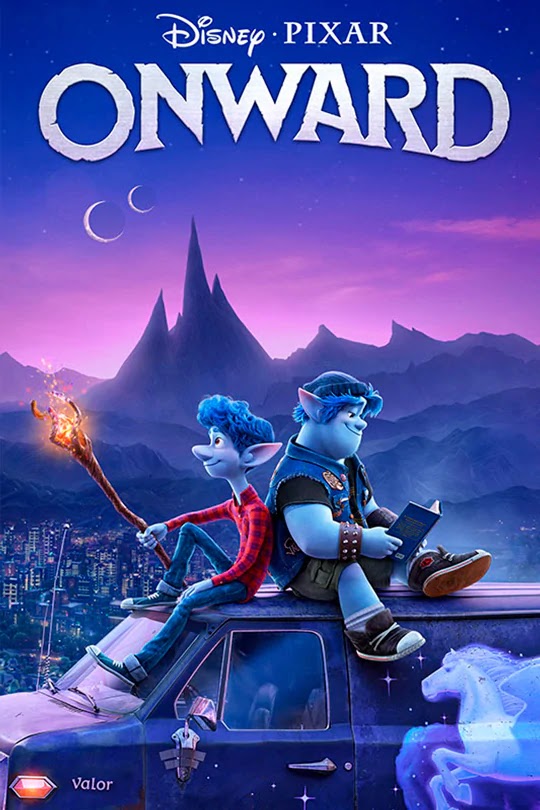
Onward: a brother adventure in a magical land

Onward is the newest Pixar film directed by Dan Scanlon, written by Scanlon with Jason Headley and Keith Bunn. The film stars Tom Holland, Chris Pratt, Julia Louis-Dreyfus and Octavia Spencer. Set in a suburban fantasy world, the film follows two elf brothers who set out on a quest to find a rare artifact that well bring back their deceased father for one day. Released on March 6, 2020 in the US, the film received generally positive reviews and grossed $104 million worldwide before the coronavirus pandemic shut down theaters. It was released on Disney+ and other screaming services on April 3.


In a world of mythical creatures, magic was once commonplace. After technological advances over the years, magic became obsolete and was largely discarded. It is now modern day, Ian Lightfoot (voiced by Tom Holland), an elf socially awkward high schooler who lacks self-confidence. His older brother, Barley (voiced by Chris Pratt), is a history and role-playing game fanatic. They live with their widowed mother, Laurel (voiced by Julia Louis-Dreyfus) in New Mushroomton. Their father, Wilden Lightfoot, died shortly before Ian born. As the story opens, it is Ian’s 16th birthday and Laurel gives the brothers a gift from Wilden: a magical staff, a rare gem, and a letter describing a visitation spell so the boys can resurrect their father for one day. When Ian accidently only resurrects their father’s lower half, the brothers are now in a race against time to fully resurrect their father. 


Onward is a funny and heartwarming adventure that audiences have come to expect from Pixar. Although, a few reviewers have pointed out that it has become a bit too cliched. For me, it was an emotional as it deals with death, loss and trying to capture experiences one never had a chance to have as Ian never had the memories of his father that Barley did. I also liked the musical score. I especially liked the song that Barley played plays in his van. It suggests Vikings and great battles. The end credit song, “Carried Me With You,” performed by Brandi Carlile, is an emotionally charged song about not taking love for granted and accepting love even when you don’t feel its deserved. One of my favorite lyrics is “To the darkness of the blue/I was just too blind to see/Like a lighthouse in a storm/You were always guiding me.” I like the lesson Ian learns along way as he gains confidence in himself, although it is a theme used quite often.


As no movie is without faults, there are a few things about the film I did not like. While I did enjoy the film, it felt like a Frozen II film for boys. A sibling adventure story for brothers rather than sisters. Also, the use of mythical creatures didn’t really add to the story. The filmmakers could have used human characters and the movie would have been just as good. It is also a film that I wasn’t overly excited to watch for the story concept didn’t grab my attention. I only watched it because my eight-year-old daughter wanted to when it was released on Disney+. She thoroughly enjoyed it and watched again the next day and watched it a third time with her dad. The animation is as expected from Pixar; however, it does not have the stunning beauty of Coco or the heart of Toy Story or Finding Nemo.


Overall, Onward is a good movie with magic, mythical creatures and a theme that we all could relate to. It may be hard to watch for individuals have lost a parent, especially early in life, as it may be too relatable. However, I wouldn’t say it was a reason not to see this film. While it had a few flaws and may be the adventure story we’ve all seen before, it is still an entertaining movie that I think families will enjoy. I recommend watching Onward as the heartwarming and funny adventure story that is expected from Disney and Pixar. 

Monday, January 25, 2016

Inside Out: a great movie about the importance of all our emotions

Inside Out, which opened June 19, 2015, was a box-office and critical success for Disney/Pixar. It would gross $856.1 million and would be the 10th highest-grossing animated film of all time. The story is features of the emotions of 11-year old Riley (voiced by Kaitlyn Dias) as she moves with her mom and dad (voiced by Diane Lane and Kyle MacLachlan) from her home in Minnesota to San Francisco. The story opens with Joy (voiced by Amy Poehler) as Riley’s first and primary emotion on the day she is born. Joy then introduces the other Emotions: Fear (voiced by comedian Bill Hader) who is “really good at keeping Riley safe,” Disgust (voiced by comedienne Mindy Kaling) who keeps “Riley from being poisoned physically and socially,” and Anger (voiced by comedian Lewis Black), who “cares very deeply about things being fair.” Then there is Sadness (voiced by Phyillis Smith), who Joy isn’t sure what she does or what role she could possibly play for a happy girl like Riley. From a console in headquarters in inside Riley’s mind, Joy and the other emotions help Riley interact with the world. From my first viewing, I loved this film. I will discuss my top three reasons for enjoying and recommending this film.


First, Inside Out gives us a story in which we can see the value of all our emotions. With joy, we can enjoy fun and celebrate great times in our lives. In the movie, Joy is very determined to keep Riley happy that she forgets that Riley’s other emotions are important too. Joy tries to get all the Emotions to see the bright side of the situations. They try but it doesn’t work as they all have different perspectives. With Anger, we can see the injustice and unfairness in life. To use anger as a push to fix the injustice we encounter. With Disgust, we can form our opinions and our standards with food, friends and other aspects of our likes and dislikes. With Fear, we can keep ourselves safe and secure debating new adventures, weighing the risks and rewards before trying new things. And with Sadness, we can feel pain and grief. Each emotion is important and deserves to be felt at the moment. While some of the emotions can be felt in extremes, when the emotions are in balance, an individual can be happy, passionate, opinionated, adventurous and sympathetic. Each emotion is a critical part of our personality, who we are as individuals. When we ignore one or more emotions, we deny ourselves a part of who we are.


Second, Inside Out explores the mind, memories and other brain functions in a fun and meaningful manner. In the central story, Joy and Sadness, with the Cord Memories, are whisked away from headquarters and land in Long-Term Memory where all her other memories are stored. Joy and Sadness must get the Core Memories back to headquarters. Core Memories were created at key moments of Riley’s life and help power various parts of Riley’s personality such as friendship, family, and honesty. While they make their way back, they meet up with Bing Bong (voiced by comedian Richard Kind), Riley’s imaginary friend who has wandered Riley’s memories as she no longer plays with him. Bing Bong helps them navigate through Riley’s mind. They pass through Imagination Land, Preschool World, Abstract Thought and Dream Production. Bing Bong points out Critical Thinking, Language Reasoning, Inductive Reasoning and Déjà vu areas of Riley’s mind. I know these are concepts and areas in which the children in the audience will not fully understand but as they watch the movie. I think it’s great to introduce these ideas in a fun way that the audience can understand without getting too technical.


Third, Sadness is a crucial emotion to a valuable life. The film features Sadness in a manner which teaches Joy a valuable lesson. Joy, in her passion to keep Riley happy, she pushes aside what she doesn’t understand, mainly Sadness. Sadness helps Bing Bong through his sadness that Riley no longer needs him by talking with him about their adventures together. Sadness realizes the best way to wake Riley up suddenly is to scare her. At the lowest point of the movie, Joy realizes that many of Riley’s memories are a mixture of emotions. Events which started out sad lead to happiness with the help of her parents and her friends. Events which started with anger turned to happiness and so on. At one point in the movie, Riley gets the idea to run away back to Minnesota and it is Sadness who is able to change Riley’s mind and realize what she is doing. Riley goes home to her parents where she confesses that she cannot be happy like they want her to be. She misses her home, her friends and she is sad. Riley’s parents confess that they miss Minnesota too and the family hugs. Sadness brings Joy to the console and together they create a memory which is filled with both sadness and joy.


The film ends as Riley grows. A new expanded console is in place where each emotion now has an important seat. New aspects of Riley’s personality are formed: Tragic Vampire Romance, Fashion and Boy Band to name a few. After watching the behind the scenes documentaries, I find that the director and writers view the movie as growing up and learning to deal with the changes that are inevitable in life. The movie also features emotions as keys to relationships. Emotions link us to others. Through tears, anger, fear and joy, we experience life with those around us. We bond with people to form families and friendships based on the experiences of these emotions. I understand their view that life isn’t about just being happy. Joy isn’t always the answer. Sometimes Sadness is the answer and we can learn joy from sadness. I love Inside Out for its ability to tackle the complexity of human emotions in a fun adventure. I’ve read reviews where people didn’t like the movie simply because Sadness is the hero and think that the writers want everyone to be depressed. To those reviewers, you missed the whole point of the movie. Without sadness, we cannot know joy. Without tears, we cannot know laughter. I highly recommend Inside Out to young and old. We all can learn from this movie.