Saturday, February 27, 2021

Jael: a decisive and courageous woman who becomes a hero

Jael is an interesting woman in the Bible. Her story only takes place in a few short verses but her story has lasting effects. Little is known about her. She is never mentioned again in the Bible. She is a decisive and courageous woman who seized the opportunity to kill an enemy of God’s people. According to the Jewish tradition, she was so beautiful that her voice would arouse lust in men (Kadari). In Judges 5:24, Deborah calls her the “most blessed of women in tents.” Women in tents refers to Sarah, Rebekah, Rachel and Leah, the Four Matriarchs (Kadari). Why would Jael’s actions be more blessed than the Four Matriarchs? What is the current take on her actions? What does her story tell us about God? What would we do if we were in Jael’s place? 

Jael was the wife of Heber from the Kenites. The Kenites were a nomadic tribe who survived by staying clear of local disputes. However, they didn’t follow this particular rule. Heber was on friendly terms with Jabin, king of Hazar (Judges 4:17) so when Sisera saw Jael at her tent, he must have thought he would be safe from discovery. Jael welcomes him into the tent, he asks for water, she gives him a skin of milk. As soon as he falls asleep, she takes a tent peg and a hammer and quickly thrusts the peg through his temple and into the ground. Sisera was dead at the hands of a woman, just as Deborah had predicted in Judges 4:9. Later, Jael will show Barak Sisera, dead, in her tent (Judges 4: 22). While she is praised by Deborah and Barak in their song in Judges 5, Jael is most blessed of women in tents. One explanation for this statement is that without Jael, the Israelities may have faced possible extinction and when she killed Sisera, she ensured “the continued existence of the people of Israel” (Kadari). 

I use the devotional “Women of the Bible” by Ann Spangler and Jean E. Syswerda as a guide for these studies. I have used it for many years, however, this study on Jael caught my attention, a detail I didn’t notice before. They asked if Jael was bloodthirsty because she killed Sisera in such a violent manner? This question didn’t sit well with me. Just because she’s a woman, she’s supposed to be dainty and a “damsel in distress” to wait for a man to rescue her? Why couldn’t she do the rescuing herself? My impression is that the authors’ feelings because she chose to kill a man rather than expose his whereabouts makes her brutal. However, my thoughts on Jael’s actions is that she thought it would be safer to kill him first rather than expose his whereabouts. While Deborah’s words to Barak were that God would deliver Sisera into the hands of a woman (Judges 4:9) could have meant different scenarios, it could have been Jael’s motives that made the differences. Did she kill Sisera out of loyalty for God and Israel? Did she fear for herself when he awoke? Whatever her motives, her story considers her actions to be the will of God (Frymer-Kensky). 

Whether you agree with Jael’s actions or not, her story is another example of God’s promise to never forget his people. When hope seems dim and prospects of victory are impossible, God is at work, bringing his plan to fruition in ways we could never imagine. In the times of the judges, the people’s faith wavered between two extremes. When times were good, they forgot God and his promises. When times were bad, they ran to him for deliverance. Nehemiah 9:28 shows this wavering behavior and God’s willingness to help them time after time. The story of the wavering people still happens today. God is, as he was in the days of the judges, always there, always willing to help us when we call and always ready to forgive. We never know if we could be God’s instrument to bring deliverance to another. We never know when we are someone’s answer to prayer. We also never know when we have been given help sent by God in the form of another. Remember Hebrews 13:1-2, “Continue in brotherly love. Do not neglect to show hospitality to strangers, for by so doing some people have entertained angels without knowing it.”

In conclusion, I love this statement: “When the outside world of national battles comes into her domestic space, Jael takes up a domestic “weapon of opportunity” and becomes a heroine” (Frymer-Kensky). I think this is the best way to view Jael and her actions. If anyone came into our home, we would not do anything we would to defend it? Yes, Jael welcomed him in and Sisera assumed he was safe as her husband was on friendly terms with the king. But that doesn't mean that Jael was. She may have known Sisera’s cruelty and did what she could to protect herself as well as others who would face his brutality. A brutal man met a brutal end at the hands of a woman. Despite her means, Jael is a hero and an example to be decisive and courageous. 


References

Frymer-Kensky, Tikva (no date). Jael: Bible. Jewish Women’s Archives. https://jwa.org/encyclopedia/article/jael-bible. Retrieved February 21, 2021. 


Kadari, Tamar (no date). Jael Wife of Heber The Kenite: Midrash and Aggadah. Jewish Women's Archives. https://jwa.org/encyclopedia/article/jael-wife-of-heber-kenite-midrash-and-aggadah. Retrieved February 21, 2021. 


Tuesday, February 23, 2021

A Scattered Life: a sweet story about family, friends and a place to belong

 A Scattered Life by Karen McQuestion is the story of life, love and finding a sense you truly belong. Skyla Medley is an observer of life. She’s quiet, not shy, as “people are pretty easy to get a handle on if you took the time to watch and listen.” She has lived the nomad life, moving from one place to another, never feeling permanence in any one place. Until one day, she meets Thomas Plinka. When we see Skyla next,  she is married with a four-year-old daughter when new neighbors move in. The Bear family is everything the Plinkas are not. Ted and Roxanne have 5 rambunctious boys, ranging 10 year old twins, Wyatt and Emmett, to baby Ferd, while Thomas and Skyla are as straight laced as they come. Something draws Skyla to the loud and outgoing Roxanne and soon the two become good friends. In the meantime, Audrey, Skyla’s meddling mother-in-law, disapproves of everything Thomas and Skyla are doing, especially when it comes to her friendship with Roxanne. When tragedy strikes the two friends, can Roxanne teach Skyla about opening herself up to love? Will Skyla finally find herself truly belonging to a family and a community?

A Scattered Life is a book with so much life in it that it was hard to put down. Every character was real and relatable, with all their flaws, quirks and annoyances. I’ve known people like Skyla who got restless and moved on, not realizing what she wanted was behind her. Thomas, the reliable and sensible guy who seems so set in his ways that it becomes boring. And the lovable Roxanne, whose loud and messy house seems to be from a lack of control and caring, but hides a mother’s love that is more than just a clean and spotless house. I immediately liked Roxanne. At one point in the story, Skyla complements her organization as Roxanne had anything one of her children could have asked for. I loved Roxanne’s response, “it’s not hard, people only make it hard.” It is a lesson in life, love and belonging. It is the lesson that opening yourself up to love can hurt but it is oh, so worth it. It is discovering you are worthy of a family and a place to call home. There were moments of laughter, of anger and of tears. Just like in life, we must go through the bad to see the good. I recommend A Scattered Life


A Scattered Life is available in paperback, eBook and audiobook


Sunday, February 21, 2021

Tribalism: what is it and is it good, bad or toxic?

Tribalism is a term that I have been hearing a lot in recent months, particularly in the media and podcasts. I had no idea what it was or what it meant. I had a general idea but in my inquisitive nature, I had to find out more. The basic definition is the state or fact of being organized in a tribe or tribes. It is the behaviors and attitudes that stem from strong loyalty to one’s own tribe in terms of ethnic groups, religious groups, regional or other social groups or political groups. In general, tribalism is seen in a positive light and a needed construct in our society. However, it has a negative connotation in a political context. While I researched this topic, I came across many who argued against political tribalism and others who argued the problem isn’t tribalism but something else entirely. 

Human survival relies on groups. Tribes, clans, nations, have been organized in all societies for the protection, strength, and growth of its members. Today, tribes or groups can be for connections and support with a specific common thread. Whether it is a diet (i.e. vegetarianism) or labor unions or nationality, we all need one or multiple ones (Taylor, 2020). We are drawn to a group or groups based on our identities and tribal identities can and will fluctuate through our lives (Segal, 2019). Tribes can be any group with a deep connection. As the English poet, John Donne writes, “no man’s an island.” When most people argue against tribalism is when it becomes toxic. When a group joins people together out of fear, anger, jealousy and spite and aligns to destroy other groups and fosters bullying and scapegoating of non-members (Segal, 2019). Fear often will bypass logic as the instinct is to fight and ask questions later. The less you know, the easier it is to fear (Javanbakht, 2019). Extreme forms of toxic tribalism is ethnic cleansing and genocide. Every day toxic tribalism is more along the lines of cyberbullying and finger pointing. Good tribalism is what we need, bad tribalism is what we need to avoid. According to Elizabeth Segal (2019), good tribalism is difficult to build but is healthier to maintain with bad tribalism is easy to build but unhealthy to maintain as the constant negative emotions can take its toll on one’s health. 

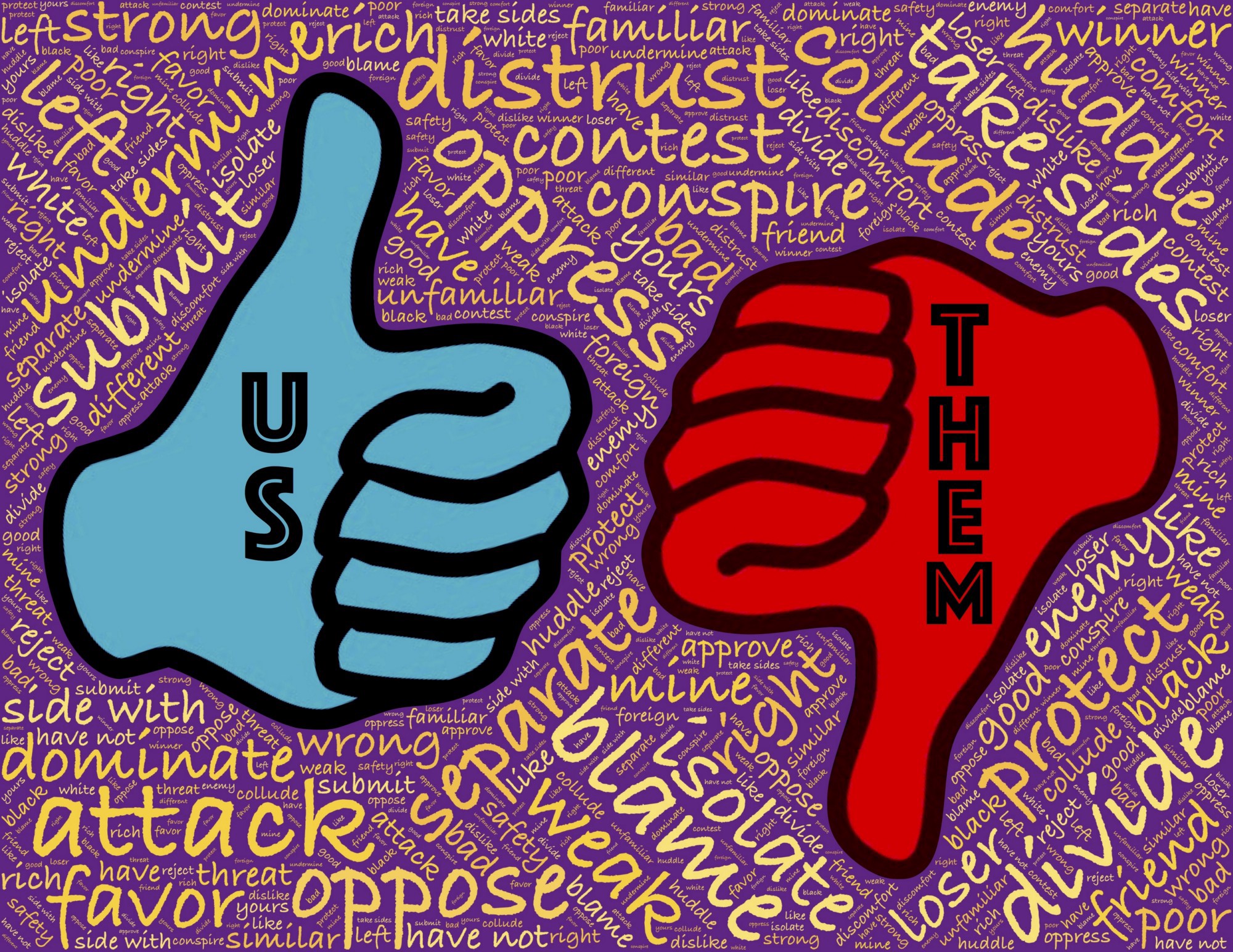
Tribalism becomes bad when it blinds its members to reason. Michael Adams says when the tribe tells you, “Don’t step outside the bounds. Don’t draw outside the lines. Don’t do anything that your tribe wouldn’t do” (Taylor, 2020). I’ve seen this in certain groups, For example, if someone is gay, they must be progressive because no gay individual would possibly be conservative. This thinking fosters the “us versus them” mentality with a “if you aren’t for us, then you are against us” battle lines. There is a social pressure to go along with the group despite what they see with their own eyes (Taylor, 2020). How often have we been told to hate a group due to a trait that has been deemed “undesirable”? How often do we encounter members of the hated group that don’t fit the portrayal at all? The social pressure as well as fear can blur human logic and the motivations behind their behaviors (Javanbakht, 2019). The most extreme example of this tribal thinking (Taylor, 2020) is Adolf Hitler. Hitler was able to convince an entire population to turn on their neighbors simply because they were Jewish or associated with Jews. It led to the extermination of millions who didn’t fit into the group as described by Hitler. There are countless other examples throughout history and since World War II of atrocities caused by tribal thinking. They all have a common thread. A leader who was able to convert the people’s tribalism and devotion into the fear of others (Taylor, 2020). 

In her article, The Problem Today is Not Tribalism but its Absence, Jennifer Brick Murtazashvili argues that the problem is not tribalism but factionalism (2020). In her argument, tribalism is the only way to fix what factionalism has broken. The focus on the smaller group rather than the nation as a whole has caused the conflicts. Tribalism is the only way to work toward meaning, community and connection and the sense of belonging (Murtzashvili, 2020). Alan Finlayson from The Guardian argues that only in politics is tribalism viewed as negative. The idea of tribalism has come to be “unhealthily excessive” and leads to irrational outlooks and hindering our thinking (Finlayson, 2019). I have dealt with this accusation as I have encountered individuals who automatically think that my Christian faith has closed my mind to all other ideas. Rather than let me consider the ideas, use my faith as a part of my decision making process to accept or reject an idea, I am automatically told I will reject it. According to John Patrick Leary, tribalism wasn’t an issue until Trump’s election when political commentators started to complain about how polarized American politics have become, how angry, how uncivil and how tribal (2020). It is nothing new but it is misleading as he continues. Attributing conflicts to ‘tribalism’ allows for the appearance of objectivity, but “it makes it easy to sidestep questions of facts and history and treat everything as an unsolvable matter of interpretation” (Leary, 2020). 

What can we do? How do we change bad tribalism into good tribalism? Elizabeth Segal (2020) has two suggestions. First, recognize that groups built on the foundation of hate, disdain, and anger build those traits in their members. At the constant urging of bad tribalism, members stay angry. I see this all the time on social media. I am supposed to be outraged at X because I am a member of a certain group. And when I’m not? My loyalty is questioned. If a group is demanding you stay outraged, angry or in a state of fear, it is best to take a step back and ask why and possibly find a new group. Second, Empathy is another powerful tool. It can broaden our sense of connections to others and diminishes the connection between bad tribalism (Segal, 2020). As Harper Lee wrote in To Kill a Mockingbird (1960), “You never really understand a person until you consider things from his point of view until you climb into his skin and walk around in it.” When we listen to understand, rather to respond, we can learn a great deal about people. 

In conclusion, tribalism, at its core, is not a bad thing. We all belong to one or multiple tribes throughout our lifetimes. We need to help and support our tribes, our communities when they are in trouble. Tribalism becomes bad when the behaviors of group members become toxic and fuel their hate toward others. We need to ask ourselves why do I fear a certain group, why am I angry at this situation? Is it because I am truly afraid or truly angry? Or am I afraid or angry because I have been influenced? It has been stated that we fear what we do not know. If we fear something, we need to learn more about it. We need to make sure our fear is justified or simply because we’ve been influenced to fear. We cannot let others in our tribes tell us how to think, feel and act. 


References

Finlayson, Alan. (December 12, 2019). Stop worrying about 'tribalism' – politics is supposed to be passionate. The Guardian. https://www.theguardian.com/commentisfree/2019/dec/12/political-tribes-passion-politics-voters-involved. Retrieved February 9, 2021. 


Javanbakht, Arash (July 19, 2019). The politics of fear: How it manipulates us to tribalism. The Conversation. https://theconversation.com/the-politics-of-fear-how-it-manipulates-us-to-tribalism-113815. Retrieved February 9, 2021. 


Leary, John Patrick (February 21, 2020). The Troubling Obsession With Political “Tribalism”. The New Republic. https://newrepublic.com/article/156448/troubling-obsession-political-tribalism. Retrieved February 9, 2021. 


Murtazashvili, Jennifer Brick (May 20, 2020). The Problem Today is Not Tribalism but its Absence. Discourse Magazine. www.https://www.discoursemagazine.com/culture-and-society/2020/05/20/the-problem-today-is-not-tribalism-but-its-absence/. Retrieved February 10, 2021. 


Segal, Elizabeth A. (March 30, 2019) When Tribalism Goes Bad. Psychology Today. www.https://www.psychologytoday.com/us/blog/social-empathy/201903/when-tribalism-goes-bad. Retrieved February 10, 2021. 


Taylor, Rupert (November 19, 2020). The Good and Bad of Tribalism. Soapboxie. https://soapboxie.com/social-issues/The-Good-and-Bad-of-Tribalism. Retrieved February 10, 2021. 


Friday, February 19, 2021

The Imposter: a story of love, family, and loyalty set during the Revolutionary War

The Imposter by Melanie Dobson is another book in the Legacy of Love series. Set in the final months of the Revolutionary War, as the battle for independence comes to a head, Lydia Caswell is faced with a choice: follow her family as Loyalists to King George III or follow the country she loves to independence. One snowy night, Lydia discovers an injured man on the riverbank near her family’s estate, Caswell Hall, and her decision to save him changes her life. Nathan introduces her to a secret network of spies, couriers, disguises, and coded messages, a network that may be the only hope to winning the war. When British officers stay at Caswell Hall, which brings havoc to the area, Lydia must choose between loyalty and freedom, between her family’s protection and her own heart’s desires. Every one must decide how high a price they are willing to pay to help the ones they love as well as their homes. 

I love Melanie Dobson’s Legacy of Love series which features historical romance among the significant events of America and the courageous people who lived through these events. So far, I have read 5 of the 8 books. The Imposter was particularly interesting because the Revolutionary War has been on the forefront of my mind since I have been watching Hamilton (2015) and reading more about the events of the war. While I knew of Washington’s spy network, I enjoyed reading more about how the network was able to work. I loved Lydia as a woman caught between two worlds: her Loyalist parents and America, the only home she has ever known. A woman driven by her faith to help her fellow man and less by seeing them as enemies. I also enjoyed seeing how some Loyalists were driven to support King George simply as a preservation because they didn’t think the Continental Army had a chance to win. I highly recommend The Imposter as well as the other books of the Legacy of Love series. 


The Imposter is available in eBook


The other books of the Legacy of Love series: (also available in eBook)

The Masquerade

The Silent Order

The Runaway

The Christmas Bride

The Journey

The Society

The Stranger


Wednesday, February 17, 2021

Easily Amused: a cute, funny story about life, love and finding yourself.

Easily Amused by Karen McQuestion is the story of Lola Watson. At 29 years old, she inherits a house on King Street from her great-aunt May, a woman she barely remembers. As she begins to enjoy her new house, her neighbors begin to welcome her and try to pull her into their community. She is content just to live there and not engage with any one unless she has to. When her heartbroken high school friend, Hubert Holmes, comes to stay at her house and her young sister, Mindy, announces that she has moved her wedding date, to Lola’s thirtieth birthday, she quickly becomes discontent with her new home. But when the mysterious neighbor, the handsome Ryan Moriarty, enters her life, Lola begins to believe she has found the perfect guy and the cherry on top, the chance to one-up her sister. Will Lola open herself to the new friendships of the neighborhood? Is there more to Ryan than meets the eye? 

Easily Amused is one of Karen McQuestion’s first published worlds and as I have read her newer books, I can see how she has evolved as a writer. The story was cute and funny. Although I found Lola to be very annoying and opinionated, especially about situations that she has no experience with, she redeems herself in the end. In Easily Amused, it is the secondary characters that were the most interesting. The residents of King Street, an eccentric but great group, were the heart and soul of the story. They are able to show Lola that family is more than who you are related to. Through Hubert, Lola finally sees there is more to her neighbors than her first impressions. The story was fun and entertaining. It is a lighthearted story which doesn’t try to take itself too seriously but gives us the reminder that love, family and a sense of belonging can be found where we least expect it. I recommend Easily Amused


Easily Amused is available in paperback, eBook and audiobook.


Monday, February 15, 2021

Meant to Be: a bit predictable romance but sweet and funny

Meant to Be by Melody Grace is the first book in the Sweetbriar Cove series. Poppy Somerville believes in happily-ever-after and she kinda has to, as she is a very popular romance novelist. Her novels have won devoted readers from all over the word. It is also why she broke off her engagement as her wedding date fast approached. In the aftermath of her broken engagement, she runs to her aunt’s beach cottage in Sweetbriar Cove. Hoping the idyllic beachside town will spark her inspiration and end her writer’s block. Her visit to the town starts off on the wrong foot as she comes face to face with a handsome and gruff contractor working on the cottage next door. Cooper Nicholson doesn’t believe in soulmates or true love. He thought he found his forever once but he was once again proven wrong. Romance is the last thing on his mind; however, he can’t keep the beautiful Poppy off his mind. As they grow closer, the sparks fly and ignite and they discover that life has more plot twists than any fiction writer could dream up. Will Cooper finally let go of the past and risk his heart again? Can Poppy find her happily ever after in real life? 

Meant to Be is a sweet, funny and sexy romance. A run of the mill romance but still very enjoyable with all the smalltown charms. It is definitely a beach book or a weekend read when you just want to escape to a place and enjoy the quirks of a smalltown and watch the romance ignite. Poppy and Cooper are definitely opposites as she dreams about love with her head in the clouds and Cooper, jaded by loss, is grounded in reality. Together they teach each other that true love does exist but it doesn’t always exist the way we think it will. While Poppy and Cooper would get annoying and grating at times, the secondary characters are charming and hysterical as they help drive the two knuckleheads together. My favorite character was MacKenize, the no-nonsense, a “tell it like it is” kind of woman who isn’t afraid to speak her mind. I also enjoyed Poppy’s Aunt June who helped provide some of the comic relief too. It was a fast read with lots of love, laughs and banter that had me laughing and smiling. I look forward to reading more of the Sweetbriar Cove series. I recommend Meant to Be


Meant to Be is available in paperback and eBook. 


Thursday, February 11, 2021

A Fire Sparkling: a family secret buried in the story of World War II

 A Fire Sparkling by Julianne MacLean is a story of love, loss, and courage in war time. After a crushing betrayal by her boyfriend, Gillian Gibbons flees to her family home in Connecticut. While she is there, her father, Edward, finds old photographs of his mother, Vivian, in the arms of a Nazi officer. Confused and possibly wounded that his mother could have been in love with a Nazi, he and Gillian confront Vivian with the pictures. The story that Vivian reveals will send Gillian and her father into a journey to the past. In 1939 England, the country is on the verge of war when Vivian Hughes meets and falls in love with Theodore Gibbons, the son of an earl and deputy minister at the new Ministry of Supply. The bombs fall and the London Blitz destroys everything she holds dear, Vivian decides to do whatever she can to protect those she loves. As Gillian learns more of her grandmother’s story, the answers only bring more questions. She decides to go to Europe to find out more information. Will the mysteries of her grandmother’s past help answer her own questions about her own future? 

A Fire Sparkling is my first book by Julianne MacLean and came highly recommended by other readers. I was intrigued by the mystery of the photos and the links to Vivian. Unfortunately, the twists and turns in the mystery were predictable and easily deciphered very early on, even the ending was predictable. The characters were hard to like especially Gillian as she deals with “the betrayal.” Her indecision whether to forgive her boyfriend was annoying and her “final straw” felt straight from a soap opera. It felt more like a romance than a historical fiction. Overall, I did enjoy the story as it was an easy read but when compared to other World War II stories that feature the London Blitz and the spy activity in France, I feel it missed the mark. It lacked the depth and intrigue that I would expect from a World War II story. A Fire Sparkling has been compared to Kristin Hannah’s The Nightingale, which is why I picked it up. However, in my opinion, the books don’t even compare. I would recommend A Fire Sparkling as a quick, weekend read but not as an in depth story of World War II. 


A Fire Sparkling is available in hardcover, paperback, eBook and audiobook.