Showing posts with label Propositions. Show all posts

Thursday, October 20, 2016

California Propositions 2016 Part 4: Props 63-67

My final review post for the California proposition. (Remember you can read the full text of each proposition as well as more in depth arguments for and against each proposition at ballotpedia.org/California_2016_ballot_propositions).


Proposition 63 is the Background Checks for Ammunition Purchases and Large Capacity Ammunition Magazine Ban Initiative. The proposition prohibits the possession of large capacity magazines and requires most individuals (exemptions include law enforcement, correctional officers and licensed private security companies) to pass a background check and obtain authorization from the California Department of Justice to purchase ammunition. Arguments for Prop 63 are that it will close loopholes in existing law. It protects the rights of law-abiding citizens to own guns for self-defense, hunting and recreation. It is supposed to address the issue of illegally armed felons. The arguments against Prop 63 are that it will burden law-abiding citizens who own firearms. It would not keep firearms and ammo out of the hands of criminals. Prop 63 would divert resources away from local law enforcement and burden an already burdened court system. Opponents also claim that Prop 63 is a safety risk and waste public resources.


Proposition 64 is the Marijuana Legalization Initiative. It is designed to legalize recreational marijuana and hemp products under state law and establish a 15% sales tax, a cultivation tax of $9.25 per ounce for flowers and $2.75 per ounce for leaves. It is designed to prevent license for large scale marijuana businesses for 5 years (as to prevent an “unlawful monopoly power”). Prop 64 also has provisions related to the rights of employers, driving under the influence and marijuana business locations. Under Prop 64, marijuana would be legal for individuals 21 and older. It would exempt medical marijuana from some of the taxation requirements. Prop 64 establishes packaging, labeling, advertising and marketing standards and restrictions for marijuana products. It prohibits ads and marketing to minors and allows local regulation and taxation. Prop 64 also authorizes resentencing and destruction of records for prior marijuana convictions. Supporters for Prop 64 claim that it safeguards against minor use while allowing responsible adult use. It would generate tax revenue and provide funding for after school programs, drug prevention education, treatment programs and research on impaired driving. They also claim that Prop 64 would prevent legislators from using revenues for pet projects and it would make marijuana safe, controlled and taxed. Opponents of Prop 64 claim it would result in more highway fatalities due to impaired driving and increase black market and drug cartel activity.


Proposition 65 is the Dedication of Revenue from Disposable Bag Sales to Wildlife Conservation Fund Initiative. It is designed to required al revenue generated by state mandated sale of carryout bags to be earmarked for a special fund for specific categories of environmental projects. Supporters of Prop 65 claim it would stop plastic bag fee revenue as extra profits for grocery stores. Instead the fee revenue would be directed to the California Conservation Board who would be responsible for allocating the funds to various projects. Opponents of Prop 65 claim it serves the interest of the plastic bag companies and would distract from the phase out of those bags. The proposition does little to help the environment.


Proposition 66 is related to death penalty procedures. It is designed to keep the death penalty in place while speeding up the appeals process by putting the trial courts in charge of initial petitions, establishes a time frame for death penalty reviews and requires appointment of attorney to work on death penalty cases. It would require death row inmates to work and pay restitution to victims’ families. Supporters argue that Prop 66 keeps the death penalty in place while making provisions to make sure that no innocent person is executed. Opponents argue that with the sped up process, Prop 66 would increase the risk of executing an innocent person and remove all legal safeguards.


Proposition 67 is the Plastic Bag Ban Veto Referendum. It would ratify Senate Bill 270(2014). It would prohibit large grocery stores and pharmacies from providing plastic single use bags with a provision for smaller stores to have an additional year. It allows single use plastic bags for meat, bread, produce, bulk food and other perishable items. It would mandate stores to charge 10 cents for recycled, compostable and reusable grocery bags with an exemption for consumers using the California SNAP program. Prop 67 also provides $2 million to state plastic bag manufacturers for the purpose pf retaining jobs and transition to making thicker, multi-use and recycled bags.  Supporters of Prop 67 argue that the opposition campaign is funded by out-of-state plastic companies who aren’t invested in protecting California’s environment. They claim Prop 67 will help protect the environment without hurting low-income consumers or decreasing job creation. According to Jon Berrier, a spokesperson for the American Progressive Bag Alliance, summarized the organization's arguments against Prop 67, saying, "The [plastic bag] industry obviously is opposed to this particular piece of legislation because it seeks to ban a 100 percent recyclable product and also put fees on consumers for other bag alternatives. It’s all orchestrated as a cash grab by members of the California Grocers Association to scam California consumers out of billions of dollars in bag fees, none of which goes to a public purpose” (San Francisco Chronicle, “Makers of plastic bags gather signatures to overturn ban,” December 29, 2014).


My final thoughts on these propositions. On Prop 63, I don’t see how it will address the criminals who will have access to these guns and magazines. Criminals are criminals for a reason. They will find a way to get them and still get them, they will. On Prop 64, the opponents claim that legalizing marijuana would led to an increase in the black market. How? The black market is usually no longer there for a substance that is no longer illegal. For instance, when Prohibition ended in 1933, the rate of bootleggers dropped dramatically. Did it eliminate bootleggers? No; however, many bootleggers lost money because people didn’t need to use them to obtain alcohol. Will the same happen with marijuana? I don’t know; but, saying that Prop 64 will increase the black market seems to be a weak argument. On Prop 65, I like that it keeps the bag fee from being extra profits for the stores; however, I can’t see how it guarantees the money will be used for the projects the proposition is designed for. Yearly audits maybe? Oh, but paperwork can be faked. I’m not sure about Prop 65. On Prop 66, the other death penalty proposition, I don’t know how a law can guarantee that no innocent person would be executed. How about no innocent person in prison in the first place? Lastly, on Prop 67, I understand the motivation behind the plastic bag ban because too many people do not dispose of the bags properly; however, the reusable bags aren’t always a healthier alternative as many people do not clean them out for the next use. I think the ban is a good idea and I think once the bags are phased out and people get used to the alternative, they will see its benefits. I just think we could have more than one alternative. Maybe bags which can be laundered? After use, throw them in the laundry. Cleaned and sanitized for the next use? Thank you for reading my thoughts on the propositions. I hope I was able to clear up some confusion or inspired you to look into the propositions a little more closely. Read for yourself. Research each proposition as best you can. Weigh the pros and cons when making your decision for a yes or no vote.

Sunday, October 16, 2016

California Propositions 2016 Part 3: Props 59-62

Continuing my review of the propositions for the upcoming election: (Remember you can read the full text of each proposition as well as more in depth arguments for and against each proposition at ballotpedia.org/California_2016_ballot_propositions).


Proposition 59 is the California Overturn of Citizens United Act Advisory Question. If approved, Prop 59 would allow state’s officials to use their authority to overturn the Citizen United v Federal Election Commission decision. The Citizens United v Federal Election Commission decision ruled that laws placing certain limits on political spending by corporation and union are unconstitutional. The arguments for the proposition is to insure the voice of the people is not drowned out by corporations and billionaires and to limit excessive political spending (i.e. “buying” elections). The arguments against the proposition is that it is a “feel good measure” that would hurt small businesses that are incorporated and fails to prohibit or limit corporate and union contributions. The proposition limits free speech of the corporation.


Proposition 60 is the Condom in Pornographic Films Initiative. If approved, it would require the use of condoms and other protective measures during filming pornographic films as well as requiring producers to pay for certain health requirements and checkups such as vaccinations, testing and medical examinations related to sexually transmitted infections (STIs). Producers would need to obtain a state health license and post condom requirement at film sites. The proposition imposes violation liability on producers or anyone with a financial interest as well as talent agents who knowingly send performers to noncomplying producers. Prop 60 permits state, producers or any state resident to enforce the requirements. The arguments for Prop 60 are that it creates accountability for work safety and health, and reduces risk of STIs and sexually transmitted diseases (STDs). Arguments against Prop 60 are it is poorly drafted, it could lead to lawsuits which threaten performers’ safety and violate worker privacy.


Proposition 61 is the Drug Price Standards Initiative. If approved, Prop 61 would regulate drug prices by requiring state agencies to pay the same prices that the US Department of Veteran Affairs (USDVA) do. It is designed to strict the amount that any state agency could pay for drugs and provides funding for the purchase of drugs, even if the drugs are not directly purchased by a government agency. Prop 61 only applies to purchases by state agencies and not individuals. It also prohibits state agencies from buying prescription drugs at any price over the lowest price paid by the USDVA, except where required by federal law. Prop 61 would apply to any program where the state agencies are the ultimate payer of the prescriptions with exempts purchase under managed care like Medi-Cal. The main arguments for Prop 61 are to fight price-gouging from drug companies and provide access to life-saving drugs. The main arguments against Prop 61 are that it will rise costs to veterans, reduce patient access to medicines and increase bureaucracy red tape and taxpayer costs. According to FacesOn61.com, Prop 61 was written by Michael Weinstein, president of the AIDS Healthcare Foundation (AHF), who exempted his own organization from the requirements of Prop 61.


Proposition 62 is the Repeal of the Death Penalty Initiative which would repeal the death penalty and making life without possibility of parole the maximum punishment for murder. It would retroactively apply to those already on death row, requires restitution paid to victims’ families, raises the amount of wages from inmates paid to victims’ families by 60%, and any provision found invalid would not affect other provisions. The arguments for Prop 62 are to save taxpayer money by replacing a costly and inefficient system, provide criminals opportunity to work and pay restitution, provide closure for victims’ families and eliminate the risk of executing an innocent person. The arguments against Prop 62 are that it protects the worst criminals while diminishing protections of victims’ rights, cost millions, and it would end the death penalty when it should be amended.


Just a few thoughts on the proposition. In response to the Prop 59 opposition who arguments that it limits free speech. Unions are made of members who may or may not agree with the candidate or law which the union leadership is trying to endorse. What about their free speech to not want their union to spend their union dues to support someone or something they don’t agree with? In response to the Prop 60 opposition’s argument that it violates worker privacy. Employers are required to provide for the safety of all their employees. So if your illness is putting others are risk, then the employers need to be aware to ensure the safety of another. I also find it highly suspicious that the individual drafting Prop 61 makes a provision to exempt his own organization. If it benefits California, why exempt the AHF? I’m on the fence when it comes to the death penalty, so Prop 62 (and the related Prop 66), however, closure for victims’ families doesn’t always come from the offender’s death. I think many people would be shocked to find out that there are victims’ families who advocate against the death penalty. Read for yourself. Research each proposition as best you can. Weigh the pros and cons when making your decision for a yes or no vote.

Wednesday, October 12, 2016

California Propositions 2016 Part 2: Props 55-58

Continuing on my overview of the ballot propositions for this coming election: (Remember you can read the full text of each proposition as well as more in depth arguments for and against each proposition at ballotpedia.org/California_2016_ballot_propositions).


Proposition 55 will require the personal income tax increase on incomes over $250,000 to be continued. If approved, the tax increased approved in 2012 would be extended for 12 years in order to fund education and healthcare programs. Proponents argue that the taxes will be kept the same as approved by Prop 30, only extended. It would only affect the wealthiest Californians. Strict accountability and transparency standards will be set to ensure money to local schools and prevent budget cuts while continuing to restore funding lost during the recession. Opponents argue that the tax increase was only supposed to be temporary. Extending the tax increase is unnecessary and would hurt small businesses.


Proposition 56 is to increase the cigarette tax to $2 a pack. An equivalent tax increase would be added to other tobacco products and electronic cigarettes which contain nicotine. The revenues generated from the taxes would be allocated for increasing funding for existing healthcare programs, prevention programs, tobacco-related disease research, law enforcement, University of California physician training, dental disease prevention programs and administration. If the new tax causes decreased sales of cigarettes and tobacco related products, the proposition calls for other tax revenue to be transferred to offset decreases to existing tobacco-funded programs and sales tax revenues. The main arguments in support of Prop 56 is the new tax would reduce tobacco-related healthcare costs and prevent youth smoking and address tobacco marketing aimed at youths. The main arguments against Prop 56 is the new tax will fund insurance companies. There is no allocation for funding schools (as was specified in other tobacco tax initiatives).


Proposition 57 is the Parole for Non-Violent Criminals and Juvenile Court Trial Requirements Initiative. It increases the parole chances for felons convicted of non-violent crimes and more opportunities to earn credit for good behavior. It also allows judges, not prosecutors, to decide whether to try certain juvenile crimes as adults. Proponents of Prop 57 claim it provides a way to reduce California’s prison overcrowding as well as rehabilitation for juveniles and adult inmates through evidence-based rehab. It keeps dangerous offenders in prison. It will save millions in tax dollars. Opponents against Prop 57 claim the bill has been poorly drafted and allows offenders of rape, lewd act of a child and human tracking to be released early. They also claim that the bill allows for career criminals to be treated like first-time offenders. Proposition 57 also overturns provisions of victim’s rights law like the three strikes law and Victims’ Bill of Rights.


Proposition 58 is the Non-English Languages Allowed in Public Education proposition. If approved, Prop 58 would repeal most of 1998’s Prop 227 and provide English learners a structured English immersion program. Supporters claim that Prop 58 allows for all students to become proficient in English ASAP (side note: it’s hard for even native English speakers to be proficient). The instruction programs will allow English speakers the opportunity to learn a second language (side note: how exactly? The proposition doesn’t specify but the school districts are to provide the opportunity). Opponents claim Prop 58 will overturn policies that have improved language education and reestablish “Spanish-Almost-Only instruction” in public schools.


Read for yourself. Research each proposition as best you can. Weigh the pros and cons when making your decision for a yes or no vote. 

Saturday, October 8, 2016

California Propositions 2016 Part 1: Props 51-54

With Election Day coming up, I decided to do a review of the presidential candidates as well as the propositions which will be on the ballot for Californians. There are 17 propositions on the ballot this coming election. I will review each briefly; however, I will not endorse a yes or no vote. That is for you to decide. I have my own opinions, which may change by Election Day. So my purpose is to possibly help clear up the information on each proposition by presenting each proposition with a brief description as well as the main arguments for and against. I highly recommend reading the full text of each proposition at ballotpedia.org/California_2016_ballot_propositions. For this post, I will discuss Propositions 51, 52, 53 and 54.


Proposition 51 is the California Public School Facility Bonds Initiative. A yes vote on this proposition would support the state issuing a $9 billion in bonds to fund improvements and construction of school facilities for K-12 and community colleges. The money would be allocated for constructions of new school facilities for current schools as well as charter schools, modernizations of older schools, facilities for career technical education programs as well as improvements to community college facilities. Supporters argue that California schools and community colleges are in desperate need of repair and maintenance to meet the standards for earthquake, fire and health safety. Opponents argue that Prop 51 will put the state further in debt and it doesn’t guarantee equitable distribution of the bond money. So larger, better equipped schools will receive money before the smaller, poorer schools.


Proposition 52 is the Voter Approval for changes to the hospital fee program. Currently, the federal government requires that the state contribute a matching contribution in order to receive federal funds from Medicaid. In 2009, a program was created that required hospitals to pay a fee to help California obtain the matching funds. If approved, money collected from hospital fees would be harder to divert from its original intention of funding Medi-Cal. Voter approval would be needed to divert funds. Opponents to Prop 52 claims that it diverts resources to special interest and does not guarantee funds will be spent on healthcare with no accountability about how the money is spent. From my understanding is Prop 52 isn’t changing the hospital fees, it is just making it harder to divert the funds without voter approval. So I’m not sure if I buy the opponents arguments against Prop 52.


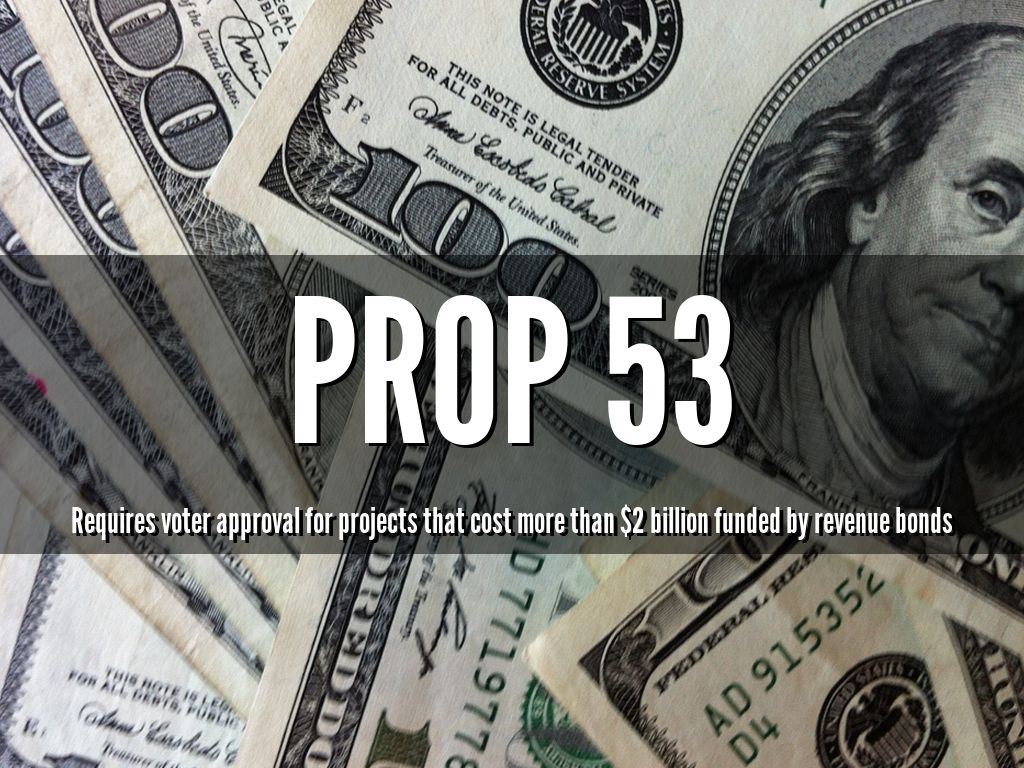
Proposition 53 would require elections and voter approval for projects that cost more than $2 billion. If approved, voters would have to approve any project costing more than $2 billion before the state can issue public infrastructures bonds that require an increase in taxes or fees for repayment. It is known as the “No Blank Check” Initiative. Proponents argue that politicians need to be held accountable to provide an accurate estimate of how much a project would cost. There would be no impact to local projects, freeway construction or natural disaster response projects. The opposition, led by Governor Jerry Brown, major claim is that it would require a statewide election for certain local projects as well as gives no exemption for emergencies and natural disasters. I have read the full text of this proposition and this argument is very wrong. From my understanding, the proposition is very clear about what projects would need voter approval and local projects are not affected.


Proposition 54 sets certain conditions under which legislative bills can be passed. The purpose is to require all bills to be published in print and online for 72 hours before each legislative house can vote on it. It requires all legislative house make audio/video recordings of public proceedings and publish them online within 24 hours. Proponents claims that it would increase transparency in California’s state government and stop the practice of “gutting and amending” legislation. Opponents claim that Prop 54 would introduce unnecessary restrictions on the legislative process, increase taxpayer costs and give special interest too much power on the legislative process.


A thought I had while writing this, I find it funny that whenever someone is in opposition of a proposition, like this one, they mention the scary “special interest.” It’s possibly true; however, they give a nameless special interests and not all special interests are evil. If I support a certain bill and I lobby for its passing, I have a special interest in it. However, does that mean the law is evil? Not necessarily. Does that mean I get money for the passing of the bill? Not necessarily. I’d be wearily of any opposition which immediately claims “special interests will benefit” because it may not be true.  Read for yourself. Research each proposition as best you can. Weigh the pros and cons when making your decision for a yes or no vote.