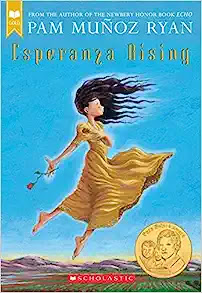
Esperanza Rising by Pam Munoz Ryan is a coming of age story set during the Great Depression. Esperanza had a great life on her family’s ranch in Aguascalientes, Mexico. She wanted nothing: fancy dresses, parties and servants. Until a series of tragic events forces Esperanza and her mother to flee to California. Along with their former servants, they settle in a camp for Mexican farm workers. Esperanza isn’t prepared for the hard labor, financial struggles and the sudden prejudice she experiences, especially from other Mexicans. She has some hard lessons to learn. When Mama becomes ill, Esperanza finds the strength and determination to rise above the circumstances and a new hope for their lives.
I first saw this book many years ago and have always wanted to read it. But I had forgotten about it until my oldest daughter read in school this past year. As she talked with me about the book, I was once again intrigued to read it. Inspired by her grandmother’s story of life during the Great Depression, Ms. Munoz Ryan writes a story about faith, hope, and survival against all odds. At a time when everyone was looking for work and coming to California, Esperanza saw the harsh realities of life outside the privilege she was accustomed to. I thoroughly enjoyed this story and discussed it further with my daughter. I highly recommend Esperanza Rising.
Esperanza Rising is available in paperback, eBook and audiobook
Last Dance on the Starlight Pier by Sarah Bird is a story set in the Great Depression as one woman struggles to rise above her past for a better future. The story opens on July 3, 1932 as Evie Grace Devlin watches in horror as the Starlite Palace burns. She had come to Galveston to escape a dark past in the fading days of vaudeville and become a nurse. When the dream of becoming a nurse doesn’t become a reality, she finds herself in the strange world of dance marathons. There she meets individuals who have been outcasted by their families and communities to make a living in the dance marathons. Evie soon finds herself in the one place she swore to leave behind: the spotlight. In the dreaded spotlight, she finds what she has wanted the most: a family, a purpose and love. Will Evie be able to truly put her past behind her and achieve her dreams?
I was intrigued by the premise of Last Dance on the Starlight Pier. What’s not to be intrigued by the Great Depression, dance marathons and the resilience of the human spirit? I thoroughly enjoyed the beginning as Evie watched the fire burn and looked forward to discovering the events that led her there. Unfortunately, the story fell terribly flat. It was way too long and incredibly boring. I couldn’t connect with any of the characters, particularly Evie. I found her to be unbelievably naïve despite her dark past. There was too much going on to be enjoyable. Was it a story of Evie and her resilience? Was it a story of the Great Depression, the mob and Prohibition? I felt the political commentary was more indicative of today’s political climate instead of being a reflection of the 1930s. There were just too many agendas trying to be in the forefront that it took away from the story. Unfortunately, I do not recommend Last Dance on Starlight Pier.
Last Dance on Starlight Pier is available in hardcover, eBook, and audiobook
The Four Winds by Kristin Hannah is the story of the Great Depression and one family’s fight for survival. The story begins in Texas, 1921 when 25 year old Elsa Wolcott spent most of her time indoors, deemed too weak to venture outside by her overbearing parents. She is now considered unmarriageable until fate steps in and with one act of rebellion, Elsa’s world is turned upside down. Her act of rebellion leaves her married to Rafe Martinelli, a young man she barely knows and begins life on a farm she knows nothing about. Fast forward to 1934, the world is in a deep depression. Millions are out of work and a devastating drought has ravaged the once bountiful Great Plains to a wasteland. Everyone is faced with a choice: stay or take a chance on a better life elsewhere. Elsa is determined to stay on the land she has come to love. But when a horrific dust storm causes her young son to become gravely ill, she has no other choice. She packs her two children and takes the perilous journey into California. What will she find there? Will it be a land of plentiful? Will they find a way to survive?
Growing up I knew my maternal grandmother lived on an Oklahoma farm during the Great Depression. Once I sat down with her and talked about her experiences. I have never forgotten what she told me. Her stories were in my mind as I read The Four Winds. It is a story about love, heroism and hope during a time when all hope seemed to be lost. The Four Winds is a story about the will to survive and a hope for a better future. It was a time of crisis and the harsh realities that divided the people and the battle between the haves and the have-nots, the powerful and the needy. Images from John Steinbeck’s The Grapes of Wrath (1939) also came to mind as Ms. Hannah described the conditions these people had to endure. It is also the story of a woman who thought she was nothing but discovers she is someone important. I had a love-hate relationship with Elsa and many of the characters. But they felt real with real flaws and made life and death decisions. The end was truly beautiful, a tear jerking moment, a thank you to those who fought and endured the Great Depression. I recommend The Four Winds.
The Four Winds is available in hardcover, eBook, and audiobook.
March 12, 1933 marks the first of President Franklin D.
Roosevelt’s Fireside Chats. The Fireside Chats were an evening radio address
given by the president between 1933 and 1944 on various topics from the
economy, the New Deal initiatives and later the progress of WWII. Remembered as
a great communicator, FDR’s Fireside Chats kept him in high regard with the
American people throughout his presidency and he used radio to quickly spread
word about his policies and actions of government. Each chat lasted between
13-44 minutes and allowed him to directly speak to the American people as a
friend speaks to another friend.
Radio was fast overtaking newspapers as a major source of
information. In 1932, 42% of Americans had radios in their homes (Biser, 2016).
President Roosevelt wasn’t the first president to utilize the radio, President
Calvin Coolidge used the radio to deliver President Warren G. Harding’s eulogy and
President Herbert Hoover used the radio to as a campaign tool (Biser, 2016). Roosevelt
felt the newspapers were controlled by his opponents; therefore, couldn’t trust
them to provide the public with the correct information. Eight days after his
inauguration, he gave the first Fireside Chat as president. In the first chat,
he discussed how and why the banking crisis occurred and the resulting bill,
the Emergency Banking Act. As a result of this first chat, there was a great
turnaround in the public’s confidence. Within 2 weeks of the chat, people took
the money they were hoarding and deposited back in the banks. In future chats,
he appeals to listeners for help in getting the initiatives passed and the
audience responded. Letters would pour into legislators, urging their support
for all measures that the president proposed. There are many different theories
about who coined the term, “fireside chat,” some sources cite Stephen Early,
the president’s press secretary (Higgins, 2018), while others cite CBS station
manager Harold Butcher (Biser, 2016).
Many historians agree that President Roosevelt’s Fireside Chats
were different from other presidential radio speeches before for many reasons.
First, Roosevelt kept the speech of each chat informal. He would address the
audience as “My friends” or “My fellow Americans.” He liked to use common
analogies and informal conversational speech. 80% of the words he used were the
thousand most used in English; so that even the uneducated listening could
understand and follow his plan. Second, the chats allowed a level of intimacy
and importance to the people that they were truly a part of the governmental
process than ever before. One listener wrote to the White House stating, “It
made me feels as though you were really one of use” (Biser, 2016). As a result,
the American people trusted Roosevelt like no other president before. Lastly, for
many Americans, chats were a source of comfort. A reassurance that the
president had a steady hand on the wheel during the crises of the Great
Depression and, later, World War II (Biser, 2016). He would often urge the
American people to face the difficult times with patience, understanding and
faith.
Roosevelt’s Fireside Chats began a presidential precedence
that every president after him would utilize. With periodic speeches,
addressing the American people, first by radio, then television and later the
internet. On October 5, 1947, President Harry S. Truman would be the first
president to address the American people by television (History.com Editors,
2019) as well as other presidential firsts. The practice of a regularly
schedule address began in 1983 with President Ronald Regan who would deliver a
radio broadcast every Saturday. Roosevelt was one of the first presidents to
appeal to the American people as a friend and fellow American a tactic that
many politicians today are trying to recreate. Today, politicians hold town hall
meetings, an intimate setting, for the public to voice their concerns, hear the
politicians take on upcoming legislation or regulation or other various topics
concerning their communities or the nation. If they connect with their
audience, the way Roosevelt did is often a matter of opinion.
In conclusion, today marks an important day in history as
President Roosevelt held the first of his Fireside Chats. The utilization of a
new media and the skills of a great communicator, Roosevelt was able to gather
support for his policies from the American people who saw him as the great
leader to help pull the country out of the Great Depression and later victory
in WWII. He spoke as a friend, a neighbor and fellow American. By using the
radio, Roosevelt avoided being misquoted or misrepresented as the newspapers
often do. Today, politicians try to appeal to the American people as Roosevelt
did, some are successful, and others are not.
References
Biser, Margaret (August 19, 2016). The Fireside Chats:
Roosevelt's Radio Talks