Showing posts with label Bible. Show all posts

Friday, March 20, 2020

A Prophetic Calendar: linking the festivals of Israel to Jesus the Messiah


A Prophetic Calendar: The Feasts of Israel by Jill Shannon is a powerful book that takes the reader through the Feasts of Israel and how each one points to Jesus, his life and his second coming. It also paints a wonderful picture of God’s timeless desire to draw all people to Him and have an intimate relationship with them. Ms. Shannon sets out to detail how the seven festivals all foreshadow the life and ministry of Jesus the Messiah and goes in depth on the origins and details of how each festival is celebrated. She details how each festival can be celebrated today in a world and culture dictated by busyness and work. Details from each festival are thoroughly examined for their symbolism and meaning, Ms. Shannon uses Scripture as evidence that the requirements for the festivals aren’t random and point to Jesus as the Messiah and Lamb of God. From the festivals laid out in Leviticus and the festivals of deliverance in celebration from historical events, readers can appreciate that God has left no detail to chance. Even the importance of celebrating the Sabbath, which means a day to cease and desist, whatever day you choose to celebrate it. Let the Sabbath be a day to focus on the Lord.


A Prophetic Calendar is a great book for Christians who want to know more and possibly celebrate these festivals. She uses Scripture, historical records and her own personal experiences to provide an experience of each festival as many Christians may not ever experienced before. Overall, I enjoyed the book and Ms. Shannon’s in depth examination of every detail. Although, she kept repeating that the Jewish holidays are hard to find on a “normal” calendar which isn’t true. My yearly calendar always has the major holidays like Passover, Purim, Yom Kippur, etc. Although I disagreed with a few of her statements, I found her to be insightful and genuine. I recommend for anyone who wants to know more about the history of the festivals and their link to Jesus.

A Prophetic Calendar
is available in paperback and eBook

Sunday, February 10, 2019

Sex and the Bible: not just for procreation


I read online recently that someone made the claim that sex is bad, evil and dirty to Christians. I serious dislike the generalization because while there are churches which teach people to feel dirty about enjoying sex but there are many churches which see sex as it was intended to be. Sex was designed by God to be a gift to a husband and wife. What is the purpose of sex? The Bible gives us a very romantic and intimate story in the Song of Songs. If sex is a gift from God, how did it become bad, evil and dirty?


When asked what the purpose of sex is, many people will immediately say “procreation.” Yes, sex is how humans procreate but there’s more to sex than just the production of children. Another purpose of sex is for intimacy and enjoyment in marriage. Yes, sex was designed for marriage. Sex within marriage can be a relationship builder. Outside of marriage, it can destroy relationships and people. Proverbs 5:18-20 says “A loving doe, a graceful deer; may her breasts satisfy you always, may you ever be captivated by her love. Why be captivated, my son by an adulteress? Why embrace the bosom of another man’s wife?” God does not intend faithfulness in marriage to be boring, pleasureless and dull. This is certainly the world’s image of marriage aka “the old ball and chain.” Sex is a gift God gives to married couples for their mutual enjoyment. Real happiness comes when we decide to find pleasure in the relationship God has given us and commit ourselves to making it pleasurable.


Song of Songs, or in some translations Song of Solomon, is an intimate story of a man and woman, their love, courtship and marriage. The most explicit statements on sex in the Bible are in this book. For example, chapter 7:7-8, “Your stature is like that of a palm, and your breasts like clusters of fruit. I said, “I will climb the palm tree; I will take hold of its fruit.’” It is a wedding song honoring marriage with three speakers. First, Lover, which tradition holds is a young King Solomon before he was obsessed with women, sex and pleasure and represents the husband in a marriage. Second, Beloved is a Jewish maiden he falls in love with and becomes his wife. Third, friends who encourage the couple as they fall in love. The purity and sacredness of love is represented in this book. One of my favorite verses is “Do not arouse or awaken love until it so desires.” It is a phase that is repeated three times in chapter 2 verse 7, chapter 3 verse 5, and chapter 8 verse 4. It is repeated because it is important to know that true love isn’t rushed. It blooms when the time is right. Another favorite verse is “My lover is mine and I am his (2:15 and 6:3), some translations use the word beloved. In a marriage, a husband and wife belong to each other. They are one body united by God and by love.


If God had created sex and intimacy for marriage, how sex became bad, evil and dirty? Easy, man did. Even within the Christian church, man took a beautiful expression of love, a gift from God and made it a thing to be tolerated. The idea that women shouldn’t enjoy sex was dictated by man.  It is hard to say in Judaism or Christianity, the thoughts on sex are simple because it ignores the different sects or denominations of each faith. However, in my research, I found that in Judaism, “a man may do with his wife as he wishes provided, he has her consent” (Judaism and Sex), which means any sexual acts between consenting spouses is not forbidden. In Christianity and especially in the history, things get murkier. “Christianity remains among the most “sex-positive” religions, even if segments of the church have on one hand, cloaked it in shame or, on the other, given it a mystical power bordering on idolatry” (Sex and Sexuality). St Augustine (354-430) and other theologians promoted the idea that sexual desire was a sin (Kuruvilla). Other church leaders would go further and state that being too passionately in love or having sex for pleasure was a sin (Kuruvilla). These ideas are far from what the Bible teaches as I have statement on above. Lust and desire for your spouse is an expression of love; however, it needs to be only for your spouse.


In conclusion, sex is a beautiful expression of love between a husband and a wife. A beautiful thing that has been twisted and distorted through the ages by men in power. Unfortunately, the effects are those policies and ideas are still seen today in many churches and many who resist God because of what they think they know. Our society has such a distorted attitude about love and marriage that for many people love equals sex and getting married is just to have a party. Sex is only one expression of love. It is important in a marriage, but it is not the only thing. Sex is a gift from God. It is to be an expression of love between a husband and a wife. It is to be motivated by love and commitment.


References
Retrieved February 9, 2019
Kuruvilla, Carol. 6 Things you probably didn’t know about Christianity and Sex (February 26, 2016) www.huffingtonpost.com/entry/christianity-and-sex_us_56cb6dc1e4b0ec6725e371d5 Retrieved February 9, 2019
Sex and Sexuality www.christianitytoday.com/ct/topics/s/sex-and-sexuality/ Retrieved February 9, 2019

Thursday, January 24, 2019

The Jesus Storybook Bible: a great Bible for young readers


I found The Jesus Storybook Bible by Sally Lloyd-Jones while searching for a bible for my daughter. The idea is that “every story whispers his name.” Twenty-one Old Testament stories and 23 New Testament stories are featured from the Creation Story to Noah to Abraham to the gospels and the parables. It is recommended for preschool to 6th grade (ages 4-8 years old) readers. It is a great format to be read aloud or independently.


The opening chapter, “The Story and the Song” is a great introduction to who God is and what his Word is to us. The Bible is more than just rules or a guide to life. It is about God and who is he and what he has done for us. The stories are beautifully illustrated by Jago. The language is simplified for young readers. There are creative liberties to help illustrate the point of each story without being too complicated for young readers. A few people who have reviewed this bible had issues with the liberties; however, I find the Bible to be a great introduction to who God is, who Jesus is, without going over their head with philosophy and theology. I highly recommend the Jesus Storybook Bible.

The Jesus Storybook Bible
is available in multiple formats
at major booksellers

Wednesday, July 19, 2017

Angels: what are they in the Bible and what purpose they serve in our lives today

Angels are supernatural heavenly beings created by God. While Scripture does not give a time of creation, but Job 38:7 implies they were created before the creation of man as they “shouted for joy” at God’s work. There are only two angels specifically named in the Bible. Gabriel, the messenger, and Michael, the archangel. While Scripture as a whole is silent regarding details of the time and cause of a rebellion leading to fallen angels, there are a few verses which reference it. 2 Peter 2:4 says that God sent the fallen angels to be bound up in hell. There is so much information about angels out there. I will try to be as concise and clear as I can. I will discuss what the Bible says about the angels’ descriptions, their work in heaven as well on earth, and their appearances in the Old and New Testaments. Lastly, I will cover evil angels and their purpose.


First, the descriptions of angels are limited; however, Scripture does give some details. There are a vast multitude of angels (Revelation 5:11). They are without a bodily organism; they often appear as men on multiple occasions. Jesus said they do not marry or die (Luke 20:34-36). They constitute a company rather than a race developed from an original pair. They possess superhuman intelligence; however, they are not omniscient. In Matthew 24:36, Jesus says that angels do not know the day or hour of his return and 1 Peter 1:12 says that the angels long to see what believers experience through Christ. They are stronger than man but not omnipotent. In 2 Thessalonians 1:7, Paul writes that powerful angels will appear with Christ at his second coming. 2 Peter 2:11 describes the angels are stronger and more powerful than man. Angels are distinct beings and are not glorified human beings. Hebrews 1:14 says that angels are ministering angels who will serve those who inherit salvation.


Second, angels work toward believers include a variety of tasks. They guide as described in Genesis 24:7 as an angel guided Abraham’s servant to find Isaac’s wife. They provide as described in 1 Kings 19:5-8 as angels provided Elijah food and drink as he fled from King Ahab and his queen, Jezebel, plot to kill him. They deliver men from harm. As in Daniel 6:22 as an angel protected Daniel from harm in the lion’s den. In Acts 12:7-10, an angel helped Peter escape from prison. They direct. In Acts 8:26, an angel sent Philip into the desert where he encountered the Ethiopian who needed help understand Scripture. They comfort. In Acts 24:23-24, an angel is sent to give Paul comfort as he sailed for Rome and trial before Caesar.  Angels work toward non-believers as well. Angels were sent to destroy Sodom for their sins (Genesis 19:13). When the Lord sent a plague on Israel and an angel stretched his hand out to destroy Jerusalem, the Lord told him to stop (2 Samuel 24:15-17). An angel struck down Herod Agrippa I when he did not praise God (Acts 12:23).


Third, angels had an important role in Jesus’ life too. An angel appeared to Joseph in a dream and announced Jesus’ conception (Matthew 1:20-21). Angels heralded his birth to shepherds in the field (Luke 2:8-15). Angels attended to Jesus after his temptation in the desert (Matthew 4:11). Paul wrote in 1 Timothy 3:16 that the angels witnesses his resurrection. In Matthew 28:1-7, an angel appeared to Mary Magdalene and Mary to proclaim his resurrection and show the women the empty tomb. Lastly, angels accompanied Jesus on his ascension to heaven (Acts 1: 9-11). Angels will play an important role in Jesus’ return to earth. Jesus said that angels will help “weed out everything that causes sin and all who do evil (Matthew 13:41) when he gave the explanation for his parable of the weeds. In doing so, angels will separate the wicked from the righteous (Matthew 13:49). An angel will be instrumental in binding Satan for a thousand years (Revelation 20:1-3).
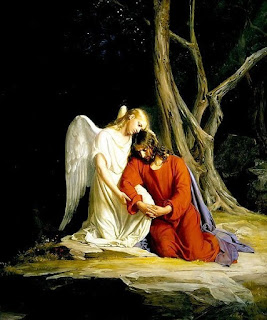

Angels appeared to people many times in the Old Testament. Including the Old Testament instances I mentioned previous paragraphs, there are many stories of angels appear to individuals. Three angels came to Abraham and proclaimed that the same time the following year, his wife, Sarah, will have a son in her old age (Genesis 18:1-15). An angel appeared to Hagar, the maidservant, when she ran away from Sarah’s mistreatment (Genesis 16:7-8). Angels appeared to Lot at the Sodom city gate (Genesis 19:1) and hurried Lot and his family out of the city before its destruction (Genesis 19:15). Jacob has a dream of stairway of heaven which angels were ascending and descending on it (Genesis 28:12). An angel appeared to Moses in the flames of the burning bush (Exodus 3:2). An angel came to Joshua to give him God’s instruction to attack the city of Jericho (Joshua 5:13-15). An angel appeared to all Israelites to remind them of God’s deliverance and his covenant (Judges 2:1-4). Gideon was given a special message from God by an angel (Judges 6:11-13). An angel appeared to the wife of Manoah to proclaim the coming of their son, Samson, after years of childlessness (Judges 13:2-5). Angels were active in the New Testament as well. Luke 1:26-38 states that the angel, Gabriel, appeared to Mary to deliver the message that she will give birth to a son. In Acts 5:19-20, an angel appeared during the night and opened the jail, freeing the apostles to continue to spread Jesus’ message. An angel appeared to a Roman centurion named Cornelius and told him to seek out Peter (Acts 10:3-8). The apostle John writes that the vision documented in Revelation was given to him by God through the angels he sent (Revelation 1:1).


Evil angels or demons are spirits whose purpose is to oppose God and try to defeat his will and frustrate his plans. Romans 8:38-39 states that nothing, not even demons, can separate believers from the love of God. The book of Job is a perfect example of demons hindering man physical and eternal welfare by a limited control over natural phenomena. In Job 1:12 states that the Lord allowed Satan to take everything from Job, but he was not allowed to physical touch him. His cattle was carried off by attackers (Job 1:13). Then the house where his children were feasting was destroyed by a mighty wind, killing everyone (Job 1:18-19). Demons often will inflict disease on believers. In Luke 13:11, 16 tells the story of Jesus healing a woman who had been “inflicted with a spirit for eighteen years (verse 11) and Jesus states it was Satan who bound her (verse 16). Demons will often be sent to tempt man to sin. In Matthew 4:3-10, Satan attempts to tempt Jesus to use his power to make bread from rocks. Whatever power demons have is limited by the permissive will of God.


In conclusion, angels are mentioned over 300 times in the Bible. Both good and bad angels, they serve a purpose in the will of God. You may be asking “well that’s great but does angels have to do with me?” Do you think God would stop using angels as his messengers? I don’t think so. Hebrews 13:2 says “do not forget to entertain strangers; for by so doing some people have entertained angels without knowing it.” As I discussed above, many from the Bible entertained angels without realizing it until it was revealed to them. Entertaining or being hospitable is simply helping others feel comfortable and at home. With people coming in and out of our lives, never to be seen again, you never know if one of them was really an angel.  A customer, someone you pass on the street may be an angel passing through with a message, a reminder.

References
Zondervan New International Bible Dictionary

Strong’s Exhaustive Concordance of the Bible

Sunday, August 14, 2016

People to be Loved: where some Christians are getting it wrong

People to be loved by Preston Sprinkle is a pastor’s search to the truth about homosexuality in the Bible. He investigates the verses which are commonly used to condemn homosexuality as well as the cultural and historical settings the verses were written in. Mr. Sprinkle goes through each verse in the Bible which mentions homosexuality and breaks it down through the original language, the cultural settings in which it was written and makes a decision if the verse condemns homosexuality or not. Through the Old Testament verse and the New Testament verses, he makes the decision that homosexuality is a sin. However, it is a sin just as lying, murder, and many other acts are. Mr. Sprinkle is very clear that just because homosexuality is a sin does not mean that Christians can condemn the LGBT community as abominations. While he spends a great deal of time discussing homosexuality in terms of the verse, he also takes more time to discuss why the LGBT community are still people who deserve to be shown Christ’s love.


As a Christian, I believe that homosexuality is a sin; however, I have never treated members of the LGBT community with condemnation and fear. I know many people who are homosexual and I have treated them with nothing but kindness and respect. While reading People to be Loved, I felt Mr. Sprinkle was trying hard to find verses which approved of homosexuality. However, as I read I realized that he was not. He was asking the Christian community to love and respect homosexuals. As he writes “Love doesn’t mean affirming one’s behavior” and “Love means accepting one’s humanity without affirming everything they do.” Affirming means to agree. I can love my friends and family without agreeing with their life choices whatever that may be. I believe this is Mr. Sprinkle’s purpose for this book. Love each other, recognize each other’s humanity and leave everything else to Christ. I recommend People to be Loved for anyone who may question what the Bible really says about homosexuality.

People to be Loved

Is available at major booksellers

Saturday, May 14, 2016

Jesus (Yeshua) is a worm...and a snake too among other things: an interesting and thought provoking book

Jesus (Yeshua) is a worm…and a snake too among other things by Kendall T. Shoulders is an interesting in-depth study of the imagery throughout the Bible as it points to Jesus as the Messiah. The book is actually two books in one. Book 1 focuses on the imagery of the worm and a snake to indicate the coming of the Messiah in Jesus. Book 2 continues that theme as similarities between figures of the Old Testament to Jesus and the prophecy of Revelation.


Book 1 is the Jesus as the tola worm as it is used throughout the Old Testament. The tola worm is an important worm to the ancient world. It was a source of dye for cloth. It was environmental cleaning. Parallels between the tola worm’s appearance in the Old Testament and the events of Jesus’ life is amazing. The imagery that is drawn between the parallels are mind-blowing. The author also draws conclusions about the use of the materials and decorations in the Tabernacle to Christ. The use of gold, silver, bronze and the colors used in the priestly garments all have a purpose pointing to the coming of Christ. The tola worm’s presence in the story of Jonah teaches that “a self-righteous attitude compels us to compare ourselves to other people” and how easy it is to accept God’s grace on our behalf but how difficult it is to accept God’s grace and even extend grace to others.


The author also draws a parallel with a snake and Jesus in Book 1. While many believers would see the snake as a symbol of Satan, an interesting point was made in the story of Exodus. When Moses makes his request to Pharaoh to let the Israelites go, Aaron’s staff becomes a snake. The Pharaoh’s wise men and sorcerers perform the same feat (Exodus 7:8-13). However, Aaron’s snake swallowed the other snakes. This is an image of Jesus “swallowing our sins, including every possible vile, evil thing that Satan could imagine.” The author also takes the story of the Israelites in the desert and they were told to look at a bronze snake in order to be healed from a sickness brought on by the people’s constant complaining (Numbers 21:4-9). Those who looked at the bronze snake high on a pole were healed, those did not died. This story seems to be a foreshadowing of Jesus on the cross. Those who look to him are healed and saved from their sins and those who don’t…


Book 2 is a bonus section which continues the theme of how Jesus is the fulfillment of all things concerning the Law (Genesis through Deuteronomy), the Psalms and the prophets. From Adam to Isaiah, images and prophecies foreshadow an event of Jesus’s life. It’s a great way to see how every book of the Old Testament points to the Messiah in Jesus. The author compares interesting similarities Genesis figures to Christ, Satan and the end times. While some are interesting and thought provoking, I found some to be a bit of a stretch. For instance, the author claims that Abel’s birth points to the virgin birth of Christ because the Bible states that “Adam lay with his wife Eve, and she became pregnant and gave birth to Cain” (Genesis 4:1); however, in verse 2 simply states “Later she gave birth to his brother Abel.” He claim is that Adam did not “lay with” Eve in order for her to conceive Abel, this is a foreshadowing of Christ’s miracle birth. Is he wrong? I don’t know but there isn’t any evidence to say it’s true.


Jesus (Yeshua) is a worm…and a snake too among other things is an interesting and thought provoking look into the Bible and how Jesus is seen in every story. When I first saw this book as it was available to review, the title caught me off guard. I requested to review it as I was anticipating being angered at the possibilities of what the title seems to suggest. However, once I started reading, I realized the title doesn’t fully give the picture of what an amazing book it is. While I disagreed with some of the author’s claims, he presents them with verses and cultural references for support. I highly recommend this book as a new and unique look into the amazing works of God as it is told in His Word.