Showing posts with label adults. Show all posts

Sunday, February 5, 2017

What does it mean to honor your parents?

What does it truly mean to “honor thy mother and thy father” as stated in Exodus 20:12? Honor is to regard in high respect or esteem. For a young child, obeying your parents is a part of honoring them. When a child listens to, heeds, and submits to his or her parents’ authority, it is honoring them. However, how do you honor your parents when you become an adult? There are some people who interpret this verse as a means that children can never disobey a parent. A child must always do what a parent says even as an adult. Many will fail to seek the out the meaning in the original language in which the command was given. I will discuss common misinterpretations of the commandment as well as the Hebrew word used in the commandment. I will also discuss how to honor parents who are less than honorable.


According to the Matthew Henry Commentary, to honor thy mother and thy father is to “esteem them, shown in our conduct; obedience to their lawful commands.” Essentially, the commentary is stating that children are to come when they are called, do what you are bidden, refrain from what they forbid you, and submit to their counsels and corrections. However, is there a situation in which a child does not need to honor their parents with obedience? Yes! If a parent ever asks a child to do something which contradicts God’s law, the child must obey God’s law first rather than his parents. Acts 5:29 states “But Peter and the apostles answered, “We must obey God rather than men.” In the case of a child disobeying a parent in reverence to God is Jonathan. His father, King Saul, was determined to kill David, God’s anointed king of Israel. And Jonathan knew this was wrong and prevented his father from succeeding (1 Samuel 20:30-34).


In order to examine what God means when He commands that we honor our parents, we must first look at the Hebrew word in the text. In Hebrew, the word, kabed, is used in commandment. It is defined as be heavy, weighty, grievous, hard, rich, glorious, burdensome suggesting a sense of “giving weight to.” The nuance here is important, according to Walter Brueggemann, professor at Columbia Theological Seminary, “the command does not advocate obeying or being subordinate but treating parents with appropriate seriousness” (ProYouth Pages). According to Rabbi Nachum Amsel, honor is a poor translation of the word, kabed. The translation should be dignity. Therefore, we are commanded to dignify our parents and help them keep their dignity. Dignity is defined as the state or quality of being worthy of honor or respect and a sense of pride in oneself; self-respect. To maintain a parent’s dignity is to respect them in a manner which doesn’t diminish their own sense of pride or self-respect.


We are even commanded to honor parents as adults as well even when parents act less than honorably. How do we do that? First, honoring your parents does not mean that you always obey or must tolerate abuse from them or maintain a close relationship with them. 2 Corinthians 6:14 states “Do not be yoked together with unbelievers. For what do righteousness and wickedness have in common? Or what fellowship can light have with darkness?” In essence, if a close relationship with your parents weighs you down, you do not need to do so in order to honor them. Second, you must show them simple respect as your respect. No name calling or mockery. For instances, if you were in a discussion with your parents and you disagree on the topic. Honoring your parents would be to say, “I disagree with that statement” and explain why. Not honoring your parents would be to say “Well, you’re an uninformed moron. You didn’t go to school so what can you possible say about that.” Third, you are to still love them. Matthew 5:44-47 states “But I tell you, love your enemies and pray for those who persecute you, that you may be children of your Father in heaven. He causes his sun to rise on the evil and the good, and sends rain on the righteous and the unrighteous. If you love those who love you, what reward will you get? Are not even the tax collectors doing that? And if you greet only your own people, what are you doing more than others? Do not even pagans do that?” Loving those who are unworthy of your love, even as your parents, carries a far greater reward than loving those who love you.


Therefore, honoring your parents does not mean that you are under their authority for your entire life. To honor your parents to help maintain their dignity with respect. To treat them as you would want to be treated. It doesn’t mean you have to do as they say. You can take their advice with a little more weight than others or not. Loving someone who is unworthy of such an emotion is hard. God commands us to do use because the hate doesn’t hurt the person, it hurts you. It eats at you and hardens your heart. Honoring your parents is about respect and dignity. Honoring is not calling your parents’ names or mocking them in anyway. Does that mean you can’t disagree? No; however, do so respectfully. Parents are given high regard in the Bible and we should regard them in life too. However, that regard does not mean you have to grovel at their feet. 


Resources:
Amsel, Rabbi Nachum (retrieved 2/2/2017): How to show respect for a parent: A Jewish View http://www.myjewishlearning.com/article/how-to-show-respect-for-a-parent-a-jewish-view/


ProYouth Pages (retrieved 2/2/2017): Taking the Fifth: Common Misuse of the Fifth Commandment http://www.proyouthpages.com/5thcommandment.html

Saturday, March 19, 2016

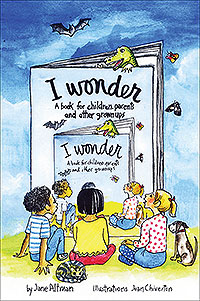
I Wonder: a book of poetry for the whole family

I wonder: A book for children, parents and other grownups by Jane Altman is book of poetry and a short story for children and adults.

Part 1 is for the children and it’s a series of poems which start with “I wonder…” and introduce a different animal. Bat, frog and alligator are among the many animals talked about in the poems. Each poem begins and ends with an “I wonder” statement. Then a short story about glowing stones. A boy and a girl leave their small village and pass a castle where they find a stone which glows in their favorite color. They pick up the stone and save it. Many years pass, the boy and girl grow up and have families of their own. After they have passed away, their families find a strange gray stone among their belongings and return it to the castle when the children see the glowing stones with the adults do not. Part 2 is for the parents and other grownups and is a series of poems along the same themes as part 1.

I wonder is a great book of poetry with simple rhymes that children will love. I enjoy poems and I love book which introduce poetry to children in a fun way. With beautiful illustrations, the poems and story come alive on the page. I recommend this book for any family and classroom library. It helps children enter the world of poetry in a fun and exciting way.

I wonder
is available on Amazon

in paperback for $10.95

Wednesday, December 9, 2015

There are limits to sharing and we need to teach our children those limits

Over the last few months, I read articles about why some parents aren’t teaching their child to share. At first, I thought what a stupid idea but the more I read, the more I can see their reasoning. I understand that there are limits to sharing and we need to teach our children those limits both as the giver and the receiver. If the toy is a “community toy” as in a day care setting, sharing it would be automatic because it doesn’t belong to the child to decide who plays with it and who doesn’t. What is the toy is the child’s personal property? Do you teach automatic sharing? During my research, I’ve come up with three limits to sharing: kindness not obligation, teaching boundaries, and curbing the entitlement culture.


First, sharing should be out of kindness not obligation. If my daughter wants to share her toys it will be out of the goodness of her heart rather than because I told her so. If we force children to share toys they aren’t done playing with or doesn’t want to share, we are teaching them obligation. “I need to share the toy because Mommy said so” and not because she wants to. When we allow a child to share out of kindness, the child learns generosity and seeing the joy of someone else enjoying the toy as well. One day, one of the neighborhood boys came to me and told me that Abby wasn't sharing whatever toy it was at the time. I know he was thinking she would get in trouble and he would have the toy next. When I told him that the toy belong to Abby and she decided who played with it and when. I've also done the opposite and told Abby that a toy which belongs to another child needs to be returned when he or she wants it back. 


Second, a child is not obligated to share just because another child says “please.” The child is being polite; however, no is a perfectly legitimate response. I think it does a child a great disservice to teach that he or she can have something simply because he or she wants it and said please. We need to teach children that because you want something doesn’t mean you’ll get it and help them cope with disappointment because it will happen. Life isn’t fair. Someone will get something you want before you can get it. As adults, we don’t automatically share our property because someone asks. If an adult says, “No, you can’t borrow (fill in the blank),” nothing is thought as the adult is being unfair but when a child says no, he or she is being mean. Why is it okay to say no as an adult but not as a child?


Third, we’ve become an entitlement culture. Life, the universe or God does not owe you anything. Parents, society or others do not owe you anything. A child needs to learn there are consequences for his or her actions. The “I want it now and I don’t want to work for it” attitude needs to stop. Now that my daughter is playing more with the neighborhood kids, I see the entitlement attitudes more and more especially “I want it because everyone else has it.” One day, my mom brought home a cupcake mix to make with my daughter. After they were done, of course, my daughter wanted one. I gave her one and soon I was bombarded with kids asking for cupcakes. When I told them no, for reasons of safety, not knowing food restrictions and parents’ allowances, they said “But she got one.” Why do they think because I gave my daughter something, it means that I will or have to give them one? I also didn’t want to set a precedence that they would expect to eat at my house when I know Abby doesn’t get the same consideration at theirs.


I know we are in the holiday season and the season of giving; however, I feel that sharing and giving should be out of the kindness of our hearts instead of an obligation. If it becomes an obligation, the true spirit of giving is lost. We need to teach our children that saying “please” is being polite but it isn’t the magical word to automatically get it. We need to live in a culture in which yes means yes and no means no without comments of being unfair or being mean. Establishing boundaries of giving when we want to protects is from being taken advantage of. If I were to ask a favor, I hope for a yes but I also expect a no. I will be disappointed with a no response but I understand that it is the other person’s right to deny my request. Why aren’t we teaching our children this principle?