Showing posts with label poetry. Show all posts

Sunday, September 20, 2020

A Strange Beginning: a story about the young life of Lord Byron

 A Strange Beginning by Gretta Curran Browne is book 1 of a seven-book series on the life of Lord Byron in which details the humble beginnings of one of England’s most famous poets. The story opens with a 10-year-old George Gordon who lives with his widowed mother and her maid. An avid reader and highly intelligent, young George thrived at school and was miserable at home. Until one day, his whole world would change. He would learn that everything he thought he knew about himself was a lie. He wasn’t a Gordon, he wasn’t poor. Soon a life of wealth and privilege would claim his life and would give him the opportunity to prove his worth on his terms. Covering Lord Byron from the age of 10 into his 20s, A Strange Beginning takes a deeper look into this iconic man.

A Strange Beginning is presented as a historical fiction, but it is more a fictionalized biography as the book’s description claims, “this is the true and meticulously researched story” and “ignoring all the old and unproven rumors and sensational scandals fabricated” at the time. I am familiar with Lord Byron’s poetry but was unaware of his personal life. I started it with interest as the opening pages were beautifully written but soon turned sour. Chapter after chapter, I lost interest. While I enjoyed reading about the events which would inspire his early poetry, the story was often dull and tedious. I don’t see myself continuing the series. However, if you are a fan of Lord Byron’s poetry, you might enjoy and find A Strange Beginning as well as the rest of the series, an interesting look into his life.


A Strange Beginning is available in hardcover, paperback, and eBook

Tuesday, September 19, 2017

Latinos in Literature: life, heroism and beauty

Today I will discuss three famous Latinos in literature. As an avid bookworm for most of my life, I have read a variety of books across genres, languages and cultures. When I decide to discuss a few important Latinos in literature, I didn’t realize what a task it would be. While there are so many great writers to choose from, it was hard for me to pick just three. However, I hope discuss the wide range of talent and cultural impact in these writers’ works. All three have been influenced by the world around them as well as influenced those who followed. All three are from different ancestral backgrounds but through their writing they attempt to bring the world closer together with stories of growing up, stories of heroism and beautiful poetry of love.


First, Sandra Cisneros was born December 20, 1954 in Chicago, Illinois. The only daughter in a family with six sons, she often left pushed aside and isolated. Ms. Cisneros is best known for her debut novel The House on Mango Street (1984) which is taught in classrooms across America. It is a coming of age story of Esperanza Cordero, a young Latina girl growing up in Chicago with Chicanos and Puerto Ricans. The major themes include the quest to lead a better life and the promise to help those who remain behind. The biculturalism and bilingualism is very important in Ms. Cisneros’ writing. She will use Spanish in place of English when the flow of the passage is improved by the beauty of the language. For example, instead of saying “my girl,” she will use “mihija” which is a Spanish endearment literally meaning my girl. However, there is a poetry with the use of mihija. I didn’t read The House on Mango Street in the context of a classroom but after the recommendation of a friend. The themes are common of any coming of age story: the beloved childhood adventures, the heartbreak as one realizes that life is dirty, unfair and requires hard work from you. In many ways, the book reminds me of A Tree Grows in Brooklyn (1943) as the main character grows from a child’s point of view of the world into the jaded adult view of someone who grows up too soon.


Second, Julia Alvarez is a Dominican-American poet, novelist and essayist. Born March 27, 1950 in New York, she spent the first ten years of her life in Dominican Republic until her father’s involvement in a political rebellion forced the family to flee. One of my favorite of Ms. Alvarez’s books is In the Time of Butterflies (1994), a historical novel about the Mirabal sisters: Minerva, Dede, Maria Teresa and Patria during the dictatorship of Rafael Trujillo. The sisters were active in the underground revolution against Trujillo. Three of the sisters were murdered on November 25, 1960 while on Puerto Plata Road. Their code name, Las Mariposas “The Butterflies” and their story has remained with me years after reading the book. Ms. Alvarez once said “A novel is not, after all, a historical novel, but a way to travel through the human heart.” In her books, the reader is able to see, feel and experience another side of life through the eyes of her characters. There is a beauty and brutal honesty in her writing. The scenes in which the sisters suffered in prison and later the scene of their death are hard to read; however, gives the reality of what the sisters and their fellow revolutionaries suffered to fight Trujillo. These are the scenes which I remember the most. As with most courageous stories, the Mirabal sisters have not been lost to time thanks, in part, to Ms. Alvarez’s book. When a writer has such an important impact to help keep such stories alive is noteworthy.


Third, Pablo Neruda is the pen name, and later legal name, of Chilean poet-diplomat and politician Ricardo Eliecer Neftail Reyes Basoalto. Born July 12, 1904, he has been called the greatest poet of the 20th century in any language. He began composing poems at the age of 10 and was published by 13. It has been thought that he published under a pseudonym to avoid his father’s disapproval of his poems and interests in writing and literature. Neruda would serve in various diplomatic posts including Buenos Aires, Barcelona, and Mexico City. He was an ardent communist for most of his life and an admirer of Stalin and Lenin. He died September 23, 1973 at the age of 69. However, it is his poetry which has gain him notoriety. Pablo Neruda has influenced many in music and movies. Jackson Browne featured a Neruda poem on the back of his album, The Pretender (1976). One of his famous poems, LA Muerta (The Dead Woman) was featured in the film, Truly, Madly, Deeply (1990) starring Alan Rickman and Juliet Stevenson. The poem is about grief and living after a loved one has passed. My favorite quote from this poem is “I shall walk with frost and fire and death and snow, my feet will want to walk to where you are sleeping, but I shall stay alive, because above all things, you wanted me indomitable.” An image of a constant grief and missing the person once they’re gone; but a moving forward because the beloved wouldn’t want him to be defeated by her death.


In conclusion, these are just three examples of amazing writers who are a great asset to their culture as well to the world of literature. They are just writers for the Latino community but for the world as a whole. Their writings speak to the universal truths of life that we all must face and the lessons we all must learn. I highly recommend reading the books and poetry I have discussed here as well as branching out to other writers. I think we can learn about a culture, a people and ourselves within those pages. Within the adventures of a book, we can discover that we aren’t that different after all. 

Monday, January 30, 2017

Psalms: the book for all occasions

Psalms is a collection of poems, songs and prayers which express praise, worship and confessions to God. The book contains 150 psalms which express the heart and soul of humanity. The shortest psalm is only two verses (Psalm 117) and the longest psalm is 150 verses (Psalm 119)! The psalmists experience the depths of despair and the heights of joy and God brings them out of their struggles. David was the most prolific psalmist who wrote 73 psalms. The psalms are said to be written between the time of Moses (around 1440 BC) and the Babylonian captivity (586 BC). With so many psalms, it was hard to choose just a few to discuss; however, I’ve chosen psalms which have great meaning to people I know as well as ones which stood out to me as I read.


First, Psalm 40 is my husband’s favorite psalm. His favorite band, U2, used Psalm 40 as inspiration for their song, “40.” It was written by David and speaks to waiting patiently while doing God’s will. While we wait, we can love God, serve others and tell others about him. Verse 1 opens this theme directly, “I waited patiently for the Lord; he turned to me and heard my cry.” Waiting patiently for the Lord is not easy but David received four blessings for he patience: God had 1) lifted him out of this despair, 2) set his feet on a rock, 3) gave him a firm place to stand (verse 2) and 4) gave him a new song of praise (verse 3). Blessings are often not received until a trial of waiting. For instance, my husband and I recently bought a car. We waited for years for our own car. From balancing sharing a car with my mom and then getting a gift of a car riddled with problems, we patiently waited for the day when we could get our own car. Then this year, God rewarded our patience with a great deal and a car we love to drive.


Second, Psalm 73 was written by Asaph, a leader of one of the temple choirs. This psalm speaks about living holy lives and trusting God for our future. The psalm opens discussing how the wicked seem to prosper: “always carefree, they increase in wealth” (verse 12) but the righteous have lasting rewards. After the riches of this earth will fade away, the righteous has something which cannot disappear: God. Verse 27-28 states “Those who are far from you will perish; you destroy all who are unfaithful to you. But as for me, it is good to be near God. I have made the Sovereign Lord my refuge; I will tell of all your deeds.” One verse stood out to me and speaks to those who feel as if they have failed and cannot return to God. Verse 26 says “My flesh and my heart may fail, but God is the strength of my heart and my portion forever.” As you and I live our life, despite our best efforts to live a Christ-like life, we will fail. We will have moments of weakness. However, as long as we cling to God in those moments, we will have renewed strength.  


Third, Psalm 103 is a psalm of David which speaks of God’s great love for us and what God does for us tells us what he is really like. Verses 8-10 tells us who God is. He is compassionate and gracious, slow to anger, abounding in love (verse 8). He will not accuse, harbor his anger forever or treat us as our sins deserve (verse 9-10). My favorite verses is 11-12, “For as high as the heavens are above the earth, so great is his live for those who fear him; as far as the east is from the west, so far has he removed our transgressions from us.” These two verses are great joy for believers. Since the east and west can never meet, it is symbolic of God’s forgiveness. When He forgives our sins, He separates it from us and doesn’t remember it. People will remember their sin and dwell on it. However, when we place our trust in Christ and seek forgiveness, God forgives and forgets. Our record has been wiped clean and we can live with a new slate. Although this doesn’t mean we won’t sin again because we will; but when we truly seek forgiveness from God, he will remove our sin.


Lastly, Psalm 112 is a psalm about the advantages of having faith in God. God guards the minds and actions of those who follow his commands. Verse 1 states, “Blessed is the man who fears the Lord, who finds great delight in his commands.” To fear the Lord is to have great reverence and respect for God and His Word. The Hebrew word for fear, yirah, have a wide range of meanings in Scripture. It can mean a fear of impending danger. However, it also means the idea of wonder, amazement, astonishment, gratitude, admiration, and worship of God. Therefore, the fear of the Lord is an overwhelming sense of the glory, worth and beauty of the One True God (Parsons). If we have fear and trust in the Lord, we “will have no fear of bad news” and our hearts will be “steadfast, trusting in the Lord” (verse 7). This verse is one of the reasons why that I do not fear the future. Despite the discord in our country and the world, I trust that God is in control and all will work for His good. Many people will be dragged into the debates, the arguments and great anger will ensue, but I refuse to do so. I have faith in the Lord and no man can change that. 


The book of Psalms is a great source of encouragement when feeling afraid or a host of other emotions. It is also a source to go to when facing struggles and difficult times. For the psalms which I have featured, these psalms teach us that if we wait patiently for the Lord, we will be blessed. Trusting in God will give us riches that will never fade. God will help us in our moments of weakness. God has great love for us and He is a forgiving Lord. Lastly, fear of the Lord helps us be unafraid in the world around us. Although it sounds too good to be true and sometimes we will fail. Sometimes, we will get inpatient, we will falter in our trust, and the fear in the world around us will overpower us, God is a forgiving God and he will welcome you back. All you have to do is turn to Him.

References:

Parsons, John J. (retrieved 1/29/2017) The Awe of the Lord http://www.hebrew4christians.com/Scripture/Parashah/Summaries/Eikev/Yirah/yirah.html

Sunday, October 2, 2016

Three great books to add to your library

Today I have two three new children’s books to review. First, A Dog Named Cat by Anne Tolle and illustrated by Ricka Kinra is a story about a dog who is chosen by his family for the boy, Tad. He is given the name Cat, after Tad’s baby sibling called him a cat. The family, thinking it was funny, called the dog Cat. He soon loves his life with his new family but he will met various animals which will lead him to question why he is called Cat when he is clearly not a cat. He is determined to change his name but how to tell his family? Until one day when he does something which causes Tad to change it for him. Ms. Toole writes a wonderful story in prose which children will love the story and the rhymes makes it fun to listen to. This story is a great way to introduce children to poetry in a fun and relatable way. I highly recommend A Dog named Cat for any school or family library. 

Second, If you were me and lived in…Poland by Carole P. Roman, illustrated by Kelsea Wierenga, introduces readers to the Central European country. From the first official kingdom in 1025, we learn that Poland was the first European country to have a constitution which was written on May 3, 1791 and only second in the world after the United States. The book discusses the capital of Warsaw and everyday life in Poland. From the grocery store items to traditional foods to famous tourist attractions, readers get a sense of what life can be like in Poland. This book is another great addition to this amazing series. As usual, the book also introduces famous Polish individuals and gives a vocabulary list at the end. I highly recommend If you were me and lived in…Poland as well as the many other titles in this series.


Third, If you were me and lived in…Viking Europe by Carole P. Roman, illustrated by Mateya Arkova, takes the reader on a historical trip to 870 AD, Northern Europe and the world of the Vikings. The book introduces some of the common knowledge and misconceptions about the Vikings. Vikings were known to travel and plunder but they were experiences explorers, settlers and traders. The book introduces life in this world as the different classes from the elite to the slaves. From their diet to their homes and everyday life and the special occasion and festivals, this book introduces a world of ages past. I highly recommend If you were me and lived in…Viking Europe.


A Dog named Cat by Anne Toole,
If you were me and lived in…Poland
and
If you were me and lived in…Viking Europe
 by Carole P. Roman

are all available through Amazon and Barnes and Noble

Sunday, May 22, 2016

The Frog that lost his croak: a lesson in being a part of the world around you

The Frog that lost His Croak by Anne Toole is a lesson in the difference of a part of the world and trying to be the world. “A little frog that loved his croak night and day/Was very sad when his croak suddenly went away./While waiting and hope for his croak to return/What valuable lessons did the little frog learn?”


A frog loved his croak. He thought it was the best croak around and he boasted about it. The other frogs were mad. Until one day, his croak was gone. He talks to his parents who tell him to rest and his croak would be back. The other frogs now made fun of him for losing his croak. As he waits for his croak to return, he finally is able to hear the other sounds around the pond: the birds, the insects. He realized that it’s not all about his. There are a lot of beautiful songs in the world and his croak is simply one of them. The book is told in prose and I love poetry. It’s a great lesson about being a part of the beautiful world instead of trying to be its center. Written for children between the ages of 4-7, the story presents such an important way that captures their imagination. I highly recommend this book for family and school libraries. 

The Frog that lost his croak
is available on Amazon
in hardback for $18.95
and
in paperback for $15.95

Saturday, March 19, 2016

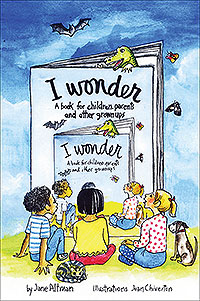
I Wonder: a book of poetry for the whole family

I wonder: A book for children, parents and other grownups by Jane Altman is book of poetry and a short story for children and adults.

Part 1 is for the children and it’s a series of poems which start with “I wonder…” and introduce a different animal. Bat, frog and alligator are among the many animals talked about in the poems. Each poem begins and ends with an “I wonder” statement. Then a short story about glowing stones. A boy and a girl leave their small village and pass a castle where they find a stone which glows in their favorite color. They pick up the stone and save it. Many years pass, the boy and girl grow up and have families of their own. After they have passed away, their families find a strange gray stone among their belongings and return it to the castle when the children see the glowing stones with the adults do not. Part 2 is for the parents and other grownups and is a series of poems along the same themes as part 1.

I wonder is a great book of poetry with simple rhymes that children will love. I enjoy poems and I love book which introduce poetry to children in a fun way. With beautiful illustrations, the poems and story come alive on the page. I recommend this book for any family and classroom library. It helps children enter the world of poetry in a fun and exciting way.

I wonder
is available on Amazon

in paperback for $10.95

Monday, March 2, 2015

Leonard Nimoy: beyond Mr. Spock

Leonard Simon Nimoy was born March 26, 1931 in Boston, Massachusetts and he sadly died at the age of 83 on February 27, 2015 at his home in Hollywood, California from complications from chronic obstructive pulmonary disease (COPD). The son of Yiddish-speaking immigrants from Iziaslav, Russia (now Ukraine), he gained famed as the Enterprise’s Science Officer, Mr Spock on Star Trek (1966-1969) as well as eight feature films. I knew Mr. Nimoy as the accomplished actor that he was. However, I didn’t know he was also a poet and photography. Today, I am going to feature three of this poems that I love and some of his photography from the Shekhina Project.


Chambers Street
I got the stick. Who’s got the ball
The tar is hot and sticky.
Buck, buck against the wall
Go yell for Joe and Dicky
Hey kids, get away from the car.
Mary’s white comin’ out the door
Communion at St. Joe’s
Pick the dice up off the floor
Tell ‘em chinky shows
Here comes a pair of penguins
They’ll rap your knuckles hard
You wanna try and duke it out
Let’s go down by the yard
Charlie’s river’s dirty now
Can’t swim there. Out of luck.
First is the pole, the car is third
Get chips from the iceman’s truck
Hey kids, get away from the car!
Run and hide from the crazy guy
Dressed in robe of black
Tied with rope, shouting loud
What’s sitting in his sack ?
We never finished summer then
It sort of slipped away.
The worry on the young one’s mind
Was what are we gonna play?
Hey kids. Get away from the car !!

Chambers Street invokes images of children playing the neighborhood. Playing stick ball, a street version of baseball with the designation of landmarks as certain bases. Nuns, priests/rabbis walking by. Boys setting up boxing matches away from the adults. All the kids clambering and running after the ice cream truck. Adults yelling at the children for doing something they weren’t supposed to. A summer of great childhood memories. Even though the poem is an image of Nimoy’s children in the 1930/40s, it brings up a childhood memory for me. I remember playing baseball in the park by our house. We had a stick from a broken broom handle and a tennis ball. Three trees formed a perfect 1st, 2nd and 3rd bases that we had our own baseball diamond. Who’s childhood wasn’t filled with friends, ice cream trucks, sports and running away from adults who caught us doing something wrong?


A silence with you
A silence with you
Is not
a silence

But a moment rich 
with peace

A silence with you is a simple poem with a powerful image. When I read this poem I image peaceful contentment as I hold my husband and daughter and realize that I could be in this moment forever. As a mother of a very active three year old, I treasure the moments of silence. When my daughter simply sits with me to watch her favorite cartoons or riding in the car and enjoying the planes landing as we drive by the airport or the train as it zooms in front of us. I also image with this poem that moment when a big fight is over and silence fills the air. Both parties fill better than they have cleared whatever has been bothering them and they have talked it out. The peaceful moment of silence when the stress is released and you can relax. Silence isn’t always just no noise, it can be filled with a million different emotions.


Because
Because
I have known despair
I value hope

Because
I have tasted frustration
I value fulfillment

Because
I have been lonely
I value love

Because is by far my favorite poem and of all Mr. Nimoy’s poems I’ve read so far, this one spoke to me the most. I have known despair, doubt, and loss, I have hope for the future. I have been frustrated and stressed that fulfillment is very satisfying and I enjoy that moment of success. I have been alone and lonely, I treasure the love I now experience every day from my husband and my daughter. I love this poem because it reminds us that the bad experiences often make the good ones more enjoyable and treasured. Even though we don’t want the bad times, they help us enjoy the good times even more. The negative and positive events are the yin and yang of life. Without despair, we can’t know hope. Without frustration, we can’t know fulfillment and without loneliness, we can’t know love.


Since I am not a big Star Trek fan, I only knew of Leonard Nimoy as Mr. Spock. I never realized how accomplished he was in many other areas. He studied photography at UCLA in the 1970s. He earned a M.A. in Education from Antioch College and his received an honorary doctorate from Antioch University. He was also an accomplished director. He directed Star Trek III: The Search for Spock (1984), Star Trek IV: The Voyage Home (1986) and Three Men and a Baby (1987). He has published several volumes of poetry since the 1970s as well as two autobiographies. His final tweet, a few days before his death, read: “A life is like a garden. Perfect moments can be had, but not preserved, except in memory. LLAP” Beautiful words from an amazing man with a beautiful soul.


Tuesday, August 12, 2014

Friendship poems

Lately, I’ve been thinking about friendships. Why some friends remain in your life through thick and thin and why others drift away. Instead of writing an essay about it, I wrote these poems. 


Seasons of friends
Every friend has its season
This I know
Spring, new, fun and sweeten
Summer, we talk, laugh and grow
Some circle back after winter’s cold
Some are gone forever in days of old


Strangers with memories
You used to be my friend
What times we had
But just around the bend
Distance grew, all things turned bad
No friends with victories
We are now strangers with memories


Friends turned family
We met so long ago
Though distance was far and wide
We never let go
After the crashing waves of life’s tide
You are my family

Sister of my heart happily


Saturday, June 21, 2014

Give your song a Voice: a beautiful book with a great message

Give Your Song a Voice by Kristin E. Schmidt and illustrated by Debra Rae Hare is a book about a young girl’s dream to give the music in her dream a voice. The story is told as a simple poem. The rhythms are simple and yet flow beautifully like listening to the lyrics of a song. A young girl has a dream and in her dream, she sees music as she wakes up, she realizes that she can’t let the beautiful music disappear. She then goes on a journey to find friends to play this beautiful music.


On her journey, she meets up with a trombone playing hippo, a drums banging chimpanzee, a gator playing the flute, an emu plucking the strings of a cello, a zebra playing the clarinet and a bull blowing the sax. Together, they form a band and put on a concert for the girl’s family and friends. After the concert, she realizes that everyone has something special in them. The little girl gathers her friends and gives them the message of the story: “A song has a no voice until you chose to share it.”


This book was sent to my daughter by my aunt who is friends with the author. I was excited to read it and my daughter loved listening to it. After reading it, I had to post a review about it. I loved this book. I love that it is in prose. I love poetry. The imagery is beautiful and the illustrations really bring the characters to life. I would recommend this book to all children. It has a great message and fun characters.


Give Your Song a Voice is available on Amazon.com for $12.99