Showing posts with label children. Show all posts

Friday, January 28, 2022

Black Cake: a moving story of betrayals, secrets and memories

Black Cake by Charmaine Wilkerson is the story of two estranged siblings who must set aside their differences to deal with their mother’s sudden death. Bryon and Benny Bennett will soon learn that there was more to their mother than they ever knew. After their mother’s death, they learn she left them a voice message, sharing her past, a past she kept hidden from everyone. Her request is that after they hear her message, they sit down when the time is right and share the last black cake she has ever made, made from a family recipe steeped in tradition. Eleanor’s story begins with a headstrong young swimmer in the Caribbean who escapes under a cloud of suspicion. Together, brother and sister learn their mother’s heartbreaking tale filled with the secrets she has held, and would challenge everything they thought they knew about their mother and even themselves. Will Eleanor’s story bring them together once again? Or would the revelations prove to be too much and separate them permanently? 

This moving story of a family inheritance is so beautifully written that it's hard to fathom that it is a debut novel. Ms. Wilkerson writes a story so intricate and powerful that the reader is taken on a journey of how one family is forever changed by the choices of the generation before. It is a story of betrayals, secrets, and memories. Black Cake reminds the readers that while we cannot choose what we inherit, we can choose who we become. There are many characters with many shifts in timelines and points of view that can get confusing if one is not reading close. I enjoyed the family saga aspect of the story with the emphasis on food and the memories it can invoke. However, there were too many topics covered in terms of cultural, social and political issues that it, at times, bogged down the story. The use of foreshadowing and the element of surprise was overused that a pattern emerged that when a twist was revealed, it wasn’t much of a surprise. Some I figured out almost as soon as another person was introduced in the story. Overall, I thoroughly enjoyed Black Cake and would highly recommend it. 


Black Cake is available on February 1 in hardcover, eBook and audiobook


Monday, January 10, 2022

The Winter Rose: a story of survival, forgiveness and reconciliation

The Winter Rose by Melanie Dobson is a story of survival and forgiveness. Grace Tonquin is an American Quaker who works tirelessly in Vichy France to rescue Jewish children from the Nazis. After crossing the treacherous Pyrenees, the children are sent to awaiting families except two. Elias and Marguerite Dupont lost their parents and no clear evidence of family waiting for them, Grace returns home to her family’s Oregon farm to care for them. Even though they are loved and cared for, the horrific experiences they had to endure would come back to haunt them, threatening to tear their family apart. Fifty years later, Addie Hoult arrives at Tonquin Lake looking for the family. It is a matter of life and death for her beloved mentor and father figure, Charlie, who is battling a genetic disease. Though Charlies refuses to discuss his relationship or ties to the Tonquin family, Addie knows that finding them is the only way to save his life. Could it also heal the wounds of the past? 

The Winter Rose is a beautiful story about a piece of history I didn’t know about and I’m sure many have not heard. It is a story to honor the effects of the American Friends Service Committee (AFSC), a Quaker organization which in part of their wartime efforts, helped rescue thousands of Jewish children during World War II. Grace, as a member of this organization, risks life and limb for the chance that these children can have a chance at life. Ms. Dobson writes a detailed story with many mysteries, twists and turns.. It is a story about the bonds of family with faith and forgiveness. As more and more authors are bringing to light stories like the AFSC, we learn that many organizations, groups and people worked tirelessly and with no qualms about their own safety to help those who were under attack. I enjoyed Grace’s faith and even in her moments of fear, doubts and trouble, she turned to God for guidance and strength. I recommend The Winter Rose


The Winter Rose will be available in paperback, eBook, and audiobook on January 11th. 


Thursday, October 8, 2020

October is National Family Sexuality Education Month

October is National Family Sexuality Education Month. Created by Dr Sol Gordon in 1975 at the Institute of Family Research and Education. The purpose is to promote family education and communication about sex and sexuality. Many parents avoid talking openly about sex with their children for various reasons including embarrassment and being unsure how and when to begin. The absence of open conversations with their parents leaves children vulnerable to misinformation and unrealistic messages portrayed in music, movies, television, and advertising. What is the important of family sex education? What are some tips to get started? What tools are available to parents?

Education begins in the home with parents. Conversation are important as children and teens are more likely to base their sexual decisions on their parents than their friends (Berger, Shafer, & Williams, 2019). It is important to start early too. With preschoolers, it is important to teach consent and empower children to say no and talk with an adult when they don’t like the physical contact or situations with other children or adults. Growing Up Knowing, an organization based in Jackson, Mississippi, hosts sex education sessions for preschoolers, elementary schoolers and middle schoolers with their parents and caregivers. By learning together about sexual health, parents and children can have further discussions about tougher topics such as preventing sexual assault, the consequences of risky behaviors and how to protect one self. Being able to discuss the awkward and embarrassing topics with your children, keeps the lines of communication open for other tough topics. “If open communication is normal, kids are more likely to speak with parents about all the other trials of adolescence, such as anxiety, depression, relationships, and the use of drugs and alcohol, as well as sexual issues” (Staff, 2019).


The number one tip for parents is to prepare yourself. Before your child can ask the questions, read the books, get the information and be ready to answer the questions for any age. Getting the information for yourself first, you can avoid using scary language in which would frighten children from asking questions in the future. Second, keep your answers age appropriate. A preschooler who asks where babies come from doesn’t need the full scientific details. Give just enough information to satisfy their curiosity for the time being. You can be more accurate as they get older. Also avoid using slang for body parts, it just makes it harder to use the correct terms later. Using the correct terms early helps build self-esteem and strengthens communication between parents and their children. Third, keep the message positive. teach children to appreciate their own bodies and to respect the personal space of others. Lastly and most importantly, reassure your child that no question is forbidden. Keep the communication open so when they hare older, your child is comfortable coming to you with the harder questions and difficult discussions.

I recommend God’s Design for Sex series by Stan Jones and Brenna Jones. It is a series of four books, each book covers the basic information needed for a certain age group. Book 1 The Story of Me (ages 3-5), Book 2. Before I was Born (ages 5-8), Book 3, What’s the Big Deal? Why God Cares about Sex (ages 8-11), and Book 4, Facing the Facts: The Truth about Sex and You (ages 11-14). The age recommendations are suggestions, parents should gage their own child’s readiness. Each book is told from a Christian perspective and gives the necessary information without overwhelming parents or children with topics that are necessary for each age group. I used these books as a conversation starter. I didn’t read word or word but used it as a guide and allowed my 8-year-old daughter to ask the questions she wanted to know and let other topics she didn’t want to know yet for a later date. Despite faith based, it doesn’t shy away from controversial topics and doesn’t speak badly about them, it just states the facts.

In conclusion, October was designated at the National Family Sexuality Education Month to promote conversations between parents and their children. Sex education starts at home. It can start with the basics and grows into more important and difficult topics as children get older. It is important to educate yourself on what information to give at a certain age, how and when to present the information. There are countless of books and other tools for parents to read for themselves as well as to use as part of their conversation. It is not an easy conversation but an important one. And it gets easier with each conversation. You’ll be ready for the difficult questions and topics.


References

Berger, Bethany, Shafer, Leah and Williams, Ronesha (May 6, 2019). Sex Ed for the Whole Family. Harvard Graduate School of Education. www.gse.harvard.edu/news/uk/19/05/sex-ed-whole-family. Retrieved October 3, 2020.

Staff (June 6, 2019). Sex education for children: Why parents should talk to their kids about sex. About Kids Health. www.aboutkidshealth.ca/Article?contentid=718&language=English#:~:text=Instilling%20your%20family%20values,of%20the%20discussions%20about%20sexuality. Retrieved October 3, 2020.


Resources

Amaze www.amaze.org. Be an Askable Parent

Growing Up Knowing www.growingupknowing.org

Wednesday, August 21, 2019

Twenty-One Truths About Love: one man's life in list form


Twenty-One Truths About Love by Matthew Dicks is the story of Daniel Mayrock, told through his lists as he struggles with his failing bookstore, his inability to tell his wife, Jill, about their financial future and her desire to have children. He is a man at a crossroad in his life. He knows that he loves his wife. He regrets opening the bookstore and quitting his job to do so. He takes great risks to save his marriage, to do almost anything for love, but he is a man who wants to do something out of the ordinary, to be special and to deserve happiness. Will he be able to do all he dreams? Will he come clean to his wife about their finances? Will they be able to have a family?


Twenty-One Truths About Love is told in an interesting style. A style I had not heard about, so I was intrigued and decided to give it a chance. While it was hard to read, it was like getting deeper into the mind of the narrator in ways I haven’t seen before. I applaud Mr. Dicks for taking a chance on such a unique idea. However, I discovered I did not like Daniel. I had no sympathy for him whatsoever and some of his comments in his lists were annoying. That was the beginning, as I read and as I saw his struggles once Jane does get pregnant and he sees his worst nightmare coming true, he realizes that success and happiness comes in different forms. There were times I wanted to scream at the book, “TELL HER!” but I also see why he fears telling her. In the end, it is a book about a man struggling to make a life for himself and his family and struggles on how to do it. If you are interested in new forms of storytelling, I recommend Twenty-One Truths About Love. If you aren’t, its best you leave this one alone. 

Twenty-One Truths About Love
will be available on November 19, 2019
in hardcover, eBook and audiobook

Saturday, April 22, 2017

Children are not an accessory

Hello everyone!

This is a letter to parents and non-parents. It is a letter of my thoughts and concerns about a recent trend I see in articles where people are complaining about parenthood. As a woman who struggles with pregnancy issues, I am deeply hurt by this and here’s why.


First, I would like to speak directly to parents. Over the last couple weeks, I’ve read a few articles in which mothers, specifically, are stating that they do not like their child because the child isn’t living up to the expectations she had for him or her. One particular article was about a mother who didn’t connect with her child because something was wrong and she didn’t know what. However, this mentality, to me, is simply wrong. A child is a unique human being. Unique in every way. He or she is not your mini-me, although some children mimic one or both parents. A child is not your carbon copy. He or she is half of you. He or she isn’t always going to like what you like or want to do what you want to do. I do not know what it is like to raise a child with special needs or challenges. And I applaud the parents who take the challenge and love the child as they are. I have never heard a parent of a child with special needs claim they could not love their child because of these challenges.

My daughter is 5 years old and is growing in her independence and I enjoy watching her make her own decision and, despite the craziness in my eyes, she goes with her choices. She’s sassy and sometimes talks back. She can be frustrating and obstinate but she is learning to create her own boundaries and limits. Yes, she likes to read like I do; however, I recognize that she might not want to read the same books I did at her age. She may discover her own childhood favorites. She likes some of the same things her father and I do; however, we did not force them on her. We introduced them to her and allowed her to grow to love them as we do. We realize that it could have gone the other way and she could have hated everything that we love.

Bottom line is you need to love your child for the unique human being that he or she is. Help them grow into the person that God has intended them to be. Introduce them to the wide world out there and let grow into the adults which will take over once we are old and gone. They may like what you like but if they don’t or they want to try new and different things, let them. You may discover you have the next great artist or musician or athlete on your hands. Something you won’t discover until you let them try and be who they are.


Second, I want to speak to the people considering having children. Some people, like me, have always known they wanted kids. I grew up around kids. I’ve been changing diapers and generally taking care of children since I was 10 years old. I’ve watched as my aunts and uncles interacting with their children. I’ve seen the good times and I’ve seen the stern disciplines and lectures. I knew parenting would be difficult but rewarding too. When I read an article in which a mother regretted having her children, my heart broke for her children. As a woman who has struggled, and continues to struggle, having children, it angers me to hear that a woman regrets having her children. A child should never be a regret. Yes, parenting is hard and it’s exhausting. You learn to live on little sleep because your baby is teething and can’t sleep and he or she is in pain. You learn to sleep in uncomfortable positions because your little one has had a nightmare and she has crawled into bed with you.

Right now, my husband and I are struggling to get our daughter to sleep in her own bed. She is afraid of the dark and she’s afraid that someone will come into her room while she’s asleep. Where her room is, she can hear people walk across the walkway to their apartments and it can be very noisy. It’s frustrating that she won’t lay down and go to sleep. But when she crawls into our bed and she curls up next to me with her head on my shoulder, I hold her tight as I cherish that she still wants to be next to me. I know one day she’ll be able to sleep on her own and I will still encourage her to do so. However, I will welcome the chance to hold her tight when I can.

Bottom line, if you are considering having children, think long and hard about how life will change with children. Nothing can really prepare you for kids. Babysitting someone else’s kids will give you a glimpse because all children will act and behave differently even within the same family. Some babies are a joy to be around and others are clingy and cry nonstop. If you are not willing to put someone else’s needs in front of your own wants and desires, then you need to put off having children until you feel you can do that. Because that little child depends on you for everything and you need to be prepare to do so.


Some people will say that life changes the moment a child is born. I say it’s the instant the test turns positive, life isn’t about you anymore. You need to be concerned with the developing person inside a woman’s body. Once that baby is born, you need to be able to put his or her needs in front of your own and learn to recognize the uniqueness of this new person in our world. For some people, parenting comes easy and for others it’s a challenge. Whatever category you may fall into, seriously consider what it means to be a parent and decide if it’s something you want or can do. I encourage many people to have children. Despite the frustration and sleepless nights, children are blessings. However, I recognize that parenting may not be for everyone. Please consider everything before having children: the good, the bad and the ugly. You may realize that having children isn’t for you or you will better prepare yourself for the ups and downs ahead.


Thank you for listening. I wish you all the best. 

Wednesday, March 29, 2017

Why boys shouldn't be favored over girls when desiring children

This week my husband and I had interesting conversations about the genders of our children. While we desire another child and hope to have another one day, we’ve been told that we really need to have a boy since we already have a girl and second, we need someone to pass the family name on. Since we don’t have the ability to choose the gender of our baby, even if we wanted to, why is it automatic that we should be desiring a boy? This idea got me thinking why are boys desired more than girls? In a recent Gallup poll, responders were asked if they could only have one child and they had the chance to choose the gender of that child, what would they choose? Forty percent responded that they would choose a boy, 28% chose girl and 25% had no preference. This poll has been repeatedly ten times since 1941 with almost identical results.


Girls are undervalued all over the world. The rates of sex-selective abortions in India and China are shocking while baby girls are being abandoned in South Korea. In the US, little girls tend to be sexualized through their clothes and though music. Girls are urged to stay young and innocent as long as possible yet media shows them that being sexy can achieve great things. Talk about a mixed message! To be concise with such a complex topic, I will discuss three reasons why boys are often preferred over girls and am argument against such reasons.


First, the main reason I hear about preferring boys over girls is because boys will pass on the family name. However, in the US today, women have the option to take her husband’s name, keep her own name or the husband can even take the wife’s name. For example, I took my husband’s name simply because I’ve always looked forward to being married and changing my name, I’m traditional in that sense. However, I do know of a family who had only girls. When one of the daughters got married, she and her husband decided to take her name so there could be a new generation with that surname. I’ve always heard of couples hyphenated their names, for example like Jones-Smith, or even combining their last names into a new last name. The best example is former Los Angeles Mayor Antonio Villaraigosa. When he married his wife, Corina, in 1987, they combined his surname, Villar, with her surname, Raigosa. To me, desiring a boy simply to pass on the family name is very weak.


Second, many claim to desire boys over girls because boys are easier to raise. The truth is neither gender is easier to raise than the other because the brains of boys and girls are different and thus develop at different rates over the course of their lives. Let’s break down the areas of raising a child and see which one is harder. Discipline: who’s harder? Boys. Why? Boys tend to respond better to physical discipline like being put into a time out chair or having their toys taken away while girls respond better to verbal discipline. Physical safety: who’s harder? Boys. Why? Boys tend to be more rambunctious and aggressive. They are natural risk takers. While girls (definitely not my daughter), tend to operate on the safer side and often need to be encouraged to take risks. Self-esteem: who’s harder? Girls. Why? Girls tend to grow up less confident and more insecure than boys. They are taught to be people pleasers, to bury their needs behind someone else’s. Another self-esteem issue with girls is body image. Parents, especially mothers, need to be careful how they express their satisfaction or dissatisfaction with their bodies because your daughters are watching and will learn to hate what you hate on their own bodies. School: who’s harder? Mostly boys. Why? Being action based, boys tend not to respond will to an indoor based school day. Early education activities like music, clay work, finger painting and physical activity, are being stopped in favor for an emphasis on academics and visual auditory learning. This type of learning can be too most for brains too immature to sit still and boys tend to act out in response in boredom. Final tally: Boys 3, Girls 1.


Some may say “hey! What about expenses? Girls require pretty fancy clothes, shows, accessories.” True, some girls may require a lot of stuff as teenagers. However, this isn’t always the case. Myself as a teenager was very low key. I enjoy, and still enjoy, a simple outfit. I enjoy getting dressed up every now and then; however, those occasions are few and far between. Boys can be expensive too when it comes to stuff. Ever looked into buying a new gaming system lately? The most current Xbox, Xbox One (2013), retails from $300-$500 with games which run as high as $80! How is this cheaper than dressing a girl? It seems that boys are the more expensive ones. I think we need to focus on how differently boys and girls develop and grow which changes the way we, as parents, need to approach raising them. What worked for your daughter won’t necessarily work for your son.


Third, fear. Simply fear. The world is a scary place and in many parents’ minds, boys are better equipped or physically able to handle the bug bad world out there. Therefore, the image of girls as dainty, fragile creatures who need to be protected from harm. Yes, the world is a scary place for girls. They could face sexual exploitation, violence, discrimination in the workplace and even in school. However, why can’t we teach and prepare our daughters to able to face these things if and when they come up? Why not teach our daughters self-defense by putting them in martial arts? Better yet, why are parents not teaching their sons how to respectful treat a woman? Why are we not teaching boys to respect when a woman says no and means no? Why aren’t we teaching our children to be partners with each other? To work together as a team? My husband and I are a team. While I do do the majority of the housework, my husband does pitch in when he has off. He helps me carry the laundry from the laundry mat. He does the heavy duty scrubbing chores that I despise. I’ve said this before in other blogs that while my husband is the head of our household, he and I discuss everything together. He values my opinion and takes my feedback into consideration when we need to make a financial decision or a decision regarding the care of our daughter. If I were to have a son, I want to teach him how to treat and respect the women in his life. And that doesn’t mean bow down and worship the ground she walks on but to value her as an important part in his life.


In conclusion, regardless of gender, our children should be valued for who they are and taught to work together for the betterment of their lives and the world. Raising children isn’t easy. It isn’t for the faint of heart. Some days I want to scream and shut the door against it all. But I’ve been entrusted with this little girl, and God willing another child, to prepare her for the world without me. A world where she have to look after herself. So regardless of what my next child will be, boy or girl, he or she will be a wonderful addition to our family and will be raised with love.  And that’s all that should matter!

Sunday, February 5, 2017

What does it mean to honor your parents?

What does it truly mean to “honor thy mother and thy father” as stated in Exodus 20:12? Honor is to regard in high respect or esteem. For a young child, obeying your parents is a part of honoring them. When a child listens to, heeds, and submits to his or her parents’ authority, it is honoring them. However, how do you honor your parents when you become an adult? There are some people who interpret this verse as a means that children can never disobey a parent. A child must always do what a parent says even as an adult. Many will fail to seek the out the meaning in the original language in which the command was given. I will discuss common misinterpretations of the commandment as well as the Hebrew word used in the commandment. I will also discuss how to honor parents who are less than honorable.


According to the Matthew Henry Commentary, to honor thy mother and thy father is to “esteem them, shown in our conduct; obedience to their lawful commands.” Essentially, the commentary is stating that children are to come when they are called, do what you are bidden, refrain from what they forbid you, and submit to their counsels and corrections. However, is there a situation in which a child does not need to honor their parents with obedience? Yes! If a parent ever asks a child to do something which contradicts God’s law, the child must obey God’s law first rather than his parents. Acts 5:29 states “But Peter and the apostles answered, “We must obey God rather than men.” In the case of a child disobeying a parent in reverence to God is Jonathan. His father, King Saul, was determined to kill David, God’s anointed king of Israel. And Jonathan knew this was wrong and prevented his father from succeeding (1 Samuel 20:30-34).


In order to examine what God means when He commands that we honor our parents, we must first look at the Hebrew word in the text. In Hebrew, the word, kabed, is used in commandment. It is defined as be heavy, weighty, grievous, hard, rich, glorious, burdensome suggesting a sense of “giving weight to.” The nuance here is important, according to Walter Brueggemann, professor at Columbia Theological Seminary, “the command does not advocate obeying or being subordinate but treating parents with appropriate seriousness” (ProYouth Pages). According to Rabbi Nachum Amsel, honor is a poor translation of the word, kabed. The translation should be dignity. Therefore, we are commanded to dignify our parents and help them keep their dignity. Dignity is defined as the state or quality of being worthy of honor or respect and a sense of pride in oneself; self-respect. To maintain a parent’s dignity is to respect them in a manner which doesn’t diminish their own sense of pride or self-respect.


We are even commanded to honor parents as adults as well even when parents act less than honorably. How do we do that? First, honoring your parents does not mean that you always obey or must tolerate abuse from them or maintain a close relationship with them. 2 Corinthians 6:14 states “Do not be yoked together with unbelievers. For what do righteousness and wickedness have in common? Or what fellowship can light have with darkness?” In essence, if a close relationship with your parents weighs you down, you do not need to do so in order to honor them. Second, you must show them simple respect as your respect. No name calling or mockery. For instances, if you were in a discussion with your parents and you disagree on the topic. Honoring your parents would be to say, “I disagree with that statement” and explain why. Not honoring your parents would be to say “Well, you’re an uninformed moron. You didn’t go to school so what can you possible say about that.” Third, you are to still love them. Matthew 5:44-47 states “But I tell you, love your enemies and pray for those who persecute you, that you may be children of your Father in heaven. He causes his sun to rise on the evil and the good, and sends rain on the righteous and the unrighteous. If you love those who love you, what reward will you get? Are not even the tax collectors doing that? And if you greet only your own people, what are you doing more than others? Do not even pagans do that?” Loving those who are unworthy of your love, even as your parents, carries a far greater reward than loving those who love you.


Therefore, honoring your parents does not mean that you are under their authority for your entire life. To honor your parents to help maintain their dignity with respect. To treat them as you would want to be treated. It doesn’t mean you have to do as they say. You can take their advice with a little more weight than others or not. Loving someone who is unworthy of such an emotion is hard. God commands us to do use because the hate doesn’t hurt the person, it hurts you. It eats at you and hardens your heart. Honoring your parents is about respect and dignity. Honoring is not calling your parents’ names or mocking them in anyway. Does that mean you can’t disagree? No; however, do so respectfully. Parents are given high regard in the Bible and we should regard them in life too. However, that regard does not mean you have to grovel at their feet. 


Resources:
Amsel, Rabbi Nachum (retrieved 2/2/2017): How to show respect for a parent: A Jewish View http://www.myjewishlearning.com/article/how-to-show-respect-for-a-parent-a-jewish-view/


ProYouth Pages (retrieved 2/2/2017): Taking the Fifth: Common Misuse of the Fifth Commandment http://www.proyouthpages.com/5thcommandment.html

Wednesday, December 7, 2016

¡Hola!: a great new book for children to learn Spanish

¡Hola! Let’s Learn Spanish with Pete the Pilot and Panchito by Judy Martialay is a fun and adventurous story through Mexico as the reader is introduced to vocabulary in Spanish. Panchito is a Mexican jumping bean and he is on an adventure to find friends. As he travels through various locations in Mexico, he introduces the basics of conversation, names, places, food and much more. The Spanish words are in bold and the English words are presented only at the first time a new word is introduced. Each time after that, only the Spanish word will be used. The book has fun games and puzzles to further teach the readers the Spanish words. For instance, a Treasure hunt can be played to find the items in Spanish around the house as well as a skit to practice a conversation in Spanish. The book also includes an online resource for pronunciation help and a Parents page for downloadable versions of the games for further practice.


I was approached by Ms. Martialay about reviewing ¡Hola! and I jumped at the chance. My husband and I have been trying to teach our daughter Spanish. I’m currently learning while my husband grew up speaking both Spanish and English. I have been looking for new ways to introduce Spanish to my daughter. While the book is recommended for children ages 6-10, my daughter, who is 4, enjoyed hearing the story as Panchito searched for new friends. I enjoyed the presentation of the Spanish words and the resource of an online Audio pronunciation help. I loved the games that the book presents as a great way to integrate the Spanish words into the reader’s everyday life. I highly recommend ¡Hola! for any family and classroom libraries. It is a great resource for children and adults who wishes to learn because you are never too young or too old to learn a new language.

¡Hola! is available on Amazon and Barnes and Noble

in print and on the Kindle

Friday, November 11, 2016

Life After Coffee: a story of one woman's struggles with life and family

Life After Coffee by Virginia Franken is the story of one woman’s journey from globetrotting coffee hunter to homebound mom. The story opens with Amy O’Hara late for her flight as she heads out for a six week work trip. She is a coffee buyer for a local coffee grindhouse, Mateo’s. She is also leaving on the day of her son’s birthday party. But on the way to the airport, she gets called back by her boss to inform her that she has been laid off as Mateo’s has been bought out. Amy goes home to the birthday party where the other parents there don’t realize who she is. When she informs her husband, Peter, about her job, he jumps at the chance to go back to work and have Amy stay at home. Peter dreams of selling a screenplay and dives into it, leaving Amy to her own devices. She and Peter begin to argue about who should be working and who should stay at home. Will Amy find her way in her new role as stay at home mom? Will she be able to get back to work? Will Peter sell his screenplay?


Unfortunately, I did not finish Life After Coffee to answer these questions. Amy is an out-of-touch mother who irritated me. I got through seven chapters before I couldn’t take anymore. I couldn’t stand the cussing. I understood why Amy was trying to be realistic about her husband’s dream of selling his screenplay; however, there are better ways to be realistic without deflating the person himself. As a woman who dreamt of being a mother and has struggled to have children, I couldn’t relate to Amy. Amy was a mother by birth only and not in action. Maybe she is able to find her motherly spirit but I found myself not caring to find out. I also found some of the dialogues of the children too unrealistic for a 5 and 3 year old. If this book seems to be your taste, then I recommend you give it a try. You may like it. I, however, could not enjoy it.

Life After Coffee
is available on Amazon in paperback and on the Kindle
and

on Barnes and Noble in paperback and audiobook

Saturday, October 22, 2016

Irena's Children: the story of a woman who was determined to save lives

Irena’s Children by Tilar J. Mazzeo is the true and amazing account of Irena Sandler. Irena has been called the female Oskar Schindler as she rescued an estimated 2,500 children from the Warsaw ghetto. The story opens in 1942 when Irena realizes that the Gestapo is coming to arrest her and she makes every effort to save the list she has of the names of the children and where they have gone. As the general of an underground army, Irena and her network has successfully hidden Jewish children in Warsaw and beyond. The story then takes the reader back to her beginnings. As the only child of a Catholic doctor and his wife, Irena learns from a very early age to care for all people regardless of religion. If they are in need and you are able to help, you are to help. This philosophy helps mold Irena’s sense of social obligation to help those less fortune. As the war breaks out and the Jews are being rounded up and pushed into the ghetto, Irena begins her plan to save all she can.


Irena’s Children is an amazing story of one woman’s determination to stand up to injustice even if it means her own death. Told from her birth to the end of the war, Irena’s story is one of danger and ingenuity in order to smuggle children out of the ghetto. An amazing story which remained untold until a group of American schoolchildren discovered her story and created a play which brought her name out of the shadows. When she died in 2008 at the age of 98, she was still very humble about her efforts. I highly recommend Irena’s Children. Her story needs to be told and retold so that the contributions of Irena and others will not be forgotten in the horrors of Holocaust.


Irena’s Children
is available on Amazon and Barnes and Noble

in hardcover and eBook

Wednesday, August 24, 2016

Great new additions to the "If you were me and lived in..." series!

Another round of wonderful books by Carole P. Roman. This books are a wealth of information for young children. If you were me and lived in… series has opened the world to children about countries they may never visit and now she has included history lessons about eras long ago.


First, the Middle Ages. The book introduces the period known as the Middle Ages and the daily lives of those who lived during this time. There is information about the communities in which people lived, the jobs which were performed and the everyday homes. The food, drink and clothing which were a part of daily life were discussed. At the end of the book, there is a list of important people from the Middle Ages as well as a glossary of terms which were introduced in the book.


Second, Ancient China. The book focused on the era of the Han Dynasty (206 BC until 220 AD), the longest dynasty and known as the Golden Age of Ancient China. The importance of the Silk Road was discussed as an important trade route to China. In addition to discussion about the food, the homes and the family dynamics, the importance of the colors in which clothes were made are discussed. Red indicates joy and happiness while white was a color of mourning. And yellow was reserved for the emperor only. Religions, important holidays and lucky (and unlucky) numbers in Ancient Chinese cultural were discussed as well.


Third, the American West. The book focuses on an important part of the American Expansion and the Oregon Trail and the pioneers who settled the West with the Great Migration of 1843. Life on the trail was hard as the dangers of disease and Indian attacks were a constant worry. Once at their destinations, the pioneers would build their homes. Readers will be introduced to the homestead community including the schoolhouse and how education was conducted as the families built their homes and towns. The book includes a list of important people of the American West including Wyatt Earp.


Fourth, a book which covers the country of Brazil. With the Summer Olympics completed, this book is a great opportunity to introduce children to the host country. Brazil is the largest country in South America and is the largest Portuguese speaking country in the world. They are the largest producers of coffee and the Amazon Rainforest and the Amazon River are contained with the country.


Ms. Roman has brilliantly made a series of book which presents information in a fun and entertaining manner. The information is simply presented but grabs the attention of the readers. These books are great additions to any school or family libraries as children begin to explore history and the world. I highly recommend these titles and other titles in the If you were me and lived in… series! 

All title in this series are available on Amazon 
in paperback for $19.99
or free with KindleUnlimited 

Wednesday, July 13, 2016

Great books for any family or school library

Today, I have two children’s books to discuss. First a story about courage and faith and another about friendship.


Stories of Courage and Faith by Isabella Augustus presented two biblical stories which demonstrate courage and faith in the face of danger and uncertainty. First, The Courageous Three is the story of Shadrach, Meshach and Abednego from the book of Daniel. These men stood up to King Nebuchadnezzar, the Babylonian king, where they refused to worship the gold statue of the king. As punishment the men were thrown in to a furnace. And when the men came out, they did not have a single mark on them. As they were saved by God for their courage and faith. The second story is David, the Shepherd Boy. As David was the only Israelite brave enough to fight Goliath, the giant of the Philistines. He would defeat him with a single stone and a slingshot. This book is a great way to introduce children to Biblical heroes. I recommend it for any school or family library. 


The Bunny and the Mysterious Butterfly by Carmel Rivello, illustrated by Toby Mikle is a story of Bella, the bunny. She lived in Farmer Sam’s garden. She loved her life but she was lonely. Then a magnificent butterfly came to her. Flutter came to bring her love, joy and friendship. Soon Bella has many friendship among the birds, bees, ladybugs and fairies. I enjoyed this book about friendship and how friends can open our world to so many beautiful things, including more friendships. I recommend this book for any school or family library. 

Stories of Courage and Faith
Is available on Amazon
In paperback for $15.95
And on the Kindle for $9.99

And

The Bunny and the Mysterious Butterfly
Is available on Amazon
In paperback for $14.95

And on the Kindle for $6.99

Monday, July 11, 2016

Great new additions to the If you were me and lived in... series

Carol P. Roman has taken her If you were in me and lived in… back in time! Four new book which introduce children to life in four very important periods in world history.


First, Elizabethan England. Children are taken back in time to 1578 and the reign of Queen Elizabeth I. The golden age of art and literature. The time of William Shakespeare. Readers are introduced to the different trades people would perform in their villages as well as the different types of houses that people lived in. Foods, entertainment and other important aspects of life in the era. At the end of the book, a glossary of terms as well as a list of very important people of the Elizabethan era are presented.


Second, Ancient Greece. Children are taken back in time thousands of years ago to the birthplace of democracy. Ancient Greeks were identified by the city-state they lived in such as Athens, Sparta and Corinth. Greek mythology is discussed and how the stories played an important role in the Greeks everyday lives. The philosophers are discussed such as Plato and Socrates. The literature of the time: The Iliad and The Odyssey.


Third, Colonial American. Travel back in time again to 1620 and the establishment of a colony in the new world. Readers are introduced to who the colonists were, why they came to the new world and how they got here. Once here, the readers learn about the harsh conditions and basics of life. At the end of the book, notable names such as William Penn, John Smith and many others are listed.


Lastly, Renaissance Italy. Children are taken back in time to 1483 Florence, Italy and the birthplace of the Renaissance. The Renaissance is a reawakening of creativity after the darkness of the Middle Ages. The art, the literature, and entertainment. Children are introduced to the life children would have lived with education and entertainment.


I loved these new additions to the If you were me and lived in… series. Each book is an excellent introduction to different time periods in our history and what life was like then. I highly recommend these books for any school or family library!

These titles are available on Amazon
In paperback for $14.99

Free with KindleUnlimited

Saturday, May 28, 2016

Broken Angels: a story of sacrifice during a time of great danger

Broken Angels by Gemma Liviero is a story about the horrors of the Holocaust during World War II. Told from the perspective of three individuals: a Nazi doctor, a Jewish woman and a young girl, the events during the war and the programs of the Nazis are told in vivid detail.


The story opens in 1996 with the funeral of a mother. Time is transported back to 1942 as a young Jewish woman, Elsi, helps her mother see the Nazi doctor assigned to the Lodz Ghetto. Willem Gerhardt is a doctor who is the son of one of Himmler’s top researchers. Matilda is a part-German child who is taken from her family and placed in a home in the hopes of molding her into the perfect Aryan child for a German family. As events unfold. Willem is confronted with the horrors and atrocities that the Nazis are doing to the Jewish people. He is sent to oversee the children’s program and he enters Matilda’s life. One night after a tragic loss, he sees Elsi, ill and being loaded onto a truck and decides to save her. He takes her in and treats her illness. He soon learns that the children who deemed unfit for adoption are being sent to the camps. He begins to falsify documents and save these children’s lives. Will he able to save these children’s lives? Will he be caught?


Broken Angels is a beautiful and heartbreaking story of Germany during the war. The atrocities of the Nazis, the indoctrination, the experimentation and the blatant disregard of human life. But it also a story of the unsung heroes who did their best to save lives despite the horrors around them and the dangers to their lives. There were moments in the story when the horrific events were just too much and I had to stop reading and process. I recommend Broken Angels as a deep look into events of World War II that many do not read about or don’t want to know about. Keeping the memories of the men and women who lost their lives simply because they were Jewish alive is important. We cannot forget them and Broken Angels will ensure that you never do.

Broken Angels
is available on Amazon and Barnes and Noble.com
in paperback $14.95
Kindle Unlimited for free

and Audiobook $14.99

Sunday, May 22, 2016

The Frog that lost his croak: a lesson in being a part of the world around you

The Frog that lost His Croak by Anne Toole is a lesson in the difference of a part of the world and trying to be the world. “A little frog that loved his croak night and day/Was very sad when his croak suddenly went away./While waiting and hope for his croak to return/What valuable lessons did the little frog learn?”


A frog loved his croak. He thought it was the best croak around and he boasted about it. The other frogs were mad. Until one day, his croak was gone. He talks to his parents who tell him to rest and his croak would be back. The other frogs now made fun of him for losing his croak. As he waits for his croak to return, he finally is able to hear the other sounds around the pond: the birds, the insects. He realized that it’s not all about his. There are a lot of beautiful songs in the world and his croak is simply one of them. The book is told in prose and I love poetry. It’s a great lesson about being a part of the beautiful world instead of trying to be its center. Written for children between the ages of 4-7, the story presents such an important way that captures their imagination. I highly recommend this book for family and school libraries. 

The Frog that lost his croak
is available on Amazon
in hardback for $18.95
and
in paperback for $15.95

Monday, May 2, 2016

Two great new books for children

Today I have two children’s books to review. Both educational and fun for the kids. I highly recommend these two books as great additions to a child’s reading list


First, If you were me and lived in…Egypt by Carol P. Roman is a new addition to the exciting series. This book takes the reader through the land of Egypt and introduces life as a resident. The book teaches about the geography, history and the cultural aspects of the country. The children are introduced to the pyramids, the food: falafels, popular games and national holidays and festivals. I have review these books before and I have loved every single one. Every book in this series, including Egypt, needs to be a part of a family’s or a school’s library. This book will help open other countries to the reader and inspire more reader about Egypt and other wonderful countries.


Second, Cave Kiddos: A Sunny Day by Eric Jay Cash is a book about four Paleolithic children who share the experience of developing and learning important words and concepts. The readers join Alk, Haha, Lala, and See as they discover the world around them. In this book, the word, water, is water. It’s a simple story which helps children flow the development and pronunciation of the word water. The author writes a note to the reader to read in a caveman voice as the characters are doing. While I don’t do voices when I read to my daughter, I’m sure there are parents who could have fun with that aspect.

If you were me and lived in...Egypt
is available on Amazon
in paperback for $10.99
or free on Kindle Unlimited

Cave Kiddos A Sunny Day
is available on Amazon
in paperback for $9.99
and on Kindle Unlimited for $1.99

Wednesday, March 23, 2016

What was I thinking?: a fun book to teach children about their brains

What was I thinking? Volume 1: My Brainy Best Friend by Zac Lange is a engaging story which introduces children to the power and responsibility of their brains.


The story follows a young boy and his best friend: his brain. It helps him think, play, laugh, and read. Sometimes when the brain takes a rest, he make mistakes because he did not think before he acts. When the brain comes back from its rest and it realize the mistake he’s made. The boy with his brain create a special list about how to avoid making mistakes in the future. First, stop and think. Think of the consequences. Will he get in trouble? Second, could this hurt? Physical injury or broken items around the house. Third, could this get me in trouble? Is he allowed to do this activity?


What was I thinking? is a great book introducing kids to the power of their brains. It teaches them to use their brain in order to do the right thing. The illustrations are fun and engaging. I think that children will enjoy reading this story and will understand the lesson involved. My 4 year old daughter enjoyed listening to the story and even today still tells me that her brain is in the head. I recommend this book for any family or classroom library.

What was I thinking?
Volume 1: My Brainy Best Friend
is available on Amazon

in hardcover $22.95
and in paperback for $9.95 

Saturday, March 19, 2016

I Wonder: a book of poetry for the whole family

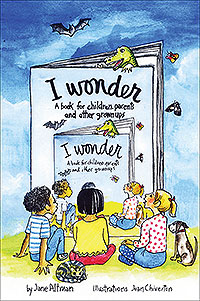
I wonder: A book for children, parents and other grownups by Jane Altman is book of poetry and a short story for children and adults.

Part 1 is for the children and it’s a series of poems which start with “I wonder…” and introduce a different animal. Bat, frog and alligator are among the many animals talked about in the poems. Each poem begins and ends with an “I wonder” statement. Then a short story about glowing stones. A boy and a girl leave their small village and pass a castle where they find a stone which glows in their favorite color. They pick up the stone and save it. Many years pass, the boy and girl grow up and have families of their own. After they have passed away, their families find a strange gray stone among their belongings and return it to the castle when the children see the glowing stones with the adults do not. Part 2 is for the parents and other grownups and is a series of poems along the same themes as part 1.

I wonder is a great book of poetry with simple rhymes that children will love. I enjoy poems and I love book which introduce poetry to children in a fun way. With beautiful illustrations, the poems and story come alive on the page. I recommend this book for any family and classroom library. It helps children enter the world of poetry in a fun and exciting way.

I wonder
is available on Amazon

in paperback for $10.95

Saturday, February 20, 2016

Lil' Lilly's 'Bow'thday Present: not as entertaining as I thought it would be

Lil’ Lilly’s ‘Bow’thday Present by Kathy Johnson and illustrated by Captain Cartoon is an adventures of Lilly from birth to her delivery by the stork and a special gift she receives. According to the press release which I received with my copy of this book, Kathy Johnson is known as a ‘master punster’ and “brings vocabulary to early grades in a most unique and entertaining way.


I have to disagree with that statement. This book was hard for me to read as well for my 4 year old daughter to listen to. The word puns were not fun or entertaining. The constant quotations and breaking up of the words was hard to read. The story is too confusing and it reads like it’s supposed to be a comic book but isn’t set up like one. I understand and commend Ms. Johnson for the lesson she is trying to teach to her readers. The book is supposed to teach the “theme of good vs evil, while building character and instilling values” and that love is the key to being happy and defeating evil. I didn’t see that. Maybe because I had a hard time reading it to myself as well as to my daughter. For me, this book failed to be fun, entertaining and while the presentation is unique, it was hard to read. I cannot recommend this book. 

Tuesday, February 16, 2016

When I grow up I want to be...A Good Person: a great book for children

The Wigu Publishing Company has released another great book for young readers. When I grow up I want to be…a Good Person is another great addition to this amazing series.


The story begins as Brendan and Blake are dragging their heels about going to a funeral with their parents. They grip and moan like kids do but their parents are insistent. They need to go and remember the kind and generous man, Mr. Becket. As the service begins, various people come up and tell stories about the kindness and generosity that Mr. Becket showed to his friends, his neighbors and his community. As the boys attend the reception after the services, they continued to hear stories about Mr. Becket and they realize that “being a good person is not just one single think but is the total of everything you do.” Brendan and Blake both decide that they want to be a good person too.


I’ve reviewed this series before and have enjoyed every title. This title is a topic that many children don’t hear about and don’t have examples of what it means to be a good person. This book will help open doors to conversation for both families and classrooms about what it means to be a good person. I highly recommend this book for every classroom and family library.

When I grow up I want to be…a Good Person
And the other titles in this series
Are available on
Amazon, Barnes and Nobles

And many other online book retailers.