Showing posts with label tips. Show all posts

Thursday, October 8, 2020

October is National Family Sexuality Education Month

October is National Family Sexuality Education Month. Created by Dr Sol Gordon in 1975 at the Institute of Family Research and Education. The purpose is to promote family education and communication about sex and sexuality. Many parents avoid talking openly about sex with their children for various reasons including embarrassment and being unsure how and when to begin. The absence of open conversations with their parents leaves children vulnerable to misinformation and unrealistic messages portrayed in music, movies, television, and advertising. What is the important of family sex education? What are some tips to get started? What tools are available to parents?

Education begins in the home with parents. Conversation are important as children and teens are more likely to base their sexual decisions on their parents than their friends (Berger, Shafer, & Williams, 2019). It is important to start early too. With preschoolers, it is important to teach consent and empower children to say no and talk with an adult when they don’t like the physical contact or situations with other children or adults. Growing Up Knowing, an organization based in Jackson, Mississippi, hosts sex education sessions for preschoolers, elementary schoolers and middle schoolers with their parents and caregivers. By learning together about sexual health, parents and children can have further discussions about tougher topics such as preventing sexual assault, the consequences of risky behaviors and how to protect one self. Being able to discuss the awkward and embarrassing topics with your children, keeps the lines of communication open for other tough topics. “If open communication is normal, kids are more likely to speak with parents about all the other trials of adolescence, such as anxiety, depression, relationships, and the use of drugs and alcohol, as well as sexual issues” (Staff, 2019).


The number one tip for parents is to prepare yourself. Before your child can ask the questions, read the books, get the information and be ready to answer the questions for any age. Getting the information for yourself first, you can avoid using scary language in which would frighten children from asking questions in the future. Second, keep your answers age appropriate. A preschooler who asks where babies come from doesn’t need the full scientific details. Give just enough information to satisfy their curiosity for the time being. You can be more accurate as they get older. Also avoid using slang for body parts, it just makes it harder to use the correct terms later. Using the correct terms early helps build self-esteem and strengthens communication between parents and their children. Third, keep the message positive. teach children to appreciate their own bodies and to respect the personal space of others. Lastly and most importantly, reassure your child that no question is forbidden. Keep the communication open so when they hare older, your child is comfortable coming to you with the harder questions and difficult discussions.

I recommend God’s Design for Sex series by Stan Jones and Brenna Jones. It is a series of four books, each book covers the basic information needed for a certain age group. Book 1 The Story of Me (ages 3-5), Book 2. Before I was Born (ages 5-8), Book 3, What’s the Big Deal? Why God Cares about Sex (ages 8-11), and Book 4, Facing the Facts: The Truth about Sex and You (ages 11-14). The age recommendations are suggestions, parents should gage their own child’s readiness. Each book is told from a Christian perspective and gives the necessary information without overwhelming parents or children with topics that are necessary for each age group. I used these books as a conversation starter. I didn’t read word or word but used it as a guide and allowed my 8-year-old daughter to ask the questions she wanted to know and let other topics she didn’t want to know yet for a later date. Despite faith based, it doesn’t shy away from controversial topics and doesn’t speak badly about them, it just states the facts.

In conclusion, October was designated at the National Family Sexuality Education Month to promote conversations between parents and their children. Sex education starts at home. It can start with the basics and grows into more important and difficult topics as children get older. It is important to educate yourself on what information to give at a certain age, how and when to present the information. There are countless of books and other tools for parents to read for themselves as well as to use as part of their conversation. It is not an easy conversation but an important one. And it gets easier with each conversation. You’ll be ready for the difficult questions and topics.


References

Berger, Bethany, Shafer, Leah and Williams, Ronesha (May 6, 2019). Sex Ed for the Whole Family. Harvard Graduate School of Education. www.gse.harvard.edu/news/uk/19/05/sex-ed-whole-family. Retrieved October 3, 2020.

Staff (June 6, 2019). Sex education for children: Why parents should talk to their kids about sex. About Kids Health. www.aboutkidshealth.ca/Article?contentid=718&language=English#:~:text=Instilling%20your%20family%20values,of%20the%20discussions%20about%20sexuality. Retrieved October 3, 2020.


Resources

Amaze www.amaze.org. Be an Askable Parent

Growing Up Knowing www.growingupknowing.org

Monday, March 4, 2019

Happy National Reading Awareness Month: tips to encourage reading for everyone


As many of you know, I have an avid bookworm. A bibliophile who loves getting a new book. The anticipation of the exciting new adventure awaiting me inside its pages. March is National Reading Awareness Month. A time to celebrate and encourage children’s interest in reading, writing and literacy. It’s aims to focus on improvement of reading skills as well as helping make reading a daily habit. It was founded in part to celebrate the birthday of Dr Seuss aka Theodore Geisel (March 2, 1904-September 24, 1991). Here is a list of suggestion on how you can encourage reading this month and every day!


1. Read Aloud
Reading aloud for 15 minutes a day helps build language development, instills a love of reading, gains knowledge and literacy skills, helps brain development and builds parent-child bonding. It doesn’t have to be 15 minutes in one sitting. It can be spread throughout the day.

2. Need something to read?
You don’t need to read a bunch of children’s books. You can read anything: a recipe as your child helps you with dinner, a product label at the grocery story, reading the menu at a restaurant, etc.

3. Take Turns
As your child gets older, you can read a book to them and then let them read to you.


4. Choose your material well
Make sure the stories are appropriate for your child’s age and maturity. Some children may not be able to handle a story’s sad ending while others can.

5. Check out your local library
Most libraries will allow children to receive their own library card. Going to the library and allowing children to browse the shelf and pick several titles to take home and read will help encourage a love of reading. Also, if you have a eBook reader or app like the Kindle, some libraries offer eBook available for check out. They are easily downloaded to your reader and when the book is due; the book will be removed from your reader. No taking a trip to drop off a book and no forgetting to turn it in and accruing late fees.

6. Reading isn’t just for bedtime    
Read aloud anytime of the day. While reading a book at bedtime is a time-honored tradition, you can change things up a bit. Read a book on a Saturday morning after breakfast or have time set aside in the afternoon for a story. I remember growing up and spending summer days at a neighbor’s house where we would read a story, usually a fairy tale, before going out to swim. It is a beloved memory I have and remember the stories fondly.


7. Let your child see you read
As the saying goes, “Monkey see, monkey do,” show your child that books are important to you and they will become important to them. My seven-year-old daughter wants to write book reviews like I do for this blog. She sees the time I carve out to read a book, to write down my thought and then write me review. Even if she doesn’t start her own book reviews, she sees that books are important in my life and she is willing to make them an important part of hers.

8. Place books everywhere
Have access to books everywhere in your house and car so when the opportunity arises to read, your child can read.

9. Introduce your child to your favorite childhood books
Dr. Seuss books are a classic favorite among many parents. Other favorites are the Winnie the Pooh stories by AA Milne, Charlotte’s Web and other books by E.B, the Harry Potter series and many more.

10. Consider audiobooks for times when reading may not be feasible
Traveling is the best opportunity for audiobooks when taking physical books is too difficult. An audiobook can be easily played in a cd player or a smartphone or tablet with apps like Audible (Amazon) and Google Play Books.


In conclusion, reading doesn’t have to be expensive or time consuming. Reading is a skill which will take a child far in life. Reading opens your world to new ideas, the depths and complexities of history and experience worlds long gone or far away. Reading also can be a great stress reliever and entertaining just like a movie or tv show. Reading isn’t just for nerds. Reading isn’t just for learning. Reading is for everyone and everything. Take an extra step this National Reading Awareness Month and instill a love of reading to a child in your life and encourage reading every day of the year.

Wednesday, February 24, 2016

Cool Kind Kid Challenge: a wonderful bullying prevention program

Bullying is a serious matter in our society today. I’ve written two blog posts about it and now I will review a new series of books which introduce how children can be kind to others and discourage bullying when they see it. Cool Kind Kid is a proactive educational curricula for schools, created by Barbara Gilmour, which includes music, characters and activities which engage the children in the lessons. I received three books with is part of the entire program. I will describe and review each book in turn.


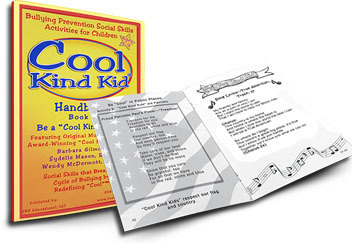
First, Be a “Cool Kind Kid” is a handbook about the basics of the program. It is lesson plan of the social skills and social competence training. The missing link in the bullying crisis, according to the program creator. The materials are designed to be easy to follow, flexible to fit the children’s understand and require very little preparation. There are questions and interaction on the children’s part which they can engage and think of ways to solve the problem in the situation. Topics covered include the Golden Rule, patriotism, and the Magic Words.


Second, Bullying Prevention Tips is a handbook for parents to read and understand that a child’s education starts at home. The social skills a child will need in life are taught and enforce at home. The book is filled with tips on how to introduce and guide children to learn kindness, empathy, respect, tolerance and acceptance, helpfulness and many others. The book gives parents ideas about how to introduce and enforce the concepts at home and in their communities.


Third, Picture Book Series Book 1 is a book which introduces the topics of the program in pictures for children who are younger. All the topics, the Golden Rule, the Magic Words, are covered in a fun manner which will capture of the attention of the younger children.


Cool Kind Kids is a great method to introduce the concept of kindness to children in a fun and useful manner. According to the information which I received with the books, the vision of the program is to give the opportunity to every child to learn the necessary social skills needed to stop bullying either as a observer, a victim or the bully. The curriculum is available for Grades 2-4 and Camp Kits for ages 4-6 and 7-9, which are designed for camps, after school programs, community and recreation programs. I highly recommend Cool Kind Kid to all schools, day cares and families who want to introduce and encourage kindness and helpfulness in our children. If a child learns to be kind to others and stand up for himself and others, bullying can be a thing of the past.

For more information about this program,
Please visit
or on Facebook facebook.com/coolkindkid