Thursday, November 5, 2020

If I had A Parenting Do Over: useful information for all parents

 If I Had A Parenting Do Over: 7 Vital Changes I’d Make by Jonathan McKee offers real advice from a parent who made many mistakes with his own children and he acknowledges areas in which he overparented and where he would have done more. While many of his advice is applied mostly to teenagers as they try to gain more independence, the advice can certainly be applied to older children before the troubled teen years. He urges parents to have conversations rather than interrogations and not to let boundaries hinder your bonding time with your kids. Mr. McKee explains the difference between quality time and quantity time. While both are important, quality time are moments that just happen while quantity time takes a bit more planning and effort. Each chapter highlights each of his vital 7 changes and ending with practical questions to ask yourself and apply to your own parenting situation.

I first heard about If I Had A Parenting Do Over from my husband who had heard Mr. McKee on the radio, talking about this book. He was intrigued and asked me to look it up. We both agreed to order it and read it. While our children are not teenagers yet, the book offers practical advice that when put into practice and “perfected” so by the time our children are teenagers, these practices will be second nature…hopefully. Even though he writes from a Christian perspective, his advice can be helpful to non-Christian parents as well. I highly recommend If I Had A Parenting Do Over.


If I Had A Parenting Do Over is available in paperback and eBook

Tuesday, November 3, 2020

November is Family Stories Month

 November is Family Stories Month. There is a great line in Hamilton (2015) which relates to family stories and histories. Aaron Burr sings “And when you're gone, who remembers your name? /Who keeps your flame? /Who tells your story?” With the rise of DNA testing and ancestry searches, people are searching for their roots. Where did we come from? And the need for family stories is growing. Many people learn amazing stories from their ancestors. These discoveries often pull us closer to history than ever before. Why are family stories important to us? What are ways we can celebrate Family Stories Month? Any time family gathers together is a great chance to take an opportunity to share those stories. I will write about one of my favorite family stories.

Family stories are important, and it is sad that many families no longer share those stories. Family stories can bring history alive. Talking with and sharing the stories of family members who served in the military. I have always loved learning about the events of World War II because both my grandfathers served during the war. My paternal grandfather served in Europe and my maternal grandfather served in the Pacific on an aircraft carrier. Learning about the different battles came alive as I imagined my grandfathers as young men, engaged in these battles. Family stories also can help boost our identity. These stories connect our families to history as they experienced it. They highlight family characteristics such as a sense of adventures, courage, and creativity as we learn who are ancestors were and what they did in their life in the historical events in which they lived. Family stories also strengthens connections between generations. The more we know about our family history, the stronger our sense of control over our lives and the higher their self-esteem. When I learned what my grandparents survived and thrived, it gives me confidence that my chances of surviving and thriving are good too because I descend from them.

There are countless ways to celebrate Family Stories Month. There is no wrong way to tell these stories. Here are a few ideas to get started. First, go through old photos and ask questions about the people in the pictures. Any anecdotes of adventures, travel, and romance. Are there any humorous stories? Stories about an epic historical event? Can you incorporate music, TV shows or movies in your stories? Second, stories about childhood are always great topics. My husband likes to tell the stories of him and his best friend playing video games at a local liquor store. They would pump gas for people to get money for those arcade games. Third, discover if there is a special story behind a family recipe or dinner tradition. Lastly, talk about fun facts about each other especially if you have kids. For example, the wild storm that was going on when he or she was born. Or a funny thing they used to do or say. For example, my oldest daughter used to say “tortilla” when she was hungry. It didn’t matter what we were eating, she was would say “tortilla” when asked if she was hungry.

One of my family stories is how my maternal grandparents met and fell in love. My grandfather grew up in Boston, Massachusetts. His best friend was a young man named John. After the Attack on Pearl Harbor, both answered the call to serve their country. My grandfather went into the Navy while John went into the Marines. My grandmother grew in Oklahoma and during the depths of the Great Depression, her parents packed up their family and moved to Los Angeles, California. John eventually met my grandmother in LA. I’m not sure how they met and when, but they began to date. On February 23, 1945, John was killed on Iwo Jima. My grandfather’s ship docked in San Pedro, CA when he heard the news of his friend’s death. After leaving the service, he sought out my grandmother to tell her the news, which she had already knew. My grandfather headed back home to Boston, only to return to LA and propose to my grandmother. They were married on May 11, 1946. When my grandfather died in 1996, they were married for 50 years, they had 12 children and 29 grandchildren. At the time I write this, there are currently 32 great-grandchildren.

In conclusion, no story is insignificant. Even if there is no great warrior story or participation in an historical event, members of our family lived through these events and we need to hear their memories, their thoughts, their feelings about the time and situations. As I’ve learned about my family history and the people who came before me, I developed a closeness to them. They become more than just names on a family tree. They become as a real as the historical figures we learn about in school. I strongly urge everyone to tell their family stories, to write them down and preserve them for future generations so that our voices, our stories can be taught to our descendants so that we become more than just a name on a family tree to them too.


Sunday, November 1, 2020

Good Man, Dalton: a sweet, fun story about finding yourself

Good Man, Dalton by Karen McQuestion is the story of self-discovery and learning that not everything you see on social media is real. Greta Hansen is off to New York City to spend the summer interning with her famous cousin’s company. Cece Vanderhaven is a social media queen who influences young girls as she dazzles on the city’s social scene. Great soon learns that her cousin’s life is a highly regulated schedule of makeup, film crews, and well-orchestrated outings. Dalton Bishop is heading to New York on a two-week experiment. He’s leaving everything behind except the clothes on his back to live on the streets as a homeless person. Soon, events begin to place Greta, Cece and Dalton a path together. Will they be able to achieve all they set out to do?

Good Man, Dalton is a sweet, fun story. Full of heart, all the characters are likable and relatable. Greta, the country mouse, off to visit her cousin, learns that Cece’s life isn’t so grand, and she is as special as the dazzling people on social media. Cece learns to stand up for herself and demand a say in her life from her rich, influential parents. And Dalton, who wants to show his father that his endeavors aren’t worthless simply because he didn’t follow the path into the family business. Each character finds the strength and courage they didn’t know they had to follow the path they needed to take. As I closed the final chapter, I had a smile on my face as a feel good, warm story would brighten any gloomy day. I highly recommend Good Man, Dalton.


Good Man, Dalton is available in paperback, eBook and audiobook

Friday, October 30, 2020

Jochebed: a mother's love sets in motion God's plan for deliverance

 Jochebed is one of the women Moses can call mother. Her name means “The Lord is Glory” and she lived a life which would display God’s glory. She lived as slave and under great oppression, chose to save her child and trust God. At great risk, she hid her son and when she couldn’t hide him anymore, she placed him in the river, hoping he would be saved. Jochebed is another example of God using ordinary people for extraordinary things. A simple item played an important role in the story of Moses: the basket. How could a simple woman and a simple basket play into God’s great plan? Jochebed was the beginning as God began to prepare his people for the great tasks that needed to be done to lead His people out of Egypt. It was her love, faith and courage that saved her child and ultimately her people.

Three hundred years after the death of Joseph, the Israelites became so numerous that Pharaoh feared their possible uprising. Pharaoh commanded that each Hebrew male child killed after birth, but the Hebrew midwives feared God’s wrath more than Pharaoh’s. They refused to follow this order, claiming that the babies were born before they arrived. Then Pharaoh commanded his soldiers to search out and smother every newborn male in the waters of the Nile. Imagine the screams of the mothers echo across the Hebrew camp as their sons were torn from their arms. Jochebed and her husband, Amram, had a plan and they prayed. After she gave birth to her son, she hid him for three months. Her older children, Miriam, and Aaron kept quiet about their baby brother. Remembering that God spared Isaac (Genesis 22:12), she laid her son in a waterproofed papyrus basket and placed him in the basket in the river. She walked away, praying that God’s protection would be on her son. And it was. Pharaoh’s daughter spots the basket in the reeds as she came to the river to bathe. She names him Moses meaning “I drew him from out of the water.”

Baskets is at the core of this story. As one of the many vessels used for a variety of tasks in the ancient world. In the home, baskets stored food. In the fields, they were used to carry clay for bricks. And baskets as luggage to store supplies on a journey. Made from plant materials, baskets were made into a variety of shapes and sizes, depending on the job needed. A basket hid Moses in Jochebed’s home for three months (Exodus 2:2). A basket protected Moses from the dangers of the Nile (Exodus 2:3). The disciples used 12 large baskets to gather up the leftovers at the feeding of the 5,000 (Matthew 14:20). A large basket was used to lower Paul out of a window to escape prison (Acts 9:25). God uses the ordinary for extraordinary tasks. Ordinary items, ordinary people and ordinary events to display His glory and amazing will. The Bible is filled with ordinary men and women doing extraordinary things. He still uses the ordinary today as he did in Jochebed’s day.


God kept Moses safe midst extraordinary dangers and evil. Through two women, a slave, and a princess, he persevered the life of Israel’s future deliverer and the entire Jewish race. According to the Bible, Jochebed saw that her son was no ordinary child and was determined to save him (Exodus 2:2, Acts 7:20, Hebrews 11:23). Was it just a mother’s love to see her child as extraordinary? Or was God giving her an insight to the plan He had for her baby? She had a great faith that God would save her son as she walked away from the river. Did she truly know he would be fine? I don’t think she did. In the animated film, Prince of Egypt (1998), an animated film features Jochebed taking her infant son to the river. I always loved this moment as it is very emotional scene and as a mother now, it is even more powerful. I can imagine the heartbreak and uncertainty in her mind as she placed Moses in the river; but her faith overruled her doubts. As parents, do we have the same faith in God for our own children?

In conclusion, Jochebed is the hero in Moses’ story. She took great risk to hide him for three months when it was ordered to have him killed. It took faith to take her son to the river. Her greatest joy is that God not only saved her son from the river but restored her child to her. Tradition holds that she took care of him until he was weaned at about 2 years. I can imagine her second heartbreak as her son left her house once again. But she still had faith that God had great plans for him. A simple woman took a simple basket and her faith and placed her son in the river. Could you imagine what we could do in simple every day situations with simple every day items with just an ounce of faith? With love, faith, and a prayer, Jochebed set God’s plan for deliverance in motion.

Wednesday, October 28, 2020

Critical Race Theory: what it is, its origins and its critics

 Critical Race Theory came to my attention when it was announced in September, President Donald Trump and the White House Office of Management and Budget would take the steps to cancel funding for training in Critical Race Theory among federal agencies. Their reasoning is it was a divisive un-American propaganda. After this announcement, the news and the internet exploded with outrage. People were proclaiming how dare he?!?! And it was a step backward. It was pushing the white supremacy agenda. I had no idea what Critical Race Theory is and why people were so upset. I had never heard it before. And like I have done with many other terms, I decided to investigate the theory. In 2002, over 20 American law schools offered Critical Race Theory courses. In addition to law, Critical Race Theory is taught in the fields including education, political science, women’s studies, and ethnic studies.

Critical Race Theory (CRT) is a theoretical framework in the social sciences that examines society and culture as they relate to race, law, and power. It developed out of critical theory of social philosophy where social problems are influenced and created more by societal structures and cultural assumptions than by individual and psychological factors. A few of the important scholars in CRT includes Derrick Bell, KimberlĂ© Williams Crenshaw, and Camara Phyllis Jones. Critical Race Theory began in the 1980s as people of color students art Harvard Law school organized protests the lack of racial diversity in the curriculum as well as in students and facility. The students supported Professor Derrick Bell’s racial law courses to be taught by a faculty of color. After the school ignored their required hired two white civil rights activists. A number of students boycotted and organized to develop an alternative course using Derrick Bell’s Race, Racism and American Law (1973, 1st edition). Harvard Law School continued to ignore the students requests led to the creation of Critical Race Theory in 1987 as an offshoot of critical legal studies. According to Crenshaw, "one might say that CRT was the offspring of a post-civil rights institutional activism that was generated and informed by an oppositionalist orientation toward racial power” (Gottesman, 2016).
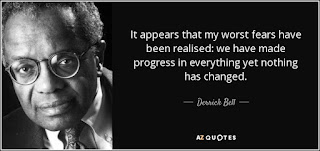
There are several themes in CRT. Rather than overwhelm my readers with the information, I will discuss a few. First, CRT criticizes liberalism. CRT favor a more aggressive approach as opposed to liberalism’s cautious approach and rejects affirmative action, color blindness, role modeling (emulating a successful person) and merit principle (goods and services are received through talent, effort, and achievement) (Delgado & Stefancic, 1993). Second, CRT uses storytelling, counter-storytelling or “naming one’s own reality.” It is the use of narratives to explain and explore experiences of racial oppression (Delgado & Stefancic, 1993). Third, CRT offers revisionist interpretations of American civil rights laws and progress. Derrick Bell argued that civil rights advances for blacks coincided with the self-interest of white elitists. Mary L Dudziak (1998) suggests that the civil rights legislations were passed to improve the US image to third world countries as the US needed allies during the Cold War. Lastly, institutional racism. According to Camara Phyllis Jones (2002) the structures, policies, practices, and norms result in the differential access to the goods, services, and opportunities by race. Historically, institutional racism was slavery, segregation, internment camps and reservations. Modern examples are bank lending practices, housing contracts, profiling by law enforcement and representation in news and media.

Many of the Critical Race Theory critics take issue with its foundations in postmodernisms and reliance on moral relativism and social constructionism. Richard Posner, a judge for the US Seventh Circuit Court of Appeals (1981-2017), argued that critical race theorists have “succumbed completely to postmodernist absurdity” and “radical legal egalitarianism” (1997). Alex Kozinski, a judge for the Ninth Circuit Court of Appeals (1985-2017), argued that CRT is a philosophy which “raises insuperable barriers to mutual understanding” and makes valid exchange of ideas impossible (1997). George Will (1996) argued that CRT’s use of storytelling and the insistence of racism “so institutionalized that all blacks are victims by definition” and not by an “identifiable act of discrimination.” Eleanor Krasne (2020) argued that CRT, rooted in Marxism, doesn’t allow for meaningful discourse that “questioning their ideas amount to tacit support of racism and makes you a racist.” She further states that “you either agree with the left’s worldview or you are an enemy of all that is good” (Krasne, 2020). Dan Subotnik also argues that leaving whites out of the race conversation doesn’t help anyone. “White males tempted to participate in the conversation were condemned in advance as interlopers, even imperialists” (Subotnik, 1998). Essentially whites were, and still, are told to step aside, sit down, and shut up, you have no say in the matter as you would not understand.

For far too long, minorities have been kept out of history, their roles pushed to the background and ignored and left out the conversations. There's no denying it. They have fought to be included in the history lessons and the conversation about today’s issues, to have their current contributions counted and celebrated as they should. However, there are a few are now enacting their revenge as they turn the tables on whites. “You left us out, now it’s your turn.” Critical Race Theory, at first look, seems like a good idea; however, in practice, it is an “agree with me or you’re my enemy” paradigm. It is still racism when the roles are reversed. An adage says, “An eye for an eye leaves the whole world blind.” Repaying evil with evil does not overcome evil. Evil is only overcome with kindness. Human nature has a long way to go.


References


Delgado, Richard and Stefancic, Jean (1993). Critical Race Theory: An Annotated Bibliography. Virginia Law Review. 79 (2): 461–516.


Dudziak, Mary L. (November 1998). Desegregation as a Cold War Imperative. Stanford Law Review. 41(1):61-120.


Gottesman, Isaac (2016). Critical Race Theory and Legal Studies. The Critical Turn in Education: From Marxist Critique to Poststructuralist Feminism to Critical Theories of Race. London, England: Taylor & Francis. ISBN 978-1317670957.


Jones, Camara Phyllis (2002). Confronting Institutionalized Racism. Phylon. 50(1/2): 7-22.


Krasne, Eleanor (June 29, 2020). How Leftists’ Critical Race Theory Poisons Our Discussion of Racism. The Heritage Foundation. www.heritage.org/civil-society/commentary/how-leftists-critical-race-theory-poisons-our-discussion-racism. Retrieved October 18, 2020.


Kozinski, Alex (November 2, 1997). Bending the Law. The New York Times Archives. www.archive.nytimes.com/www.nytimes.com/books/97/11/02/reviews/971102.02kosinst.html. Retrieved October 17, 2020.


Posner, Richard A. (October 13, 1997). The Skin Trade. The New Republic.

Monday, October 26, 2020

My Sister's Husband: a story of jealousy, secrets and sisters

 My Sister’s Husband by Nicola Marsh is an intense story of sisters, family secrets and jealousy. The opening line in the prologue states it clearly “family can be toxic” with “secrets, half-truths, mysteries, and outright lies.” The story opens with Brooke coming home to Martino Bay, California for her sister, Freya’s wedding after being gone for 11 years. She is also coming home to see her Aunt Alice the only mother she has ever known and who is in failing health. As soon as she comes home, Brooke realizes there is more going on than she thought. She recognizes Freya’s fiancĂ©, and the decline of Alice’s health doesn’t add up. Brooke decides to figure out what happen to Alice and what led to her rapid decline. Told between three perspectives, Brooke and Freya, and Alice in the past, the reader is taken on a journey with many twists and turns. Will Brooke find out the truth? Will the truth set them free or drive them further apart?

Wow! What a book! From the opening prologue to the last chapter, the story will twist and turn as you try to figure out what happened and what is going on. It is the story of two sets of sisters: Brooke and Freya and Alice and Diana, Brooke, and Freya’s mother. As I read the interactions of the sisters, I am so glad that I do not have that relationship with my own sisters. It was hard to like or relate to these women though I found Brooke more likable especially as the story progressed. There are a few secrets that I guesses at, which turned out to be correct, but just when I thought I had it figured out, Ms. Marsh still had a few twists that I didn’t see coming! My only complaint is with Alice’s perspective, it was hard to determine when the events she talked about happened. Overall, I really enjoyed My Sister’s Husband and I highly recommend it. It is a roller coaster ride that you do not want to miss!


My Sister’s Husband is available in paperback and eBook

Saturday, October 24, 2020

The Lost Husband: a story of forgiveness and moving forward

 The Lost Husband by Katherine Center is the story of Libby Moran, a widow with two young children, trying to find a new normal. After the sudden death of her husband, Danny, Libby was forced to stay with her hypercritical and narcissistic mother, Marsha. For two years, she suffered the snide and berating comments from her mother and trying to help her young children, Abby and Tank, pick up the pieces of their lives. Then suddenly, one day, her crazy Aunt Jean sends her a letter that offers her an escape. Jean needs help on her farm in the Texas Hill country. Libby finds herself packing up her minivan and hitting the road with her kids without a second thought. For a city girl, life on the farm is a culture shock, but she finds herself enjoying the strenuous work. She feels something familiar in the quiet of the country and Libby starts to find peace and a new purpose.


The Lost Husband is a sweet, funny, heartbreaking and yet encouraging story of grief, life and moving forward. Each character is flawed and battling their own demons. Libby must deal with the guilt she carries from the last conversation she had with Danny. Jean holds a secret of her own, afraid that if it is revealed, she will lose Libby. And O’Connor, the shaggy and gruff farm manager, is battling his own guilt and the weight of his secrets. Yet together, these three find a life that is strong, rewarding and a family. A film version of The Lost Husband is available on Netflix and Prime Video rental as well as DVD, starring Leslie Bibb as Libby and Josh Duhamel as O’Connor. The film didn’t have the same impact as the book did; however, I recommend watching it after you’ve read the book. Of course, I recommend The Lost Husband.


The Lost Husband is available in paperback, eBook and audiobook